Matrix Group International

Blog

  • Why Every Organization Should Care About Search Engine Optimization (SEO)

    Why Every Organization Should Care About Search Engine Optimization (SEO)

    Internet search conceptEvery once in a while, a client or prospect will tell me their organization doesn’t care about search engine optimization (SEO). Why? I get these reasons:
    • The organization targets a very specific, very niche set of audiences.
    • The organization has a defined universe and they are largely known to the association and vice versa.
    • The organization doesn’t have e-commerce on the website so they don’t need to reach out a wide audience to make sales.
    Even if all of this is true, I say that EVERY organization should care about SEO because:
    • A huge number of people use Google (or another search engine of choice) to access a known website. We know this because when Google used to make search terms available, it was shocking to see that so many people type specific URLs into Google. Evidently, there are people who just always start with search without even realizing it.
    • Your target audiences may know your organization very well, but they may not know your URL off the top of their heads. So what they do? They Google for it. Again, looking at search terms tells us a whole lot of traffic comes from Google, from people who know the specific organization they seek.
    • Many, many people rely on Google to search a website because the internal site search sucks. During many user interviews, members tell us they use Google to find what they are looking for on a specific site because the site search wasn’t effective.
    • If your organization is a trade association, you may “know” all of your member companies, but new member company staff may not who are you and what your organization does.
    • No matter how good your marketing and how often you mail or email, the vast majority of your customers do not know everything your organization has to offer. For example, Suzie Smith attends your annual conference ever year but she doesn’t know that you also publish a certain publication on a specific topic, so what does she do? She Googles for it!
    If your website isn’t search-engine friendly because you think SEO doesn’t matter, I hope you’ll think again. Even people who know your organization still rely on Google to find your site and search your site. If Google can’t find your site and can’t index the content properly, you may be losing out on traffic from the very people you think are going directly to your site.
  • Pick Up the Phone! Why Your Marketing Plan Needs a Personal Touch

    Pick Up the Phone! Why Your Marketing Plan Needs a Personal Touch

    Phone in handI am a big fan of phone calls. I spend most of day in meetings and on the phone. Why? Because I can’t land new deals or big deals via email, just doesn’t happen. When we launch websites, I try to call the client contact and the CEO within a few weeks to say thank you. On the weekends, I call my friends, I don’t just post Facebook updates. Recently, I’ve noticed a bias against phone calls. During a roundtable discussion with a group of association executives about meetings and tradeshows, I asked how many make phone calls to past attendees or must-have attendees. Only 1 association had an active phone initiative. Why not make phone calls? I got these reasons: it’s too hard to do, it’s too expensive, it’s too time-consuming.

    I’m grateful to Michael Lanham of Learning Forward for sharing a recent study featured in The NonProfit Times. Here’s an excerpt:

    “During the 2014 International Fundraising Congress (IFC), Geoffrey W. Peters, chairman of CDR Fundraising Group, shared the findings of his organization with a test it undertook. Of 6,225 total donors, 1/3 got no acknowledgement, just ongoing mail; 1/3 got a thank you note; 1/3 got a phone call. Here are the astonishing results from the test:

    • Thank-you calls increase subsequent giving. The subsequent gift rate for donors who received a call was 47 percent higher than those who received no thank-you response and 22 percent higher than those who received a thank-you note.
    • The thank-you call increased the average size of the subsequent gifts. The average gift from donors who called was 8.3 percent higher than those who received no acknowledgment and 3.5 percent higher than those who received the note.
    • The donors who received the phone call generated an additional $8,661 in gross revenue at a 2.4:1 return on investment (ROI).”
    With results like this, isn’t it worth exploring how we can integrate phone calls into our membership recruiting, new member onboarding, fundraising, meeting campaigns, and exhibitor recruiting? Here are some ideas:
    • Make phone calls to new members to say thank you for joining, to explain the membership path, and give them concrete ways to become involved right away.
    • Make phone calls to past attendees of meetings to say thanks for attending in the past and here’s why you should come this year.
    • Make phone calls to people who donate their time and money to your foundation or cause.
    • Make phone calls to random members throughout the year to ask them how your organization can do better.
    When I was a fundraiser many years ago for the San Francisco Education Fund, my boss used to say, “Joanna, people don’t give money to causes. They give money to people.” Most of my trade association and professional society clients tell me that people join and stay because of the people, the networking opportunities, and the access to people in the industry. So I say let’s put the people back in our marketing and make some phone calls!
  • What’s In Store for Associations and the Web in 2015?

    What’s In Store for Associations and the Web in 2015?

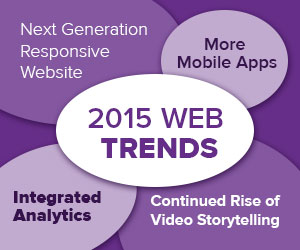
    web_trendsI have the honor of helping a number of association clients plan their web budgets for the next year or two or three. When preparing a web budget, my team and I do research, look at what other organizations are doing, talk to the innovators in the space, and brainstorm with our clients. So what’s in store for associations in 2015?

    Next Generation Responsive Website

    Associations that don’t already have a responsive website need to get one. And fast. Clients that already have a responsive website should be looking closely at their analytics and interviewing members to find out the information and services they most need when visiting the association’s website on a tablet or smartphone. This data will help you prioritize some content over others, change the order of calls to action on a mobile view, make some items disappear, or bring other content to the forefront. You don’t have to collapse your entire menu and you don’t need to just tile the elements in a straight line.

    What’s more, the next generation responsive website doesn’t just resize webages, it serves up different media files based on screen size and bandwidth. For example, on a phone over 4G, a responsive website will display lower resolution images. The same website on a retina screen iPad over broadband will serve up higher resolution images and HD video.

    More Apps

    Since phones and tablets are selling at a much faster rate then desktop computers, it only makes sense that apps be a part of your mobile strategy. Meeting and convention apps that connect attendees, help them explore content, and feature exhibitors are a no-brainer. Apps that introduce your industry to a wider audience are great. Technical apps that replace a desktop program might make sense, unless it devalues a high-priced, high value product. Finally, news apps that aggregate content across your websites and social media pages will help keep members abreast of all the news in your space.

    Integrated Analytics

    Most organizations rely on multiple platforms for their communications. The problem is that each platform has its own set of reports and analytics. Your website may be running Google Analytics. Your CMS has its own internal usage reporting. Your blast email platform reports on views and clicks. Your LMS (learning management system) has yet another set of reports. In 2015, I recommend that organization integrate the reporting across their systems. For example, most trade associations know what people are doing on their websites and their newsletter open/click rate. But what if they could also know what percentage of primary contacts are logging in to their members’ only site and opening their weekly newsletter? Integrated reporting that ties demographics and activity data will provide valuable, actionable data.

    Continued Rise of Video

    I know I sound like a broken record, but video needs to be part of every organization’s 2015 strategy. Pages with video encourage more visits, and longer visits. Google increasingly includes YouTube videos in search results. Video can be used to brand an organization, explain what an organization does, showcase success stories, tech people how to use applications, and give members and customers a voice.

    Storytelling

    Finally, in 2015, associations need to make their case to members, legislators, the media and the public via authentic storytelling. The formal, stilted language of the press releases of yore is not nearly as effective as writing that sounds like you’re having a conversation with someone you know and trust. Unless you’re The New York Times or The Wall Street Journal, your content needs to be succinct, fresh and user-friendly.

    My team and I will be on the lookout for evidence of these trends around the web and certainly amongst our clients and report on them as we learn and adapt to these trends. How about you? What will YOUR focus be in 2015?

  • Why Should You Hire an Agency to Redesign Your Website?

    Why Should You Hire an Agency to Redesign Your Website?

    matrixgroup292Every once in a while, I hear from a prospect who says his organization is considering redesigning their site and they’d like to do the design and CMS implementation on their own. They either want to use in-house resources or they intend to use an off the shelf template for design and styling.

    Sure, this can seem really cost-effective, but is it really the best solution? On the flip side, does it pay to pay an agency to handle your redesign?

    When you hire a great agency, you’re getting the best thinking from strategists, designers, front-end developers, developers, SEO managers, and content experts. There’s no way that a WordPress theme you purchase for $49 can give you all that. And most organizations’ can’t afford to have all those resources on staff because they’re pricey and they don’t need them full-time for an ongoing period of time. For the cost of one really great staff person or half a person, you get the combined talents of 5-7 talented professionals for a concentrated period of time.

    What’s more, a great agency gives you the benefit of this great team of people working together to give you great results. When Matrix Group designers are working on comps for a client, there’s always an internal review to discuss compliance with the specs, implementation pros and cons, impact on SEO, and usability.

    Finally, a great agency goes beyond the templates and the programming. They help you develop the powerful content that will ultimately bring search engines and real visitors to your site. Off the shelf templates and themes never do this for you.

    I have a good friend with whom I share a fabulous hairdresser. Eileen always needles me that I argue too much with Crystal. She says, “you want your clients to take your good advice about web design coz you’re the expert, right? You should do the same with Crystal.” Touché!

  • 2015 Top Resolutions for Managing Your Website Better

    2015 Top Resolutions for Managing Your Website Better

    resolutionsI was in the car yesterday and a radio talk show host was already talking about failed New Year resolutions! C’mon, it’s not even the middle of January! Surely we have a few more weeks (and months!) of trying to change behavior before throwing in the towel on failed resolutions.

    Me, I’m resolving to stretch more and eat less sugar. As for my company website and blog, here are my top resolutions. Don’t know if these resolutions will be easier or harder to live up to, but they’re equally important if you’re a marketer.

    1. Update your website more often and according to a schedule. We all get busy and somehow, website updates take a back seat to other things. I have clients who would never NOT publish their monthly magazine, but they routinely get “too busy” to update their website. But your website is arguably more valuable as an information resource to your members, customers and prospects, has a wider reach, accessible to search engines and available 24/7/365 to the whole world (but you already know all this!). Get posting!
    2. If you don’t already have one, create an editorial calendar that maps out topics by platform and week/month. For example, in December, my design team usually blogs about trends for the coming year. Even though we don’t know in January what trends we’ll be blogging about in December, we know that we’ll have at least a couple of posts on the topic. So that topic goes into the calendar and we assign appropriate staff.
    3. Add video to your toolbox. Video continues to rock the web. Pages with video get more views and visitors will spend more time on your site, etc., etc. So what’s stopping you? You don’t need a gigantic budget (although budget always helps!). Create screencast that shows people how to navigate your members-only site or interview senior staff and members about challenges facing your organization, industry or profession. Video adds authenticity to your website more deeply than text and images.
    4. Take your analytics to the next level. I was talking to a client yesterday about a much anticipated microsite they had just launched. He was happily reporting on the usage that the new site was generating, including referrals from their blast email. If you’re not already doing it, you should be checking your usage reports regularly and this data should be guiding your marketing decisions. This year, resolve to integrate your analytics with your CRM so that you know *who* is visiting your website. What percentage of your traffic is coming from members? Primary contacts? New members? What are members interested in doing on?
    5. Get serious about mobile. If your website isn’t responsive, if you’re not thinking about a mobile app, and/or if you’re not looking at your mobile traffic, 2015 is the time to get serious about mobile. Making your website mobile-friendly will generate an explosion of mobile traffic — promise! While you’re at it, make sure your emails are responsive as well since more email is read on a phone than a desktop these days.

    Well there you have it— my top 5 resolutions. Stuff you already know. So just do it.

    What are your resolutions?

  • 2014 Top Techie Holiday Gift Ideas from Matrix Group

    2014 Top Techie Holiday Gift Ideas from Matrix Group

    gifts stackedIt’s that time of year again! Time to celebrate the holidays (whatever your affiliation) and do some shopping! Once again, I polled the Matrix Group staff and asked them for their favorite techie/geekie gift ideas. Here are some gifts that will wow, amaze and up your geek cred. 🙂

    • This is one I want. The Amazon Echo is like a radio, music box and Siri rolled into one. It’s always on, waiting for your commands. The “always on” part wigs out my husband a little bit because he figures it’s always listening and storing your conversations in the cloud. I figure it will be my companion when I’m getting ready in the morning, when I have nobody to talk to, and I’m in need of music, traffic and weather.
    • Maki loves his Makelangelo Drawbot, which is a little robot that lets you design and then draw images on large sheets of paper with a Sharpie pen! Maki recommends the 2.5 or 3 versions.
    • Everykey is a wristband that replaces keys and passwords. It’s sleek, secure, and can be deactivated at any time. It’s basically a Bluetooth wristband that allows immediate access to your password-protected electronics such as a smartphone, tablet, or computer, as well as physically locked items including doors, car doors, bike locks, and other controlled access devices.
    • SoloShot: This is a camera with tripod that automatically zooms in/out and follows you (when you keep a tracking chip on you). Fantastic for filming active kids, pets, athletic activities.
    • Speaking of cameras, I want a Go Pro wearable or mountable camera! I thought about getting one to wear while I do my tae kwon do, or putting one on my 4-year old to see the world from his perspective.
    • If you and your kids love Legos and you want to take your Lego experience to the next level, get the latest Lego Mindstorms – EV3. Make cars, dinosaurs and monsters that move, fight, are motion-sensitive and more! This is an awesome STEM toy you can feel good about!
    • Tetris Stackable LED Desk Lamp:  If you love Tetris the game, you’ll love this lamp, which you can configure and reconfigure to your heart’s content. The LED light turns on when the pieces are stacked together and stays off when disassembled.
    • For the coffee lover, in your life, why not give them a monthly coffee subscription for some really great Craft Coffee? This isn’t K-cup coffee (although we love K-cups around here), this is for serious coffee snobs!
    • For the neat freak with little to no time, try the Swivel Sweeper. One staff member says she spends 10 minutes with this bad boy and it does a super job! It “cleans up almost all crumbs on my hard wood floor and works for those annoying carpeted steps.”
    • Maria loves her Instant HotPot, which is 7-in-1 programmable electric pressure cooker that can also be a slow cooker, rice cooker, yogurt maker, steamer, etc. Works great, easy to clean and you can replace so many individual appliances with this one item.
    • Head Case – The Desktop Nap Pillow: Now, wherever you are, you can enjoy refreshing nap time just like you did in kindergarten. The Ostrich Pillow has head-friendly polypropylene filling to cushion your noggin and convenient hand pockets to accommodate perfect napping posture. Easy to use – insert head, pronate face toward horizontal surface. Naps are good.
    • Big Hero 6 Baymax Plush Toy: If you saw the movie Big Hero 6, you’ll understand the appeal of this. I want my own Baymax!

    Happy Holidays and may your gift giving be full of blinking lights and batteries! If you’ve got a cool techie gift idea, please write a comment!

  • Intentional Marketing: Who Should Attend Your Next Conference or Convention?

    Intentional Marketing: Who Should Attend Your Next Conference or Convention?

    Woman on PhoneEarlier this week, I hosted a roundtable discussion with a group of select clients to discuss the future of trade shows. Instead of sending a blast email to our entire list, my marketing team sat down with me to discuss who we wanted at the discussion. We only wanted clients that have trade shows and wanted a mix of trade associations and professional societies. We also wanted Director level or higher. We sent out the first email. We got one response.

    Rather than continue to send emails, we decided I should make phone calls to the Directors, VPs and CEOs who we most wanted at the event. I called, left messages and spoke with a few people. And then I re-sent the promo email. The response was terrific. Nearly all of the organizations we targeted sent a representative.

    When clients ask us to help them increase meeting registrations and/or exhibit sales, we ask: Who do you want at the meeting? Anyone? A specific slice of your membership? Or do you want members that meet certain criteria, like members in a specific geographic area or members at risk of canceling? And then we ask: how we can let this group of companies or individuals know that you want them at your meeting?

    No, I don’t believe sending a generic, blast email is enough. In our experience, a mix of blast emails, personal emails, phone calls, and direct mail works best.

    When Matrix Group is planning its webinar series, I sit down with my team and ask them: Which clients should attend this webinar on Sitefinity, cybersecurity, design, Twitter or x topic? If my marketing team is doing its job right, they will have a list and that list gets a personal email from me, a Director or a Project Manager, or a phone call from my Cultivation Manager, in addition to getting the blast emails. We get the best response from the personal emails and the phone calls and I bet you’re not surprised by this finding.

    The next time your organization is planning a campaign to promote a meeting, publication or show, ask your team these questions:

    • Who do want to target and why?
    • What is the best way to reach them and why?

    In the end, it’s easy to just send another set of emails to your entire list but I believe you must be intentional with your marketing to get the best results.

  • Don’t Be Victimized by These Social Engineering Scams

    Don’t Be Victimized by These Social Engineering Scams

    Phishing conceptA couple of weeks ago, a client called in a panic to ask if their website had been hacked. Here’s the scenario: one of the administrative assistants had received an email from a senior VP, asking for a copy of their membership database. The email looked legit so she exported a member list and emailed it to the VP. Or she thought she did. Turns out the senior VP’s email had been spoofed. She had actually emailed the member list to an outside email; the email only appeared to have come from the VP.

    Eeek. How did this happen? Did the website get hacked? We did a scan of the server, checked the logs, and rechecked the intrusion detection service logs. No breach. So how did this happen? Turns out that the association publishes a full staff list and it would have been easy for anyone to find the email addresses of a senior VP and an admin. It’s not hard to create an email address and “hide” the email by displaying the “pretty name” in the email header. BTW, turns out a number of our clients are getting these types of emails.

    Here’s another scenario that will scare you. Several clients have reported that their exhibitors are receiving calls from people posing as the association staff exhibitor contact. The caller goes on to ask if the exhibitor has booked a hotel room. If the exhibitor says no, the caller asks for a credit card and bam, the credit card has now been breached.

    Eeek and double eeek. These types of attacks are called social engineering attacks. Wikipedia defines “social engineering. in the context of information security, refers to psychological manipulation of people into performing actions or divulging confidential information. The attacks described above are not technical threats, they are human threats and they are on the rise.

    So how do you protect your organization? I could spend days talking about social engineering, but here are my top tips:

    • Talk to your staff about social engineering: what it is, the dangers, what it looks like.
    • Train your staff to be suspicious. One IT Director I spoke with said, “I’ve trained my staff to be paranoid. If they get a request that looks fishy, they need to confirm the request by voice. And they are told that senior staff NEVER ask for exports and reports from the database via email.”
    • Train your staff to never divulge passwords, account numbers or other confidential information over the phone or email unless they can verify the request in person or via voice.
    • If a social engineering attack occurs, don’t sweep it under the rug and pretend it didn’t happen. Talk about it, train on it, discuss it.
    • Talk to your IT vendors about training for your staff.
    • Keep reading and educating yourself and your staff about social engineering.

    How about you? Has your organization been victimized by a social engineering hack? What are YOU doing to protect yourself and your organization?

  • How I Came To Represent 12 Million People

    How I Came To Represent 12 Million People

    Male hand holding microphone for the interviewA couple of weeks ago, my husband got a letter in the mail from the American Institute of Consumer Studies. AICS wanted to interview him about his media viewing habits. A couple of days later, someone knocked on our door. Turns out AICS wasn’t interested in interviewing Maki; they wanted to interview an adult female in the house. Hmmmm…. so why did they send the letter to Maki? Maki reported all this to me, knowing that I am fascinated by these types of surveys and am usually game to do them, time willing.

    So I call the AICS field interviewer and schedule a meeting. He comes to our house and I end up spending about an hour with the field rep, who by the way, is a FEMA inspector. He says he doesn’t get paid much money when there aren’t any disasters, so he supplements his income by doing interviews for AICS. Fascinating!

    AICS wanted to know about my media habits: what newspapers and magazines I read, what radio stations I listen to, what shows I watch, and what websites I visit.

    To start with, I was given a huge stack of index cards listing all manner of newspapers and magazines. I was to group the cards into three piles: Don’t read, Not sure, Read. For the Not sure and Read piles, I was then asked HOW I read the periodicals: how often in the last six months, past 30 days, past 7 days; online or in print; and how much of the periodical I read (cover to cover? 20%?). At one point, the field rep said, “this is really good news for TIME, Smithsonian and the Washington Post.” Why? Because it was clear from the interview that I LOVE my TIME magazine. I read it every week, pretty much cover to cover AND I visit the website every week. The same for Smithsonian magazine, although it’s a monthly. If Joanna Pineda was good for TIME and Smithsonian, she was not so good for The New York Times. I have many friends who can’t start their Sunday without the New York Times, but me, I’m a Washington Post gal.

    I was asked similar questions about the radio stations I listen to. Here’s the wrinkle: in the last 7 days, I had driven down to NC and back, so I had spent a lot of time in my car, listening to the radio. While I was within range, I had my radio tuned to my 3 favorite stations: WAMU, WRQX and WMZQ (don’t judge me, k?). My listening habits that week did NOT reflect my normal listening habits but Mr. interviewer insisted that I report on my listening in the last 7 days.

    What I found fascinating about the interview was how little I was asked about TV shows once I reported that I do not have a cable or satellite TV subscription. Pages and pages were skipped in the gigantic interview book. I protested, “but wait, I watch TV, just not via cable. I subscribe to Hulu, Netflix and Amazon Instant Video.” But no, AICS was NOT interested in my TV viewing habits outside of cable. A little shortsighted, I think, because not subscribing to cable certainly does not mean I don’t watch TV. In fact, the opposite is true. My husband and I now watch more TV because we’re finding all kinds of great shows on the Internet-based services. And yes, I explore shows by network. Love my SyFy channel. Hmmm…. is it still TV if I watch on my iPad?

    Many of you will probably be shocked to learn that I willingly divulged so much personal information. Personally, I felt like it was a two-way street. I learned a lot about what media companies want to know about consumers and the whole interview process was illuminating.

    At the end of the interview, Mr. AICS Interviewer said, “you know, you represent 12 million people.” Could it be true? Could one interview have so much weight? If so, TIME magazine owes me a check. 🙂

  • A Chef’s Life

    A Chef’s Life

    I am a HUGE fan of A Chef’s Life, the PBS show about a chef in North Carolina who is “exploring the South one ingredient at a time.” The website features episodes, recipes, a blog, interviews and more.