Matrix Group International

Blog

  • An Executive Director’s Guide to Getting the Most Out of Your Next Conference

    I recently had coffee with Carol Singer Neuvelt, Executive Director of NAEM. NAEM is a professional association that empowers corporate leaders to advance environmental stewardship, create safe and healthy workplaces, and promote global sustainability.

    Carol says that one of NAEM’s biggest member benefits is its peer-led educational program, during which members share what they’ve done at their companies.

    “How do you make sure members get the most out of these conferences?” I asked Carol.

    Turns out Carol has three rules for getting the most out of a conference and she doesn’t hesitate to remind her members of these three rules at every turn.

    1. Learn something. This sounds so obvious, but how many of us decide to learn something? Carol says that if we go into each session with an open mind and a keen intention to learn at least one thing, the conference will be a success.
    2. Participate in the conversation. Carol says passively attending a conference is not enough. We should ask questions during sessions, interact with the speakers and attendees during the breaks, post comments on social media, and otherwise make our voices heard.
    3. Make a friend. This is my favorite pro tip from Carol. She’s basically telling us to get off our phones and make a new friend. At lunch, during dinner, at breakfast, during a reception. Introduce yourself, explain what you do and why you’re at the conference, and look for ways to connect with others.

    I loved these tips so much, I had to share. They’re so obvious and yet so wise and so needed. I hope you’ll think about these tips as you head out to your next conference and encourage your staff and co-workers to do the same.

  • What Does Digital Transformation Mean for an Association or Non-Profit?

    What Does Digital Transformation Mean for an Association or Non-Profit?

    What does digital transformation mean for an association or non-profit? What does this transformation look like?

    These were two of the questions posed by Teri Carden, Founder of ReviewMyAMS and organizer of AMS Fest 2017, held a couple of weeks ago in Chicago. AMS Fest is a conference devoted to bringing together Association Management Software (AMS) companies and association executives looking for a new system to power their organizations.

    I saw lots of scribbled answers about using data to make better decisions, paying attention to data, having advanced analytics, next generation data maturity, etc.

    To be honest, these answers leave me cold. If an organization has great analytics and uses it to make better decisions, has it been digitally transformed?

    Webster defines transformation as “an act, process, or instance of transforming or being transformed.” The verb transform has multiple meanings:

    1. to change in composition or structure
    2. to change the outward form or appearance of
    3. to change in character or condition

    To transform something, therefore, is to make it new or completely different. If organizations do something different or differently, it has not necessarily been transformed.

    In my mind, an organization has been transformed when it no longer recognizes itself. When it engages in activities and behaviors that would have been unthinkable five years ago. When its decision-making and governance have been upended. When it attracts and retains a different class of members and staff. When members say “I don’t recognize my association.”

    And while a transformation is not necessarily positive, I think the only type of transformation we should concern ourselves with is the kind that is positive – the kind that results in growth, and ushers in a period of self-renewal.

    Data and data analytics no doubt play a huge role in any digital transformation, and even paying attention to data may represent a big change in some organizations. But analytics is only a means to the transformation that many organizations seek and desire today.

  • When Redesigning Your Website, Don’t Confuse Goals with Requirements

    When Redesigning Your Website, Don’t Confuse Goals with Requirements

    I read a lot of RFPs and I attend a lot of website redesign kickoff meetings. The most important questions I ask are, “Why redesign? Why now?”

    I usually get answers like:

    • Our website needs to mobile-friendly
    • The website needs a faceted search
    • Our site search sucks
    • The website isn’t user-friendly

    While these are all perfectly good reasons, I think of these statements as requirements, not goals.

    When Matrix Group is working on a project, we strive to understand the measures of success. If we launch a site that is gorgeous, user-friendly, mobile-friendly and has a great search, will we have been successful? Sure… BUT is the new site generating membership leads, encouraging downloads of research, generating more revenue, raising awareness through better ranking in search, and ultimately bringing in more members and customers?

    Those are the goals we want to ferret out during kickoffs and discovery. How is the new site ultimately supporting the strategic and growth goals of your association?

    In my mind, we won’t know the answer for six to 12 months after launch. That’s scary. It’s so much easier to say the new site is a success because the board loves it and it’s easier to update. But after spending $50,000, $100,000, $150,000 or more and countless staff hours, don’t you want to be able to point to more quantitative results related to your mission and strategic plan?

  • How Google Docs and Google Slides Changed Biz Dev at Matrix Group

    How Google Docs and Google Slides Changed Biz Dev at Matrix Group

    A few years ago, Matrix Group Creative Director Alex Pineda suggested that we ditch PowerPoint and move to Google Slides. The reason? Collaborating on a PPT file is really hard. We used to pass around huge files via email or rely on the network share. Alex came up with a beautiful template and the rest is history.

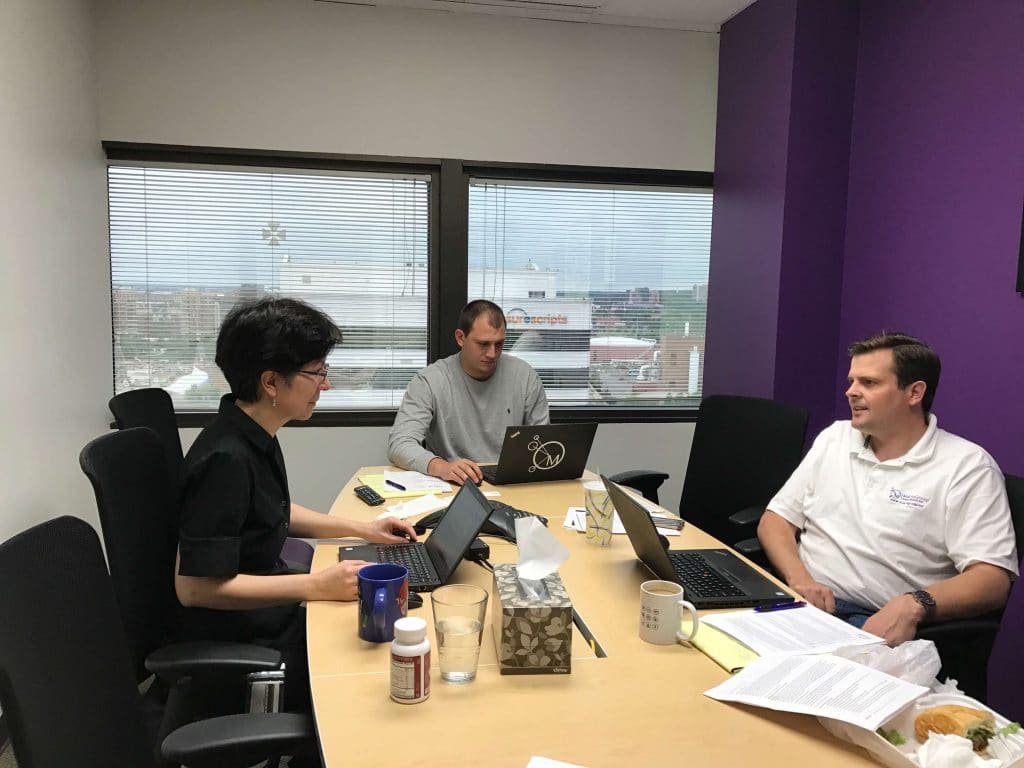
    Today, when the marketing or biz dev team is working on the slides for a webinar or pitch, we all gather in one room (the remote folks call in from home), get on a conference line, share the slides and get to work. It is mind-boggling how awesome this experience is. We’ll talk about a new slide, Leah will create it and Alex will make it beautiful. Or I’ll move slides around while Leah is proofreading. In real-time, at such a low cost – it’s ridiculous. No Sharepoint, no programming.

    18 months ago, we decided to give Google Docs a try for drafting proposals. It was fabulous except for one thing. The Google Docs Table of Contents didn’t have page numbers; I guess Google assumed everyone would be viewing documents online. Ugh, this was a dealbreaker because the new biz team creates PDF files of proposals and sends them on to clients, prospects and consultants.

    Then, about a month ago, we realized that Google Docs now has page numbers in the Table of Contents. We decided to give Docs another try. But when should we try? I don’t know about you, but there’s never really a good time in a busy agency to switch to a new system, especially one for authoring proposals.

    But then we had two weeks (a luxury!) on one proposal and we decided to give it a go. We migrated our proposal language and styles, then Alex got to work. He added more color, added editable graphic elements, updated the default font to be our official font, and created graceful table layouts.

    Last week, five of us worked on the proposal in real-time. I wrote up the solution. Nick updated the bios. Bryan checked to make sure all elements were in place and worked up the timeline and budget. Leah proofed and edited. Alex used his designer’s eye to make the proposal gorgeous. “Yay,” Alex said, “I can finally make our proposals look amazing!” Gosh, even the PDF of the proposal looked great.

    I can honestly say that switching to Google Docs has been life-changing.
    • We are no longer passing around large files.
    • We save so much time because we can work at once on the same document.
    • While there is always a document “owner,” everyone can make a contribution.
    • Slides and proposals are now viewable AND editable from my phone!!!

    I still use Word for contracts and tasks orders because clients and attorneys like to work in Word to track changes. Next week, I’ll talk about how Matrix Group uses Google Docs to write up and collaborate on spec documents. Maybe in the future, I’ll negotiate a contract in Google Docs!

    If you haven’t experienced the life-changing magic of collaborating on a Google Doc or Google Slides, now’s the time! And if you’re already on the bandwagon, please share your experiences!

  • Farewell Google Site Search, Hello Google Custom Search Engine

    Google wouldn’t be Google if it wasn’t shaking things up with its products and offerings. The latest shake up? Sunsetting the Google Site Search.

    As you may have heard, over the course of the next year, Google Site Search will be discontinued, leaving in place Google’s Custom Search Engine (CSE), which will continue to be ad-supported. As of April 1, 2017 Google has stopped selling licenses and renewals for the Google Site Search, and will completely phase it out by April 1, 2018.

    What are the differences between the old Site Search and the Custom Search Engine? The biggest, notable differences are that:

    • Ads are required. Google will, however, make exceptions for 501(c)(3) organizations.
    • Google branding is required with the new search version, and cannot be disabled, even for 501(c)(3) organizations.
    • There are monthly search query limits, so if you are running a high-traffic website there is a chance that the search will stop working once you hit your limit.

    Wondering what this means for your organization and your website’s site search if you are a Google Site Search user?

    Nothing, until your current Google Site Search license expires. You will continue to have access to the Google Site Search and your implementation and settings will stay the same until your license expires. At that time, Google will automatically convert your site search to the ads-supported CSE version and the changes mentioned above will take effect.

    If you are a 501(c)(3), are okay with the Google branding on your site search, and have a relatively low site search usage on your website, the transition to CSE should continue to meet your needs. Once you are converted, you will simply need to disable the ads and should also be prepared to provide Google’s legal team with proof of your 501(c)(3) status, if requested. Pretty simple.

    If you’re concerned that Google CSE won’t meet your needs, always keep in mind that there are other options on the market. For example, we’ve implemented the Searchblox and Solr site searches for our clients with excellent results. In fact, I recently spoke with CEO Joanna Pineda about why we love the SearchBlox site search so much. If you’re interested in what other options are available to you, please reach out! We’d love to work with you to find the perfect solution for you organization.

    Have you been switched to the Custom Search Engine yet? What are your thoughts?

  • Why Your CEO Needs to Attend Your Redesign Meeting

    Why Your CEO Needs to Attend Your Redesign Meeting

    I attend a lot of kickoff meetings. For  redesigns, mobile apps, custom databases, you name it.


    The best kickoff meetings are the ones where the CEO, Executive Director, the EVP or President attend, participate actively and provide insight. Why?
    • When the top person in the organization attends a meeting, staff know that meeting is important. Staff show up and pay attention.
    • The CEO usually has a good read on who the organization’s target audiences are and what they need. This perspective usually comes from their frequent interactions with members, partners, sponsors, the media, and Capitol Hill.
    • The top person is also usually the top spokesperson for the organization, they can best articulate the brand, mission and voice. 
    If your CEO opts not to attend, telling you he or she trusts your judgment, still ask for a 20 minute meeting. Ask him or her to rank target audiences and describe what success looks like for your project. Any decent CEO will give you 20 minutes and his or her insight will be an invaluable road map to success.
  • Why There is Still Room for a Small, Local Player in the AMS Space

    Why There is Still Room for a Small, Local Player in the AMS Space

    Last month, some of the largest AMS (association management software) companies (YourMembership, Abila, Aptify and NimbleAMS) joined forces to create Community Brands, which they describe as “a powerful and unified family of brands and a connected eco-system of software and services to better serve associations, nonprofits and government entities.”

    One can quibble over whether or not Community Brands will be a “family” of complementary or competing brands. But for a company like Matrix Group, with our web-based MatrixMaxx AMS, the big question is: In this age of mega-mergers, is there still room for a small, local player? Can we compete with the big guys for clients and talent?

    I’m confident that the answer is a resounding “Yes!”

    Many years ago, the book club at Matrix Group read Small Giants by Bo Burlingham, Editor-at-Large at Inc. magazine. In the book, Bo writes about 14 companies that are small and growing or small and choosing to stay small. In all cases, they have chosen excellence over growth.

    Excellence over growth has always been my mantra. If growth made sense in any given year, we went for it, but never at the expense of technical excellence, customer service, customer intimacy and terrific user experience.

    Sure, in many ways, being small, niche and custom is anti-trend. Aren’t we all shopping at Amazon and big box retailers? Aren’t we most impressed by the companies that have big, booming growth and huge total revenue numbers (often ignoring net income; we rarely hear about that). But on the other hand, there’s a movement to support small, local businesses. Think of the millennials who prefer independent coffee shops, bookstores and clothing shops.There’s a reason they prefer small and local and I’d wager it’s because they get a more personalized, friendly, and tailored experience.

    I spoke with a few clients over the past few weeks and they told me that they like working with Matrix Group because:

    • We have an amazing staff
    • Our work is of very high quality
    • We offer superior technical solutions on the AMS and custom sides of the business
    • We are easy to work with, easy to reach
    • We listen and respond to their needs
    • They never feel like just another client among hundreds or thousands
    • We have a track record of success
    • They know we’ll do what it takes to help them be successful
    • They get customized, personal attention and ideas

    While small companies don’t have a monopoly on the above characteristics, somehow, smaller companies are more likely to take the time to really get to know their customers.

    As for the war on talent, I absolutely love this opinion piece by columnist Gene Marks in Inc. Magazine. He talks about why it’s better to work for a small company over a large company. In fact, I have refugees from large firms who tell me they enjoy have a large voice in the company, having an outsized impact on clients’ success, and easy access to senior leadership.

    For sure, going up against a behemoth like Community Brands will be challenging. But I gotta stay true to my core belief that we can compete with any company and help our clients make the world a better place. I know that Matrix Group and the MatrixMaxx AMS can compete based on technical solutions, customer service, price and customer intimacy. No question about it.


  • Designing for Users with Autism

    Website design and usage is getting more challenging for a lot of us. In addition to more older Americans accessing the internet via smartphones only, more young people than before are living with diagnosed cognitive disabilities like autism spectrum disorder (ASD), which the Centers for Disease Control and Prevention says affects 1 in 42 boys and 1 in 189 girls.

    Researcher Cheryl Cohen recently shared those numbers in a UXDC Conference session about web accessibility for teens and adults with autism that I was able to attend back in April. Cohen gave an overview of the cognitive traits that can affect users with autism and some recommendations for improving websites and apps to better meet their needs. This was very eye-opening to me!

    What should we know about autistic users, and how can we design websites and apps to give them the best user experience? Here are the considerations and solutions that Cohen shared:

    • Contextual misunderstanding: Whether presented in words or in imagery, idioms and metaphors can be confusing to some people with autism.
      • Use more intuitive, less symbolic icons. Include descriptive text, which helps improve SEO, too.
      • When you’re writing for your website, keep the language simple. This might include shorter sentences or a conversational tone.
    • Visual processing: When looking at a lot of information all on one screen, some with autism become confused or distracted. So they simply focus on one specific item and ignore the rest of the page.
      • More white space, more visuals. Too much stuff crammed onto a screen distracts users and can add unnecessary steps to an otherwise simple task.
      • Fewer words, more bulleted lists. Large blocks of text make it difficult to find and focus on what is most important on a page.
      • Does your website feature rapid animation only viewable by Flash player? Get rid of it. It’s hard to look at and process fast-moving visuals.
    • Auditory processing: From voices to machines to their environment, some people with autism focus equally on multiple sound sources.
      • Sound quality matters. If your audio content or videos feature muddy or distorted sound, someone with autism will have a harder time discerning voices.
      • Captions improve comprehension. Mentally matching the sound they’re hearing with the images they’re seeing can be more difficult for a person with autism. Add captions to your videos and images as often as possible.
    • Different way of mentally organizing items: Inconsistencies can make it challenging for a person with autism to use web interfaces, especially if that person has trouble getting past mistakes or exceptions within a website.  
      • Watch how you design forms. In Cohen’s research, she found that teens with autism had a hard time filling out web-based forms. The biggest culprit? Inconsistent spacing between labels and input boxes.

    The teens she interviewed and observed will, perhaps, grow up to become members of our clients’ organizations — but at the very least, they will be, or already are, consumers and users of other online content and resources. Improving accessibility for these users improves the digital experience for all users, so why not always design with these user needs in mind?

    To learn more about designing for those with cognitive challenges, check out these resources from the good folks at Web Accessibility in Mind

    Are you considering these factors when designing web or apps? What other specific user accessibility considerations have you come across that improve the UX for all users?

  • How a $35 Device Disrupted an Industry

    How a $35 Device Disrupted an Industry

    A few months ago, the office space committee met to discuss conference rooms at Matrix Group. We have a standing committee that is thinking about the future of work and we decided that we needed more collaborative space, complete with a screen and projector since we’re always looking at wireframes, designs, applications or code.

    It was going to cost a bunch of money to outfit four meeting spaces with screens and projectors. Yuck. Would we have the budget to do it?

    Then one of the committee members said, “Hey, why don’t we just get big TVs and Chromecasts?” A Chromecast is $35 device from Google that lets you stream from your laptop or phone to your TV. I have one at home and we bring it when we go on vacation so that we can stream Netflix to the TV in our hotel room. Could this work in our office setting?

    We did some research. Amazon had 55″ LG TVs for $499 each. Even better, they were on Amazon Prime Now, which meant we could have them delivered within two hours. The Chromecasts were $35 from Best Buy down the street. For less than $2,700 (or the cost of one projector of decent quality), we could outfit all of our collaborative spaces with a large TV and Chromecast.

    So we did a trial run. We spent $550 on a TV and Chromecast and put it in our “war room” – the open space we use when a group of people are launching a site or troubleshooting a problem. The TV and Chromecast worked beautifully! The Chrome browser has the casting capability built-in. And when you cast your desktop, you can stream any application, including other browsers, PowerPoint, anything.

    I gave the trial my blessing and now every meeting space at Matrix Group has a TV and Chromecast. We even added a Chromecast to the projector in our large conference room to make it easier to project, but we kept the large, pull down screen. We also got a Chromecast for our reception area so it’s easier to show PowerPoints and movies in our lobby. Yay! No more wires, a friendly user interface, super reliable casting, and no special software needed. When we have guests who need to project, we just ask them to go to Chrome, cast their desktop, and then go to their browser or PowerPoint presentation; they are always amazed at how easy the process is.

    Total win for Matrix Group, big loss for the projector industry, another industry being disrupted by a small, innovative and inexpensive device.

    I’ll be talking a lot in the next few months about disruption and innovation. No matter what business you’re in, you’re in disruption or about to be disrupted. No company is exempt. So what’s your innovation strategy in the face of disruption?

  • “What’s Special About Today? Life Lesson from a Six-Year-Old”

    “What’s Special About Today? Life Lesson from a Six-Year-Old”

    I was trying to get my 6-year old out of bed the other morning. He wouldn’t budge. Finally, he challenged me by asking, “What’s special about today?

    That stopped me my in tracks. “What IS special about today?,” I thought. I named a few things: “I’m picking you up early. You have TaeKwonDo. I’m making pasta.” Satisfied, MJ bounded out of bed and ran downstairs. The day proceeded normally, better than normal even.

    As I’ve blogged about in the past, my children make me better by making me see the wonder in life. Is it really special that we’re having pasta tonight? And yet, by simply asking the question and coming up with an answer, I reframe my day and change my perspective. You know, it IS special that we’re having pasta because it’s my son’s favorite pasta and he’s happy when I make it.

    At work, perhaps it’s special that my team hit all their deadlines today. That my most recent project is under budget. That I had a great conversation with my mom. Or that the downstairs deli has an especially great egg salad sandwich today. But how often do we acknowledge and celebrate these victories every day?

    Research shows that feeling awe makes us more spiritual, generous and content. Research also shows that being grateful can transform our lives.

    In 2017, one of my resolutions is to recognize more of these special moments and acknowledge them as special. Now when any member of the family is a sleepyhead in the morning, we ask, “What’s special about today?” It’s a great way to start the day.