Matrix Group International

Tag: Matrix Group

  • JP Rule #10: Never Deliver Bad News Via E-mail or IM. Never.

    Just as our moms and Miss Manners tell us to never to break up with someone via email or Facebook, I tell my Project Managers to never, ever deliver bad news to clients or staff via e-mail or instant messenger (IM).

    Delivering bad news via email or IM is just plain bad business so why do people do it? They do it because they’re pressed for time. Or they don’t want to face the client and answer tough questions. Or they’re clueless and think sending an email will fix the problem. Or they don’t know how to deliver the bad news and negotiate a solution. Here’s what I tell my team:

    • If you have bad news, you owe it to the other side to deliver the bad news by phone, if not in person. This shows respect and thoughtfulness. Most importantly, a meeting or call is a two-way conversation, not a one-sided delivery.
    • Bad news is any news that might upset someone. The news could be monumental, e.g., Mr. client, we need more time to test the new database. Or less so, e.g., Ms. staffer, you can’t take off next Friday because we have a new site gong live.
    • Some news, even if it’s not bad, deserves a call or meeting. For example, we made the changes the client requested to the home page designs and they don’t look great so we want to discuss alternatives.
    • Email messages, no matter how carefully crafted, can be easily misinterpreted because they don’t have benefit of tone, body language or conversational context.
    • Staff deserve the same thoughtfulness and regard as clients. In other words, don’t assume that because someone works for you, you can deliver bad news via email or IM.
    • In general, IM is a bad way to communicate complex messages and a bad medium for a discussion.
    • When in doubt, pick up the phone or get advice from your manager.
    • Clients and staff aren’t Facebook friends you can post updates to. They are people and they deserve your time and attention.

    I have actually found that it’s our ability to turn around a mistake or a bad situation that cements our client relationships. If we have bad news, it’s an opportunity to explain how we got there and what we’re going to do to make the situation better. This can never, ever be done via email or IM.

    How about you? Have you ever received bad news via email or IM? What did you do?

  • When The Going Gets Tough, We Set Up a War Room

    I have a nice corner office at Matrix Group, but I haven’t seen it in a while. Why? Well, it’s been a busy couple of months at the company and I’m spending most of my days in the War Room.

    We don’t really have a War Room like the White House. At Matrix Group, any room where a bunch of staff are working together on a project can be called a war room. Some people call it the Peace Room, while others call it a huddle. Whatever we call it, in the last year, we’ve discovered the joys and benefits of working collaboratively, in the same space. Here’s how it happened.

    About a year ago, we had a small team that had six months to get a lot of work done. Their manager asked if he could sequester the team in one of the small conference rooms so they could collaborate, discuss issues immediately, look at each other’s code, and have the front-end developer immediately address prototyping and styling needs. The answer was, of course, yes. The result? The team got the project done and they did a great job. They reported being super-productive because they had easy access to each other, they were largely uninterrupted by the rest of the company, and they had snacks.

    Six months ago, another team was crashing on three deadlines. I suggested that they set up their own war room and I was told it was too hard to lug computers and monitors into the small conference room.  My response: why don’t we outfit the room with a bunch of monitors and keyboards? Then teams can come in with their laptops or desktops, have benefit of multiple monitors (which is how everyone works around here), and have an immediate war room. So we did and it worked. Staff are loving having the ability to work together collaboratively, as needed.

    Even my new biz team requests huddles several times a week. During these huddles, four of us sit in a big room, discuss a topic, get work done, discuss some more and get more work done. We’re not talking the entire time and we’re not really meeting; we’re just working in the same room and occasionally looking up and getting instant access to each other.

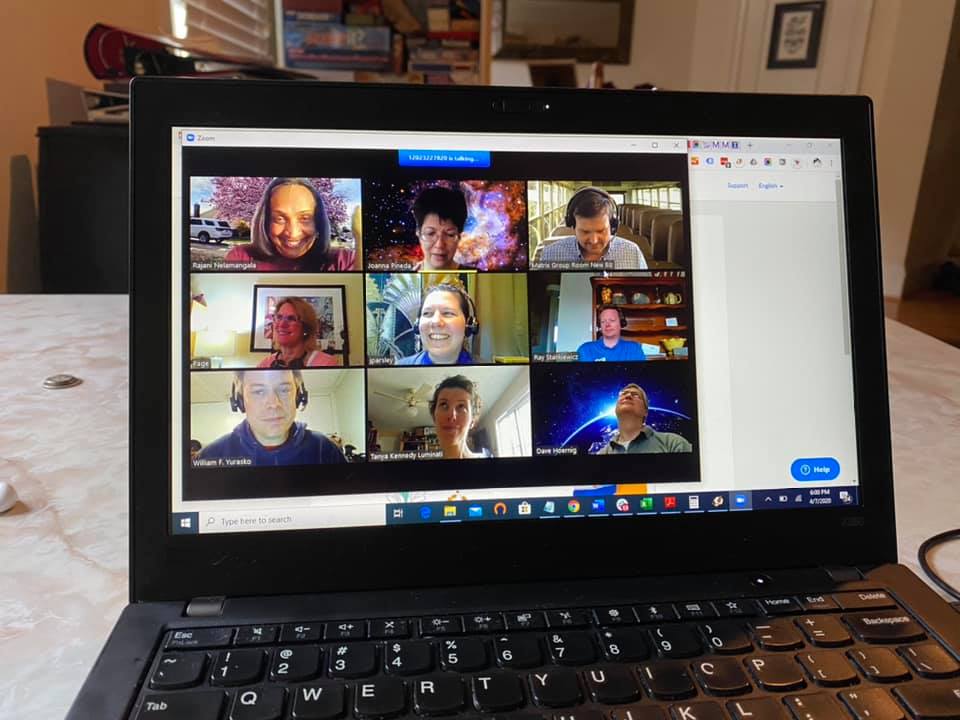
    I recently did a Matrix Minute YouTube interview with a team that set up a war room for a week to finish up a project.

    If you think your team might benefit from a war room, here are my tips for doing it successfully:

    • Make sure the right people are in the war room. For example, we find it helpful to always have a front-end developer in the room because they can handle so many tasks and can address the CSS issues that sometimes block developers.
    • Establish a deadline and a set of goals so the team has a clear idea of what they need to get done, broken down by day and week.
    • Free up people’s schedules so they can spend time in the war room uninterrupted; it’s too distracting if people have to get up and leave all the time to sit in meetings or take calls.
    • Keep the team well nourished with snacks. Don’t forget healthy alternatives!
    • Make sure the collaborative space is big enough and well-lit so that the team doesn’t feel like they’re in grim, cramped quarters.
    • Set up the room with good technology (monitors, good chairs, etc.) so that staff doesn’t feel like they’re giving up the benefits of their own space.
    • If you’re the manager, you should probably be in the war room as well. At the very least, spend part of your day in the war room or check in regularly.

    How about you? How does your organization handle crazy deadlines? Have you ever set up a war room? With what results?

  • Making Our Webinars More Social

    Matrix Group hosts two webinar series each year, one in the Spring and one in the Fall. Topics for this season’s series are Google Analytics, Integrating your CMS with your AMS (association management system), Advanced Twitter and Creating Content-Rich Mash-up Pages. Here’s the issue: although our webinars are pretty well attended and clients tell us that they love them, we weren’t getting many questions during the webinars nor were we getting many responses to the survey that we sent out after each webinar.

    So I challenged my marketing team to come with ways to make the webinars more interactive, more social. Here are some of the ideas that we recently tested during our most recent webinar on Google Analytics (GA):

    • A couple of days before the webinar, we sent out a survey to find out why people registered for this specific webinar and get questions in advance. Half of the attendees filled out the survey. We got great information that we used to customize the webinar.
    • Instead of the usual powerpoint presentation, we decided to use a case study/Q&A format. We compiled a list of most frequently asked questions about GA from the survey and from our recent calls and meetings with clients. The webinar became a conversation between me and my co-presenter, Eric Fair, the resident GA guru at Matrix Group. Instead of talking about what you can do with GA, Eric did a deep dive into the Matrix Group GA reports and showed attendees exactly how we are using campaigns, creating customized dashboards, driving traffic to our site through search and our blogs, yada, yada.
    • During the webinar, a marketing staff person was assigned to monitor the Webex chat and be on the lookout for questions. As a presenter, it’s too confusing to present, run the slides and monitor for questions, so it was helpful to have someone else monitoring the chat window. We got more questions during this webinar and I think the Q&A format made the difference.
    • At the end of the webinar, we announced that Eric Fair would take follow-up questions about GA on our Facebook page. This way, attendees who have a question after the webinar still get a chance to ask it AND we get more interactions on our Facebook page.

    These were small changes but I believe they made our webinar more engaging for attendees.

    How about you? What are you doing to make your events more social? What’s working?

  • Your Employees as Brand Ambassadors

    Your Employees as Brand Ambassadors

    Last week, Matrix Group launched a new staff blogSnackOClock.net. SnackOClock came out of an internal town hall meeting I held with staff late last year about recruiting. As a company, we decided to launch a staff blog to showcase our expertise, highlight cool projects, discuss innovative techniques we’re implementing on client sites, and demonstrate thought leadership among our peers.  SnackOClock launched last week and half of the company is now blogging.

    The idea of a staff blog has shocked many of my CEO friends who tell me that SnackOClock will simply facilitate poaching of my stellar staff, and that I am giving my employees a platform to show off their talents and then go make more money elsewhere. Pretty serious stuff and I admit that I had to think hard about this when the idea was first discussed.

    But here’s what I realized: identifying and poaching (attempted, at least) of my staff is already happening. Most of my staff are on Twitter and LinkedIn where it’s ridiculously easy to find employees at specific companies. Heck, Facebook even lets companies target employees of just certain organizations when taking out Facebook ads. Finally, Matrix Group already encourages staff to be involved in their local tech communities by participating in e-mail discussions and attending meetups.

    So, after some hard thinking and weighing of the pros and cons, I decided to embrace the idea of Matrix Group staff as brand ambassadors. Whenever one of my employees posts to a list, attends an industry event, tweets or blogs, they are representing themselves and the company. This is because Matrix Group is in their e-mail signature, they hand out business cards, and they mention the company in their profile. By creating an official platform, SnackOClock, that allows staff to show off their expertise, I’m harnessing their knowledge and expertise for the good the company — on a platform owned, managed and edited by the company.

    SnackOClock has only been online for just over a week (we had a soft launch last week, the official announcement to the world is this week), but here are the results so far:

    • Most staff are blogging or intending to blog.
    • Staff love that they can blog when they want to and get editorial and writing support, which makes it easy for new bloggers to get going.
    • There’s a ton of excitement among the staff about the blog and it’s infectious.
    • The entire company is sharing individual blog posts to their social networks, so we’re achieving our goal of wide distribution of posts, which can only be good for recruiting and prospecting.
    • Blogging was on many staff members’ “want to do” list, so the company is facilitating their professional development through the blog.
    • SnackOClock is promoting knowledge-sharing within the company.

    SnackOClock has exceeded my expectations regarding the quality of the posts and the coolness of the design. I loved Liz’s post on SiteFinity 4.4, Rich’s post on Ghostery, Eric’s post on real-time Google Analytics, and on and on. Check out SnackOClock.net for yourself. I hope you’ll subscribe to the RSS feed, comment on posts and share individual posts to your social network.

    How about you? Does your company see staff as brand ambassadors or gems to keep hidden away? What do YOU think of employees as brand ambassadors?

  • Matrix Group Is Raising Money for Local Charities!

    Matrix Group Is Raising Money for Local Charities!

    Our social fundraiser last year was so successful that we’re repeating it this year. Help Matrix Group raise money for DC area charities by participating in our social media campaign. We’re starting with a pot of $1,000. We’re adding $10 for every new “like” on our Facebook page and every new subscriber to our YouTube channel. Then we’ll distribute the money according to votes for the videos about each charity on our YouTube channel.

    This whole campaign has been about social media and group effort. First, I polled the Matrix Group staff to see if they wanted to repeat the social media fundraiser from last year. The answer was yes. Then I asked the staff to nominate their favorite charities; I picked the top 5 charities selected by staff.

    Next, we reached out to the local charities and asked them to create an informative video that makes the case for giving them money. Not surprisingly, we got amazing, authentic videos from each organization. One was created by a volunteer who did a stellar job.

    Next, we came up with a way to fold in social media, increase our reach, and make the campaign fun. So we filmed a kitschy video that explains the campaign and tied the donations to getting new likes on Facebook and subscribers on YouTube. The whole campaign, including creating the video, working with the charities and putting it all together on the web was made possible by my amazing staff.

    Check out our funny video on YouTube explaining the campaign and introducing the charities.

    Watch the videos of the five deserving organizations on YouTube. The five organizations are Doorways for Women and Families, Food and Friends, SPCA of Northern VA, Washington Animal Rescue League and the Washington Area Bicyclist Association.

    Here’s how YOU can raise money for those in need this holiday season:

    You’ve got until December 20 to like, subscribe, vote and share. I’d love to raise $5,000. Can you help?

  • Why Your Receptionist Is Your Company’s Most Important Brand Ambassador

    Why Your Receptionist Is Your Company’s Most Important Brand Ambassador

    I was on the phone with a company receptionist the other day, trying desperately to reach someone in sales or customer service. Trouble is, the person I was speaking with could not have cared less about me or my needs. She kept repeating that she had no idea where anybody was, she could not leave her desk and all she could do was put me through to voice mail. You can imagine how that encounter made me feel about the company and their products.

    In the corporate world, it’s conventional to believe that the person answering the phone is the lowest person on the totem pole. Worse yet, many companies believe we can replace receptionists with automated attendants: ring the doorbell for service or dial by extension.

    Me, I’ll always have someone answer our main line because most people calling Matrix Group are customers who need help or prospects who need our services. So you better believe I want a warm, friendly, knowledgeable and committed person answering our phones! And because it’s not always clear to people who does what in a Web agency (do you talk to the programmer or a front-end developer or the PM about an error on your admin site?), a good receptionist can field and route calls efficiently.

    My Creative Director Alex Pineda says that every employee is a brand ambassador for the company. So my receptionist, as the person who perhaps has the most contact with the most people, is arguably the most important brand ambassador I have. Which is why her title is First Impressions Officer. The other admins in the office, who also share customer interaction responsibilities, are equally important brand ambassadors.

    Scott Spanbauer defines a brand as “more than just your company image. It also includes your customers’ experience and the expectation you set when doing business with your company. In short, it is (a) promise.”

    As a CEO, I may set the tone for our corporate culture and brand, but it’s my staff who live and reinforce it with our customers. Company owners everywhere, remember that your customers’ experiences start with the person who answers the phone and greets people at the door.

  • The Prank of the Year or Why Green is the New Purple

    The Prank of the Year or Why Green is the New Purple

    It’s kind of a tradition at Matrix Group that when you go on vacation, especially if you’re gone for an extended period of time, you get pranked. When Dan went to Cancun for a week, he came back to find his area converted into a resort, complete with beach umbrella and inflatable pool filled with jello. When Maggie went on vacation, she came back to find 400 balloons in her area; it took a couple of hours to pop the balloons so she could reclaim her space.

    So when Maki and I went to the beach last week, what did the staff do? They pranked me and prank me good they did!

    I came back to find that my blog had been completely redesigned and rewritten. I became Jar Jar Binks, my signature purple was now green, and I had apparently been blogging about our new dress code and drinking on the job (if you know me, you know that I’m not much of a drinker). The net admins went to great pains to make sure that my new, green blog wasn’t available from outside the office.

    I was in shock initially. Then I panicked that the blog had actually been replaced. Then I started laughing hysterically when I realized I had been pranked and pranked hard.

    Check out the alternate version of The Matrix Files. (If the image comes in small, click it to make it full screen in your browser. Trust me, this will be worth it.)

    Kudos to Liz, who masterminded the whole prank, and the whole gang of people who designed, wrote, posted, and hosted.

    If you’re at familiar with some of the internal jokes at the office (purple is our signature color, we don’t allow shorts, yada, yada), you’ll get a chuckle at the posts. The writing is so good that I think I’ll recruit some new guest writers for this blog.

    If you’re shocked at the amount of time that goes into our pranking or that I even allow pranking, let me just say that pranking is great for office morale and productivity. The prank prep is done during personal time and it’s just plain fun.

    How about you? Have you pranked anyone lately? Share stories!

  • The Matrix Minute is Born!

    The Matrix Minute is Born!

    Even though Matrix Group has had a YouTube account for years now, we weren’t doing much with it. Well this past week, we finally, fully integrated this platform into our overall marketing and social media strategy by launching a new series called The Matrix Minute.

    Why so late to the YouTube game? As I’ve explained before in previous blog posts and webinars, I believe that it’s important to create a layered experience across different media. In other words, don’t just post the same stuff to Facebook, Twitter, your website, YouTube, your blog, etc. Have an overall strategy, but take advantage of each site’s capabilities and culture to maximize followers across all platforms.

    Until recently, we didn’t have a clear idea of how we wanted to incorporate YouTube into our marketing, sales and client engagement strategy. We had videos from Matrix Group staff events, but we had reserved our Facebook page for information and posts about the project we’re working on and corporate culture. I didn’t want to use YouTube as another place to promote corporate culture. And until we hired a new Marketing Coordinator, we didn’t have the bandwidth to staff an active YouTube channel properly.

    But this past week, we launched The Matrix Minute, which is a series of interviews with in-house and outside experts who discuss web technologies, mobile technologies, social media, design and web development. Occasionally, we’ll feature local CEOs who will talk about leadership and what their organizations are doing to stay relevant and vibrant.

    Here’s how the Matrix Minute fits into our overall sales and marketing strategy:

    • As a company, we’re extremely committed to ongoing education for staff and clients so content-rich interviews make sense for us.
    • It’s a way to showcase the expertise we have within the staff.
    • It’s a way to leverage the expertise of our clients and partners.
    • It’s a way to continue demonstrating thought leadership.
    • We get to show off our video production capabilities.
    • YouTube is owned by Google and Google favors keyword-rich videos and descriptions so the channel is good for search engine optimization (SEO).
    • It’s a way to layer YouTube into our strategy in a way that’s new and different from what we’re doing on our website and social media.

    The Matrix Minute has also been a lot of fun.  So far, I’ve been doing all of the interviews and I’m learning a ton. Ray Stankiewicz, New Biz Manager at Matrix Group, is the producer and Melissa Bader, Designer at Matrix Group, does the video editing.

    We’ve got a half dozen interviews already online. For example, Jill Foster of Live Your Talk talks about videoblogging. Jennell Evans of Strategic Interactions shares her tips for managing remote teams. And Sherrie Bakshi of Matrix Group talks about why 2011 is the year to start a corporate blog.

    BTW, we call it The Matrix Minute, but the interviews are usually 2-3 minutes long. 1 minute just didn’t provide enough time for a meaningful interview and Matrix Minutes sounded goofy.

    I hope you’ll check us out on YouTube (http://www.youtube.com/MatrixGroup) and you’ll rate, comment and subscribe. Tell us what you think of our latest initiative!

  • It Ain’t Easy Being Green

    It Ain’t Easy Being Green

    Matrix Group is competing in the Arlington Green Games, a competition for the commercial office sector (property owners and tenants) in Arlington, VA to reduce greenhouse gas emissions. Gold, Silver, Bronze and Recognition awards are given based on points achieved in different categories: Energy, Transportation, Waste, Water, Materials, Employees & Outreach, and Innovation.

    When we first signed up for the competition, the office was all gung ho. We formed a green team, we filled out the benchmark survey and we got to work on our green initiatives. Turns out, it ain’t easy being green. Here’s why:

    • Little Control Over Major Systems. At home, my husband and I ultimately control our energy consumption. We upgraded our HVAC system to a high efficiency system; our house is cold in the winter and warm in the summer; we just upgraded our windows to be triple-paned, argon gas-filled and super efficient; we installed dimmers; we wash our clothes in our cold water; yada, yada. But at work, our options are much more limited because we can’t control many of the systems that generate the most greenhouse gases. For example, as a tenant, I can’t exactly upgrade the windows on the 12th floor and we didn’t install the HVAC system that heats and cools the building.
    • Being Green Costs More. As any news article on green technologies and lifestyles will tell you, being green just plain costs more. The Green Games website recommends that we purchase green credits to balance our CO2 emissions. We can also make sure that all of our purchasing (office supplies, equipment, furniture) is green, which can be considerably more expensive.
    • There’s Little Incentive to be Green as a Tenant. I once asked a friend if she had switched her light bulbs to compact fluorescents and she said, “Why should I? I don’t pay for my electric bill. My building does.” As a tenant in a commercial office building, it’s hard to see the effects of our energy-hogging or green ways.

    So what’s the green path and how are the Green Games making us better?

    What I’m appreciating the most about the exercise is twofold: 1) we are focusing on obvious practices like composting our Keurig grounds and making sure the recycling is going into the right bins and actually being picked up by the recycling contractor and 2) we have initiated a conversation about real policy changes at the company that will result in meaningful greenhouse gas emission reductions.

    For example, we currently subsidize half of employee parking fees and Metrocheck cards. But we don’t have incentives (financial or otherwise) for the staff who walk or bike to work. What can we do for these staff beyond giving them $50 a month that will mostly get eaten up by taxes (whereas parking and Metro subsidies are tax-free)? Can we alter the IT policy of leaving our computers on at night so that security patches can be installed; can we at least turn them off on the weekends? And how much of our company profits are we willing to forgo in favor of purchasing green products and credits? All tough questions that we don’t have answers to but that I look forward to exploring this year.

    When I was in college and taking a course on aid in the developing world, my professor urged us students not to think about what one person can do in a day, but what a community of people can do over time. The Green Games are hopefully helping the business community in Arlington chart a course for real green practices and change in Northern VA. While it ain’t easy being green, the alternative ain’t much better.

    How about you? What is your company doing to be greener? What innovative policies and initiatives have you come up with? What’s worked? What hasn’t?

  • Grocery Manufacturers Association Website Redesign

    Grocery Manufacturers Association Website Redesign

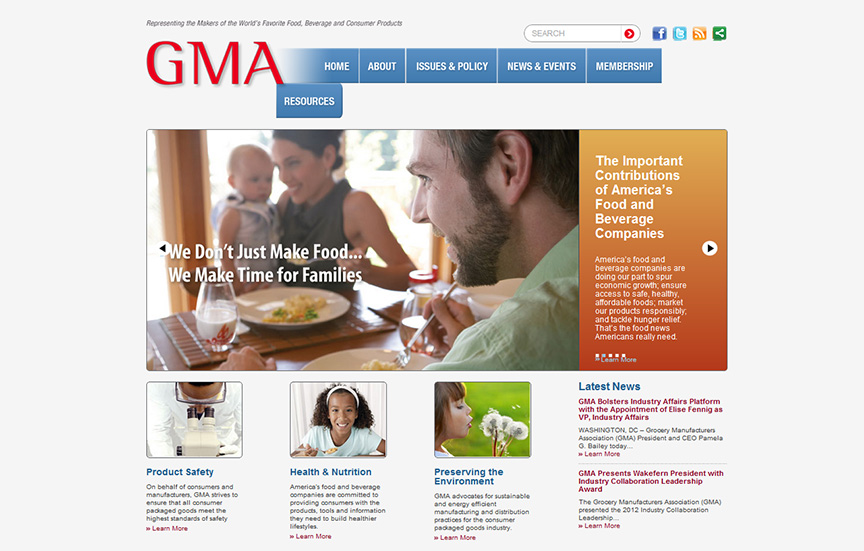
    Matrix Group partner, Grocery Manufacturers Association (GMA) is the leading voice for food, beverage and consumer product companies and serves many audiences in communicating the interests, research and publications developed by staff and also helps its members produce safe products through a strong and ongoing commitment to scientific research, testing and evaluation. GMA partnered with Matrix Group and Rational 360 on a website redesign and implementation. Rational 360 created the information architecture and design, while Matrix Group implemented a new content management system and integrated the website with GMA’s membership database.

    Matrix Group and Rational 360 work features:

    •  News and information organized by topic, including Product Safety, Health & Nutrition and Preserving the Environment.
    •  A unified member experience for members who previously had to use multiple passwords to access content on two websites (GMA merged with another organization several years ago), and multiple, separate e-commerce applications. Today, visitors use one username and password to access ALL resources and members seamlessly gain access to protected content and discounts.
    •  Complete integration with GMA’s back office. Member profiles are changed instantly, purchased are processed in real-time, and all registrations are automatically saved to GMA’s association management software, MatrixMaxx.

    Visit the Grocery Manufacturers Association Website.