Matrix Group International

Tag: Matrix Group

  • How to Make Your Remote Culture Work: Coworking and Virtual Water Coolers

    How to Make Your Remote Culture Work: Coworking and Virtual Water Coolers

    I’ve been thinking a lot about work 3.0 and how to make sure that my company continues to foster collaboration and create social capital, even though we’re all remote. I found this great article in Forbes by Dr. Gleb Tsipursky. I heard Dr. Tsipursky speak during one of my Vistage Worldwide, Inc. meetings and have found his work fresh and inspiring.

    Dr. T talks about two things that make remote work even better than in person: Virtual Coworking and the Virtual Watercooler. Virtual coworking is when you and a co-worker (or co-workers) park on a Slack, Meet, or Teams call and just work side by side. You don’t need to be meeting or even working on the same thing. You’re co-working and able to talk to your co-workers instantly.

    The virtual watercooler is when you have a Slack or Teams channel for off-topic things, not work related.

    When I read these articles, I realized some things about myself and my company, Matrix Group International, Inc.

    We Were Already Coworking Before the Pandemic

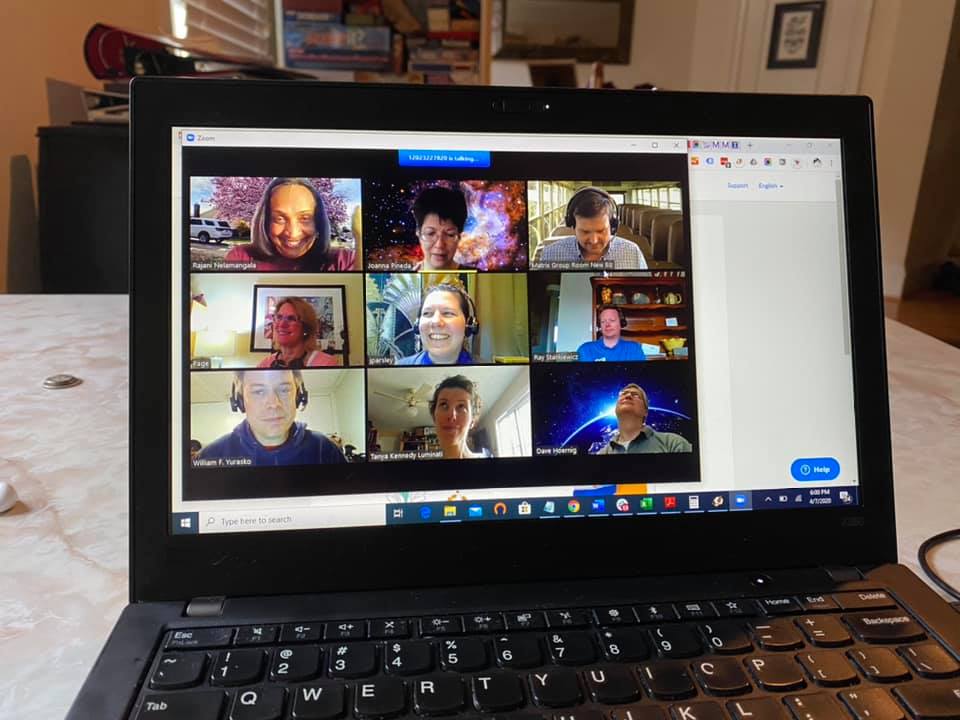
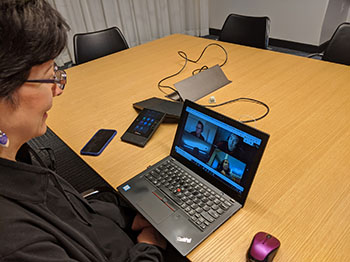
    Matrix Staff in Zoom meeting

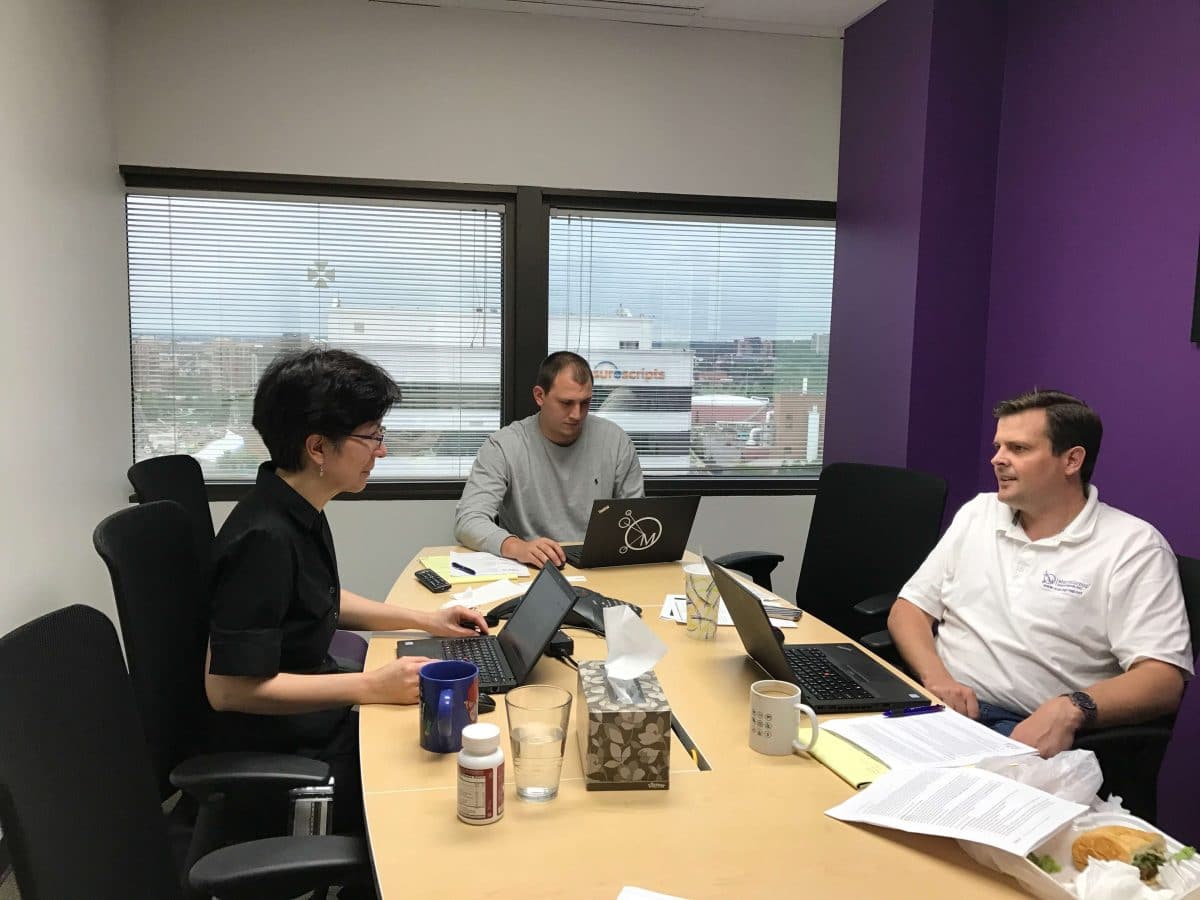
    Before the pandemic, we had several spaces in our office that were devoted to co-working. We had a large space we called the “war room” where we gathered for staff meetings, launches, and troubleshooting. The space had several, long standing desks, a couple of couches, lots of power, and a large LCD screen. The biz dev team was also in the habit of co-working. We would park on a conference call when working on slides or a proposal. And sometimes, we gathered in a conference room just to be able to work next to each other.

    When we went 100% remote in March 2022, coworking continued. The biz dev team routinely parks on a Slack call or Google Meet to just work together or work on a proposal. Sometimes, when I’m lonely for company, I’ll ask on Slack “anyone want to war room this afternoon?” When I get at least one yes, we work silently until one of us wants a break, or needs something. It’s been a great way to work together without needing to be in a “meeting.” Other teams at Matrix Group co-work mostly during launches or when troubleshooting a problem, but after reading the article by Dr. T, I’m going to ask them to experiment with more coworking time.

    Virtual Water Coolers Are Great Fun

    I admit that before the pandemic, I sometimes fretted over the watercooler channel we had on Slack. People would post cat photos, talk about the weather, link news articles, post memes, or just say hello. I worried that too much time was being spent on socializing.
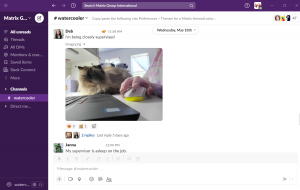
    But when the pandemic hit, even I found myself gravitating toward the watercooler channel for some socializing. It was fun to see the furry companions of my staff; the view of the snow from wherever they were, or their kids doing distance learning in a tutu. Staff used to ask for permission to create new social channels, and now, I give them free reign. We have a parenting channel where parents can rant, commiserate, or ask for advice. We have a cooking channel where people share recipes and post photos of their dishes.

    Even I have been inspired to post emojis and funny gifs. I’ve even blessed funny memes during staff meetings!

    Work 3.0

    I know that many CEOs are eager for work to “return to normal” and for staff to come back to the office. No matter how you or your leaders feel about remote work, some type of remote work is here to stay. So I’m devoting myself to figuring out how to make Matrix Group really good at it.

    How about you? What do you think about work 3.0? How do coworking and virtual water coolers fit into your culture?
  • Navigating Your Responsibilities as a Leader During COVID-19 Crisis

    Navigating Your Responsibilities as a Leader During COVID-19 Crisis

    CEO Joanna Pineda on video conferenceThere’s no question that this COVID-19 pandemic is proving to be a test of leadership. As a CEO of Matrix Group, I have responsibilities to my employees, my clients, my clients’ customers, my employees’ families, and certainly our own family.

    Many of you know that I’m a member of Vistage, which is the world’s largest executive coaching organization. My group of 16 CEOs (run by trained coach Peter Schwartz) has been meeting regularly to help us navigate this crisis. As Pete says, “CEOs bring the weather,” meaning we can bring sunshine and energy to any situation, or we can dampen spirits and projects with our attitude and energy level.

    So what’s working for me and my family?

    Work From Home Extended to All Staff

    My leadership team decided early to send everyone home. It’s been three weeks and I’m hoping that this decision will keep everyone healthy. Of course, it helps that last year, when we moved to our new office, CTO Maki Kato proclaimed that we would no longer have a server room. So the remaining on-premise services went into the cloud or moved to a SaaS (software as a service) platform. Even our office admin can work from home because our phone system allows her to answer and route calls from home, and our accounting system is in the cloud.

    Asynchronous Work

    Expecting staff to work the same hours is just not realistic these days. Many of us are home with kids, so I made the decision to allow asynchronous work. Since we have good task management systems and good oversight, our productivity has not gone down. While it’s exhausting for parents to work and school/oversee their kids, at least they can relax knowing that it’s okay to say “I’ll be offline for a couple of hours because little Johnny is having a meltdown and we are going outside for a couple of hours.”

    More Frequent Staff and Family Meetings

    I do a daily huddle with my husband and kids, a daily huddle with my biz dev team, a weekly huddle with my Directors, and a weekly huddle with all staff. These check-ins are more frequent than they used to be, but they’re allowing me to keep tabs on how folks are doing emotionally and physically, and determine who might need extra support. We start every meeting with a Matrix Group fundamental and ask if anyone would like to check in and tell us how they’re feeling. Note that we start with feelings, not tasks.

    Business as Usual, When Possible

    To the extent possible, we are working as if it’s business as usual. We are blessed and grateful that our work has been largely unaffected. Our clients need us to continue work on their websites, database and mobile apps; update their websites, keep communications flowing to their members, and provide back-up for sick staff. So while we’re working, we try to block out the terrible things happening outside our homes, because we can and because we must.

    One of my DEVs said that he sometimes almost forgets we’re in lockdown until the Instacart delivery guy comes around and he’s wearing a mask. I hope that by keeping our spirits up AND staying home, we are doing our part to stay healthy and not spread this sickness.

    Sharing Zoom, Making More Calls

    I’ve always been a telephone gal. I like to connect with people via phone. These days, I’m making more phone calls, to people I rarely call, or haven’t called in decades. It lightens my heart. I’ve also allowed my staff to use our Zoom accounts to organize Zoom meetups for their own families, friends and clubs. Janna is doing a virtual knitting group meetup every week. And last night, I think there was a meeting of werewolves.

    I don’t have time for a new hobby, extra baking, puzzles, or a TV marathon. But I do have time for some phone or Zoom calls, and my Duolingo streak (I’m learning Italian and practicing my French) continues!

    Preparing for the Worst

    My friend Heinan Landa wisely told me that I need to prepare for the time when people I know start getting sick or even start dying. How will I support a family member? A sick employee? The sick parent of an employee? How do we keep working going so that the company stays productive? How do I do this with compassion and understanding? I don’t have the answers but I’m working on it.

    What are YOU doing to help your company and family weather this storm? Please share. And be well.


  • How Matrix Group Ended up with Four Addresses In One Year

    How Matrix Group Ended up with Four Addresses In One Year

    Clients, Partners and Friends, the Matrix Group address is changing. Again. We are imposing upon you, once more, to change your records so that correspondence, checks and everything else arrive at the proper place.

    Here’s the complicated story of how our one move generated three address changes.

    For 10 years, our address was 2711 Jefferson Davis Highway, Suite 1200, Arlington, VA 22202. It was sometimes confusing to find us because while the building was on Jeff Davis, you couldn’t enter our building from Jeff Davis. Our entrance was on Clark Street.

    Last June 2019, Alexandria changed Jeff Davis to Richmond Highway, but only in Alexandria, so we weren’t affected. Sort of. GPS maps went haywire. Google couldn’t find 2711 Jefferson Davis Highway in Arlington, only in Richmond, VA.  BUT the post office would only deliver to Jeff Davis. That was fun directing clients to enter a different address into their phones when they came to visit.

    Last July 2019, we moved down the street to 2611 Jefferson Davis Highway. Never mind that this building wasn’t even on Jefferson Davis Highway. We changed our address on everything digital BUT we knew that political winds were likely going to necessitate a change to Jeff Davis, so we did not print new letterhead, business cards, etc.

    Then in October 2019, Arlington County finally changed Jeff Davis to Richmond Highway. Some GPS maps still couldn’t find us because our building is really on South Clark Street. In fact, typing 2611 South Clark Street usually worked better in Google maps. Yuck. We changed our email signatures, website, proposals, intranet, extranet, yada, yada. But we still didn’t print anything because our landlord said more change was coming.

    Fast forward to January 2020. Arlington County, at the request of our landlord, approved a request to change our address to 2611 South Clark Street. Finally, something that made sense! Sort of. While Google maps recognizes 2611 South Clark, retailers like Amazon and Best Buy still do not. So when I bought new TVs for the office, I had them delivered to 2611 Richmond Highway. Oh, and Amazon is still delivering to 2611 Jefferson Davis Highway.

    It will likely take a few months before the post office, Google maps and all retailers recognize our new address, but I think we can now print new business cards. Oh heck, maybe we’ll eliminate our physical address from our cards altogether!

    Bottom line: Please update your records. Matrix Group is located at 2611 South Clark Street, Suite 330, Arlington, VA 22202. Come see us. We have an amazing office and we love having visitors!

  • How We’re Using Agile and SCRUM to Manage our Office Move

    How We’re Using Agile and SCRUM to Manage our Office Move

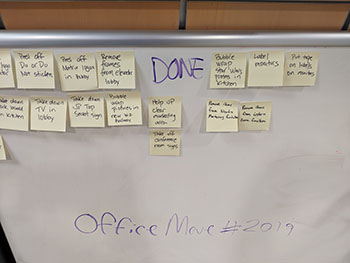
    SCRUM board for Matrix Group MoveMatrix Group is moving! We’ve been in this office for ten years and it’s time. Our needs have changed, and my creative team (yes, even developers are creative types, in my opinion) needs a change of scenery.

    As with all moves, there are about a million tasks that need to be done. So how are we managing all of these tasks, while still doing work for our clients?

    Ten years ago, we set up a SCRUM board for the weekend of the move. This time around, we’re using weekly sprints and a SCRUM board for the entire process. Here’s how we’re managing the work:

    • We have a Move Team that meets twice a week to see how we’re doing against the mammoth task list and timeline that we established a couple of months ago.
    • The timeline, tasks and decisions are stored in a Google doc. The tasks are grouped by week, so in essence, we’re doing one week sprints.
    • Maria is in charge of managing the Google doc, marking things done, adding details, and documenting decisions. I guess you could say she’s the SCRUM Master. Even though she’s remote, she knows everything happening as part of this move.
    • I’m the Project Owner because I’m the one who ultimately decided that we needed to move. And I make the high level decisions about what we’re moving, what the new office will look like, timing and budget.
    • To get the zillion tasks done, we set up a SCRUM Board in our lobby. Starting Monday, the Move Team has been writing down tasks that need to be done and sticking them on a TO DO board.
    • Staff have been grabbing tasks and doing them. Some tasks take 15 minutes, some longer. Once a task is done, the post-it is moved to the DONE board.
    • Move Team members add tasks to the TO DO board as they come up. The list of TO DO items will likely grow as we get closer to the move.

    The SCRUM Board works because:

    • Everyone can help, according to their availability and schedule.
    • We have a visual on the amount of work to be done.
    • The move becomes a shared responsibility, not just a task for the admin team or the Move Team.

    It’s only been a couple of days but already, the results have been amazing.

    During the actual move weekend, we’ll have music and food so that the task of setting up the new office isn’t a drag, but rather a party and a celebration!

  • The Checkbox War is Over: How to Pick a New AMS Partner

    The Checkbox War is Over: How to Pick a New AMS Partner

    checklist on clipboard graphicI was talking to my friend Ben Muscolino at Benel Solutions. Ben’s company does netFORUM implementations and other AMS integrations. Matrix Group has several clients in common and we love working with Benel Solutions.

    Anyway, we were talking association management software (AMS) companies, how the space is pretty crowded, and how difficult it is for associations to choose between vendors. At some point, Ben quipped, “well, the checkbox war is over, so how do clients choose their platform?”

    The checkbox war is over.

    I think Ben is absolutely right. The AMS market has reached such maturity that nearly all the platforms (MatrixMaxx from Matrix Group included) are able to check off the boxes in the RFPs that we receive. Yep, we let associations manage individual and company-based memberships, meetings, tradeshows, publication sales, digital downloads, sponsorships, subscriptions, fundraising, yada, yada.

    So how on earth does an association pick a platform? I think the answer is you don’t. You pick a partner instead.

    A partner that can help you:

    • Rethink your member experience
    • Work well with the other vendors in your digital universe
    • Guide your business process transformation
    • Get creative with your budget and needs

    Is YOUR AMS partner doing all this for you?


  • What Employees Want From Office Space: Flexibility

    What Employees Want From Office Space: Flexibility

    About a year ago, I was facing a big office space decision. Do we stay in our current office or move? Keep the current space design or blow it out? Our landlord paid for a fancy architect to come up with new layouts and designs. In the end, we decided to stay in place, sign a short lease and use a modest budget to think about what the next generation Matrix Group office space should look like.

    I held meetings with staff, we visited other offices, and we scoured design magazines and blogs. After a year of discussions and moving furniture around, here is what we’ve learned:

    It’s not about offices, workstations or open space. It’s about flexibility. Turns out most of my staff like being in an open, airy area. BUT, on a regular basis, they want the option to work from home, be isolated so they can concentrate without interruption, or crash on a project with 2-3 other team members. It’s not unusual to find the IT team huddled in one of our huddle spaces during a launch. Or the new biz team meeting in Tatooine (one of our conference rooms) when crashing on a proposal.

    Small meeting rooms can meet a lot of needs. Previously, we had two small meeting rooms and one large one. The large room is used infrequently – a few times a month when we have staff meetings and for large meetings. We replaced the finicky projectors with large TVs and Chromecasts and never looked back. We use the small conference rooms for group calls with clients, troubleshooting teams, and as isolation rooms for people who need quiet time.

    Good design and lack of clutter are inspiring. Over time, office space just degrades. We accumulate junk, the walls get dinged, and stuff gets dingy. It’s so important to step back and give the office a fresh look. In our case, we didn’t have budget for a complete overhaul, so we cleaned the carpets, repainted some walls, bought some new lobby furniture and came up with new artwork for the walls. We also encouraged the staff to declutter their spaces; it’s amazing how much stuff I tossed just from my own office! When I walk around the office, I can feel the breathing room we created just by tossing a lot of junk we had stopped noticing!

    Rethinking how we communicate. On any given day, I have staff working from home or working in a location other than their desk. So how does the poor receptionist find people when they get a call? How do I find someone I need to consult on a project? In our case, Slack has been a godsend and a game changer. Using Slack, we can communicate directly with other staff. Even better, we have Slack channels for each client and each team (e.g., the MatrixMaxx team or the new biz team) so we can easily collaborate, share, and keep each other updated. The expectation is that all staff stay on Slack if they’re working. So it doesn’t matter if you’re working in the kitchen or Tatooine; you will respond if you get a Slack message. Most of us have Slack on our phones as well, so it’s easy to respond to quick questions. Yes, Slack has reduced the amount of in-staff email we send out.

    I’m almost done with the my office redo and the new wall stickers and artwork are coming next week. So stay tuned for a blog post with before and after photos. I’m loving our office and loving the conversations we continue to have about next generation office space.

    How about you? Do you love your office space? What’s working? What do you wish you could have and do?
  • How Google Docs and Google Slides Changed Biz Dev at Matrix Group

    How Google Docs and Google Slides Changed Biz Dev at Matrix Group

    A few years ago, Matrix Group Creative Director Alex Pineda suggested that we ditch PowerPoint and move to Google Slides. The reason? Collaborating on a PPT file is really hard. We used to pass around huge files via email or rely on the network share. Alex came up with a beautiful template and the rest is history.

    Today, when the marketing or biz dev team is working on the slides for a webinar or pitch, we all gather in one room (the remote folks call in from home), get on a conference line, share the slides and get to work. It is mind-boggling how awesome this experience is. We’ll talk about a new slide, Leah will create it and Alex will make it beautiful. Or I’ll move slides around while Leah is proofreading. In real-time, at such a low cost – it’s ridiculous. No Sharepoint, no programming.

    18 months ago, we decided to give Google Docs a try for drafting proposals. It was fabulous except for one thing. The Google Docs Table of Contents didn’t have page numbers; I guess Google assumed everyone would be viewing documents online. Ugh, this was a dealbreaker because the new biz team creates PDF files of proposals and sends them on to clients, prospects and consultants.

    Then, about a month ago, we realized that Google Docs now has page numbers in the Table of Contents. We decided to give Docs another try. But when should we try? I don’t know about you, but there’s never really a good time in a busy agency to switch to a new system, especially one for authoring proposals.

    But then we had two weeks (a luxury!) on one proposal and we decided to give it a go. We migrated our proposal language and styles, then Alex got to work. He added more color, added editable graphic elements, updated the default font to be our official font, and created graceful table layouts.

    Last week, five of us worked on the proposal in real-time. I wrote up the solution. Nick updated the bios. Bryan checked to make sure all elements were in place and worked up the timeline and budget. Leah proofed and edited. Alex used his designer’s eye to make the proposal gorgeous. “Yay,” Alex said, “I can finally make our proposals look amazing!” Gosh, even the PDF of the proposal looked great.

    I can honestly say that switching to Google Docs has been life-changing.
    • We are no longer passing around large files.
    • We save so much time because we can work at once on the same document.
    • While there is always a document “owner,” everyone can make a contribution.
    • Slides and proposals are now viewable AND editable from my phone!!!

    I still use Word for contracts and tasks orders because clients and attorneys like to work in Word to track changes. Next week, I’ll talk about how Matrix Group uses Google Docs to write up and collaborate on spec documents. Maybe in the future, I’ll negotiate a contract in Google Docs!

    If you haven’t experienced the life-changing magic of collaborating on a Google Doc or Google Slides, now’s the time! And if you’re already on the bandwagon, please share your experiences!

  • Why There is Still Room for a Small, Local Player in the AMS Space

    Why There is Still Room for a Small, Local Player in the AMS Space

    Last month, some of the largest AMS (association management software) companies (YourMembership, Abila, Aptify and NimbleAMS) joined forces to create Community Brands, which they describe as “a powerful and unified family of brands and a connected eco-system of software and services to better serve associations, nonprofits and government entities.”

    One can quibble over whether or not Community Brands will be a “family” of complementary or competing brands. But for a company like Matrix Group, with our web-based MatrixMaxx AMS, the big question is: In this age of mega-mergers, is there still room for a small, local player? Can we compete with the big guys for clients and talent?

    I’m confident that the answer is a resounding “Yes!”

    Many years ago, the book club at Matrix Group read Small Giants by Bo Burlingham, Editor-at-Large at Inc. magazine. In the book, Bo writes about 14 companies that are small and growing or small and choosing to stay small. In all cases, they have chosen excellence over growth.

    Excellence over growth has always been my mantra. If growth made sense in any given year, we went for it, but never at the expense of technical excellence, customer service, customer intimacy and terrific user experience.

    Sure, in many ways, being small, niche and custom is anti-trend. Aren’t we all shopping at Amazon and big box retailers? Aren’t we most impressed by the companies that have big, booming growth and huge total revenue numbers (often ignoring net income; we rarely hear about that). But on the other hand, there’s a movement to support small, local businesses. Think of the millennials who prefer independent coffee shops, bookstores and clothing shops.There’s a reason they prefer small and local and I’d wager it’s because they get a more personalized, friendly, and tailored experience.

    I spoke with a few clients over the past few weeks and they told me that they like working with Matrix Group because:

    • We have an amazing staff
    • Our work is of very high quality
    • We offer superior technical solutions on the AMS and custom sides of the business
    • We are easy to work with, easy to reach
    • We listen and respond to their needs
    • They never feel like just another client among hundreds or thousands
    • We have a track record of success
    • They know we’ll do what it takes to help them be successful
    • They get customized, personal attention and ideas

    While small companies don’t have a monopoly on the above characteristics, somehow, smaller companies are more likely to take the time to really get to know their customers.

    As for the war on talent, I absolutely love this opinion piece by columnist Gene Marks in Inc. Magazine. He talks about why it’s better to work for a small company over a large company. In fact, I have refugees from large firms who tell me they enjoy have a large voice in the company, having an outsized impact on clients’ success, and easy access to senior leadership.

    For sure, going up against a behemoth like Community Brands will be challenging. But I gotta stay true to my core belief that we can compete with any company and help our clients make the world a better place. I know that Matrix Group and the MatrixMaxx AMS can compete based on technical solutions, customer service, price and customer intimacy. No question about it.


  • How a $35 Device Disrupted an Industry

    How a $35 Device Disrupted an Industry

    A few months ago, the office space committee met to discuss conference rooms at Matrix Group. We have a standing committee that is thinking about the future of work and we decided that we needed more collaborative space, complete with a screen and projector since we’re always looking at wireframes, designs, applications or code.

    It was going to cost a bunch of money to outfit four meeting spaces with screens and projectors. Yuck. Would we have the budget to do it?

    Then one of the committee members said, “Hey, why don’t we just get big TVs and Chromecasts?” A Chromecast is $35 device from Google that lets you stream from your laptop or phone to your TV. I have one at home and we bring it when we go on vacation so that we can stream Netflix to the TV in our hotel room. Could this work in our office setting?

    We did some research. Amazon had 55″ LG TVs for $499 each. Even better, they were on Amazon Prime Now, which meant we could have them delivered within two hours. The Chromecasts were $35 from Best Buy down the street. For less than $2,700 (or the cost of one projector of decent quality), we could outfit all of our collaborative spaces with a large TV and Chromecast.

    So we did a trial run. We spent $550 on a TV and Chromecast and put it in our “war room” – the open space we use when a group of people are launching a site or troubleshooting a problem. The TV and Chromecast worked beautifully! The Chrome browser has the casting capability built-in. And when you cast your desktop, you can stream any application, including other browsers, PowerPoint, anything.

    I gave the trial my blessing and now every meeting space at Matrix Group has a TV and Chromecast. We even added a Chromecast to the projector in our large conference room to make it easier to project, but we kept the large, pull down screen. We also got a Chromecast for our reception area so it’s easier to show PowerPoints and movies in our lobby. Yay! No more wires, a friendly user interface, super reliable casting, and no special software needed. When we have guests who need to project, we just ask them to go to Chrome, cast their desktop, and then go to their browser or PowerPoint presentation; they are always amazed at how easy the process is.

    Total win for Matrix Group, big loss for the projector industry, another industry being disrupted by a small, innovative and inexpensive device.

    I’ll be talking a lot in the next few months about disruption and innovation. No matter what business you’re in, you’re in disruption or about to be disrupted. No company is exempt. So what’s your innovation strategy in the face of disruption?

  • Why Matrix Group Was Finally Ready to Switch to Google Apps

    Google appsA few years ago, I blogged about Google Apps. I wondered if my business, and businesses everywhere, were ready to make the switch to Google Apps.
    Well, a few years later, we finally made the switch. A couple of months ago, Matrix Group switched over to Google Apps. We now use:

    • Gmail for email
    • Google calendar for our corporate calendar
    • Google slides for presentations
    • Google drive for file sharing
    • Google hangout for some internal meetings

    So why did we switch to Google Apps?

    First, the Google Apps suite is just so good, it’s hard to ignore as an offering. The calendar and email are terrific. Second, many of us use Office 365 but the file sharing is simply not as easy, fast or intuitive with OneDrive, so we started using Google Drive. Next, we were already using Google slides for presentations because it is simply awesome having five people work on slides at the same time during collaboration meetings. Finally, a friend who runs a private security firm gave Google the thumbs up, so any lingering concerns about security melted away.

    We timed the switch to coincide with our email renewal and discovered that switching to Google Apps is less expensive than the renewal for our email alone. And now we don’t need to worry about hardware, patches and upgrades.

    So what’s different and what have we learned?

    1. Most of us already use Google personally, so it wasn’t a huge stretch to switch to Google. We did find, however, that we needed to create new protocols for scheduling meetings. For example, we have a main calendar and a PTO calendar. The PTO calendar makes it easy to filter on who’s out. Only the admin staff can edit the PTO calendar.
    2. Even though it’s Google, training is still important. We’ve held several all staff trainings to review the protocols for calendar, email and security. IT worked with each staff person to make sure they downloaded the Duo app, which we use for two-factor authentication. We also have a Slack channel devoted to Google Apps issues, questions and discoveries.
    3. We are only scratching the surface of what’s possible. We embedded the Google calendar into our intranet, which was super useful because we can see everyone’s schedule, with the ability to filter by person. During the last staff meeting, I figured out how to create a Google hangout from the calendar detail page. Score! And we think there’s a way to create a hangout from a Slack channel. We’re learning new stuff every day.

    So far, the switch has been terrific. For less money, we’ve added new functionality, made systems more intuitive and made our systems more secure. I’ll keep blogging about our journey with Google because I suspect the journey has just begun. If you are using Google Apps, why did you switch and what’s been your experience so far?