Family and friends scattered all over the globe? LINE lets you make good quality long distance calls and text long distance for free!
Blog
-

Once Upon A Time
I love this show! It takes fairy tale characters and puts them in the modern day world, all set in a little town in Maine called Storybrooke.
-

Why and How to Support the Victims of Hurricane Haiyan in the Philippines

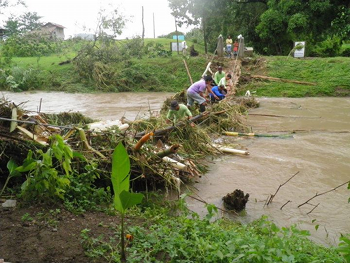
Photo of the GEH footbridge wiped out by Hurricane Haiyan Some of you know that I am a Filipino-American. I was born and raised in the Philippines and came to the US when I was 14 years old. The US is now my home but my dad and countless relatives still live in the Philippines. So you can imagine how the devastation from Hurricane Haiyan has hit me and my family hard. BTW, in the Philippines, Haiyan was called Typhoon Yolanda.
People have asked me why there is so much devastation and I think there are two main reasons:
Hurricane Haiyan was the most powerful typhoone/hurricane every recorded. The entire country was covered in storm clouds (that would be like one storm system covering the entire Eastern seaboard). When you have winds that top 200 mph, you’re going to have damage and if you add tidal surges, you’ll get even more.
Disasters in developing countries produce more damage. While in college, I took a class called Earthquakes and Man. Professor Abernathy made the point that earthquakes produce so much more damage in developing countries because they don’t have the building codes, the resources and the construction industry to produce building that will withstand natural disasters. Yes, hurricanes hit towns in US hard, but they don’t usually kill hundreds or thousands of people.
During this holiday season, I’m hoping that you’ll reach into your wallets and support the many, many victims of Haiyan. If you’re wondering how to support the victims, here is my list:
- GreenEarth Heritage (GEH) Foundation Philippines is a non-profit run by a friend of my sister, mom and cousin. GEH supports families and farmers who are committed to sustainable agriculture. Haiyan wiped out their operations. Here’s my sister’s fundraising page; she’s trying to raise $50,000 for GEH; use this link and you’ll get a tax receipt.
- My aunt helps run the Ayala Foundation, which is a prominent non-profit in the Philippines that focuses on nutrition and infrastructure projects. You can make a donation to this local organization through their Donate page.
- I have always admired the work on the Red Cross. You can support the Red Cross Philippines, which is one of the leading relief organizations in Leyte province right now.
- An easy way to give is through the mGive Foundation, which is collecting money for many organizations. Simply send a text and your wireless carrier will send money. For example, you can text the word AID to short code 50555 to give a $10 donation to Operation USA. Texting different words will benefit different organizations. Note that this is NOT the fastest way to provide support, because funds can take weeks or months to be remitted but every little bit helps.
- TIME Magazine has a list of ways to support the victims in the Philippines.
How much to give? To give you some perspective, GEH says:
- $25 feeds a family of four for a month – I’ve spent $25 on one lunch for two people!
- $150 pays for a child’s education for a whole year – I think I spent that much for a fancy dress last month!
I know this sounds corny, but when terrible things like this happen in the Philippines, I wonder how I got to be so lucky that I’m here and the victims are over there. I’m grateful that my entire family is safe.
I hope you’ll join me this holiday season and give generously to the survivors of Hurricane Haiyan. If you can, how about a $150 gift, or more, to educate a child for a year?
-

NECA Safety Professionals Conference Website Redesign
Designed for safety directors, human resource professionals, project managers and risk managers, the National Electrical Contractors Association‘s Safety Professionals Conference is the electrical construction industry’s premier annual safety event. Attendees learn the most up-to-date information on regulation, compliance, management techniques and standards development – issues that impact safety and health in the electrical construction industry on a regular basis.
To promote the 2014 conference, NECA partnered with Matrix Group on a redesign of the site. Matrix created a design inspired by the conference’s safety theme and location in Chicago. The site was re-implemented in WordPress, making it easy for NECA staff to update it with the most up-to-date conference information.
The website uses a simple navigation to guide users directly to information pertinent to them. Attendees can:
- Register for the conference
- Sign up for the latest updates on the conference through the site
- View the full conference schedule and read about the keynote speakers
- Read testimonials from past attendees
- And more!
Learn more about the conference.
Visit the website at www.necasafetyconference.com.
-

Mining Your Membership Database for Business Intelligence
I had the pleasure of co-hosting a webinar on business intelligence with Wes Trochlil, President of Effective Database Management earlier this week. Wes is a terrific speaker, he runs a great association consulting practice, and I love that he’s passionate about business intelligence (BI). Wes speaks and blogs tirelessly about BI. His main message during the webinar: BI can be a powerful tool to increase revenue, decrease costs and spot member trends.Wes’ definition of BI is pretty simple: Business Intelligence is a management process for using data to make decisions. He shared case studies of organizations that analyzed their membership and meetings data to learn which member segments are most engaged, most likely to renew their membership, and most likely to register for meetings. For example, one association measured member engagement across 36 variables. The association found that companies in the top 30th percentile of engagement renewed at 100%, while the bottom 30% were not likely to renew. Even more profound, the engagement variable that mattered most were related to serving on a committee, writing a paper, or presenting at a conference. So the association developed a strategy to encourage more participation in the areas that seem to matter most when it comes to member retention.
The case studies were incredibly compelling. So why don’t more organizations invest in BI?
Wes says most organizations are fearful of BI and are reluctant to become data-driven because of FEAR: Fear of not doing it right, Fear of making mistakes and getting in trouble for it, Fear of data contradicting conventional wisdom, Fear of having to change behavior. Here’s where leadership comes in. Strong leaders need to have the courage to see the data for what it is, allow staff to experiment with new initiatives based on what the data is telling you, acknowledge that mistakes will happen, and not let conventional wisdom get in the way of innovation.
So how do you go about creating a data-driven organization? Wes and I shared our tips:
- Identify the data that is MOST useful to your organization, have a plan for collecting that data and make sure you actually ACT on that data
- STOP collecting data you’re not using!
- Identify what data you have, who manages it now, and where that data is kept
- If data is in multiple sources (it almost ALWAYS is), determine your process for getting key data from those multiple sources into a single source for analysis
- Involve your membership database or CRM vendor; ask your vendor what reports are available and what other organizations are doing
- Revisit all your processes at least once annually
The irony is that while most organizations fret about the data, most already have the reports and searches they need to get started with BI. Changing an organization’s culture to pay attention to the data and then acting on it can be time-consuming and most definitely requires a culture and process shift.
-

Food Marketing Institute Foundation Website Redesign
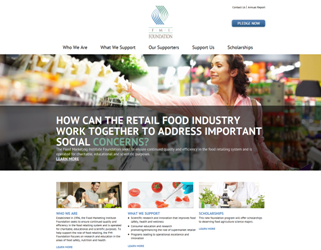
The Food Marketing Institute Foundation, the charitable arm of the Food Marketing Institute (FMI), seeks to ensure continued quality and efficiency in the food retailing system and is operated for charitable, educational and scientific purposes. The Foundation focuses on research and education in the areas of food safety, nutrition and health.
“The FMI Foundation website redesign comes at a pivotal time,” said Cathy Polley, FMI vice president of health and wellness and executive director of the Foundation. “With health, wellness and food safety continuing to be at the top of mind for today’s consumers, the Foundation wanted its site to be more consumer friendly and a destination where it could communicate its research and education programs. It also wanted to ensure that the site fell under the FMI brand.”
Matrix Group worked with FMI Foundation staff to understand the Foundation’s target audiences, messaging and brand. We then came up with a new design that showcases the work of the Foundation in a way that is consistent with the overall FMI brand, but gives the Foundation its own identity. Matrix Group also moved the Foundation site to the Sitefinity content management system, giving Foundation staff total freedom to maintain the website and keep the information fresh.
Today, the website showcases the work of the Foundation in the areas of food safety, health and wellness and the battle against childhood obesity. The website also features the Foundation’s most recent initiative, “Let’s Put Our Plates Together,” an initiative to help food retailers encourage their customers to eat together as families more often.
View the redesigned website at http://www.fmi.org/foundation.
-

What Happened to My Button? How iOS 7 Will Influence Web Design
I upgraded my iPhone to iOS 7 over the weekend and immediately realized why the Internet is buzzing about this OS upgrade. I did a webinar last week on mobile strategy and one of the attendees asked, “how will iOS 7 affect web design?” Once again, it seems Apple is leading the way and creating a new aesthetic for good mobile design.
After playing with iOS 7 for a few days, here’s what I’m realizing the following:
iOS 7 celebrates flat design. In a recent SnackOClock post, Matrix Group Creative Director Alex Pineda pronounced the death of skeumorphism. Wikipedia defines skeumorphism as “an element of design or structure that serves little or no purpose in the artifact fashioned from the new material but was essential to the object made from the original material.” Check out the new iMessage interface below. The buttons are all gone! The only things distinguishing Messages from Richard and Contact are color and position. Even Send at the bottom of the screen is just simple text! Apple is basically saying, “you know what this navigation means, we’re not going to use beveling and gradients and such to tell you that something can be clicked.”
iOS 7 is encouraging the device and the OS to get out of the way and let the content shine. For example, when I browse a website in the new Safari, back and forward buttons are gone as well. I can swipe to the left and right to visit previously accessed pages.
Mobile design trends will influence web design overall. It used to be that mobile design came after desktop and now mobile and desktop are on equal footing when it comes to designing a user experience. In some cases, I’m even recommending that clients design for mobile first so mobile will set the tone for the overall experience. However, desktop and mobile can’t be the same because think about it: on a small screen, you’ve got to be very focused with your design. On a large screen, there’s usually a lot going on so we will probably always need skeumorphic elements to create focus and paths through our websites.
The Apple Developer website says iOS 7 embodies the following principles:
Deference. The UI helps users understand and interact with the content, but never competes with it.
Clarity. Text is legible at every size, icons are precise and lucid, adornments are subtle and appropriate, and a sharpened focus on functionality motivates the design.
Depth. Visual layers and realistic motion impart vitality and heighten users’ delight and understanding.Pretty fancy language and if I just read the above, I’m not sure I would understand it. But after playing with my iPhone for a few days, I think I get it. Next stop, upgrade the family iPads (we have 3!).
-

National Electrical Contractors Association Mobile App
The National Electrical Contractors Association (NECA) is the voice of the $130 billion electrical construction industry that brings power, light, and communication technology to buildings and communities across the United States.
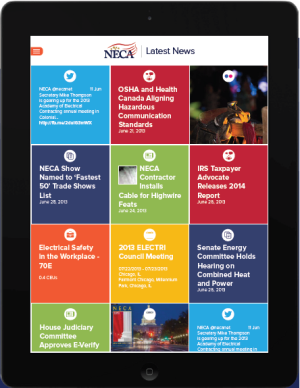
Now available for download from iTunes and the Google store, the new NECA news app aggregates feeds from the NECA main site, foundation site, magazine site, convention site, conference sites, Twitter feeds, YouTube channel, Flickr and blogs. Members can find out what’s new at NECA for the last 90 days or view articles, stories, social media updates and videos based on green construction, safety or labor relations.
The app rolled out just in time for the association’s annual convention, NECA 2013 Washington D.C., which brings together industry professionals from across the nation.
Download the news app at http://www.necanet.org/neca-news-app/
Learn more at www.necanet.org.
-
5 Top Sources for Free Stock Photos
Stock photography, when used properly, can be a real visual asset to your site. However, there is a lot of garbage to sift through to get to the good stuff and the process can be down right tedious and expensive. If you have a website or blog, there is a solid chance
you’ve run into the problem of finding quality images at an affordable price.The major problem with stock houses is that their overly posed, stiff images tend to be severely dated, but yet they still want you to pay a premium for them. That doesn’t always seem like a good deal to me, so when I have time—and a small budget—as a designer, I tend to look at these top five free stock photography sites first.
All of the images on this site are uploaded with Creative Commons licensing, and are owned by the individual users, not Wikimedia. Creative Commons licensing basically means the photographer is graciously letting you use their image for free, but be sure to read the terms, sometimes there are conditions.
2. Compfight
This site is great because it allows you to filter Flickr images though Creative Commons, making the process much easier. The images are all uploaded by real users, and therefore appear much less stocky.
3. Stock.xchng
This is a more traditional stock house, just without stock house pricing.
4. morgueFile – The word “morgue” is taken from the name of the room from the publishing world in which all clippings and image files were kept. Probably not what most people think of when they hear “morgue.”
5. Wylio
This site was set up with the blogger in mind. They make it easy to search, resize, download and imbed images into your blog all at once. 5 free images per month, with reasonably priced upgrades. You just have to grant access to your Google picasa web album.
Bonus! 6. Unsplash
This is technically a Tumblr page, not a searchable stock site. It’s full of beautiful, artistic, completely free, do whatever you want to them, images created by the people at ooomf. If you subscribe to their page, they’ll send ten new images to your inbox every ten days. And who doesn’t want eye candy sent to their inbox?
Knowing when you can and cannot legally use an image can be challenging, so make sure you read—and follow— the licensing info that accompanies the image. You don’t always have to “get what you paid for,” you just have to know where to look.
What’s your favorite free or low-cost resource for stock imagery?