Matrix Group International

Author: Joanna Pineda

  • Campbell Wealth Management Web site Redesign

    Campbell Wealth Management Web site Redesign

    Matrix Group partnered with Campbell Wealth Management a leading financial advisor firm to launch a redesigned Web site.  Matrix Group worked closely with Campbell and his team to create a Web site that strongly connected with his personal philosophy, “to build, manage and protect clients’ financial wealth through a superior level of service with one goal in mind—to enhance their quality of life.” Campbell’s philosophy and approach has been a critical component of the company’s marketing efforts, and was the basis for the Web site’s design.

    Matrix Group:

    • Included a user-friendly navigation that lets visitors know about Campbell Wealth Management’s financial services.
    • Added interactive videos that provide information on financial strategies  and best practices to building, managing and protecting financial assets.
    • Valuable tools and forms to help visitors with their financial planning, including  financial calculators to assess their current performances and outlook.
    • Incorporated information on Campbell and his team, highlighting their accolades and expertise in the financial planning sector.
    • Collaborated with Campbell Wealth to ensure that the site complied with regulatory standards.
    Visit the New Campbell Wealth Management Web site!

  • Pulmonary Hypertension Association Web site Redesign

    Pulmonary Hypertension Association Web site Redesign

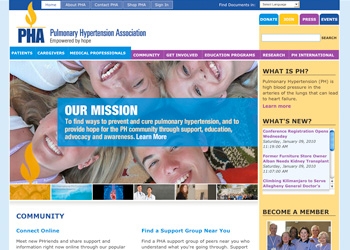
    Matrix Group partnered with the Pulmonary Hypertension Association (PHA) to launch a redesigned Web site.  The goal of the redesign was to create a Web site that conveys PHA’s mission-to find ways to prevent and cure pulmonary hypertension through community support, education, advocacy and awareness.  In addition, it was imperative that the new site design focused on effectively communicating the right information to each type of PHA’s diverse audience of medical professionals, patients and their families, volunteers and donors.

    Matrix Group:

    • Created a user-focused navigation that directs visitors to specific areas on the Web site based on their needs, motivations and online behaviors.
    • Collaborated with PHA staff on a rework of the site’s content to ensure each page’s key messages and calls to action were clearly defined.
    • Seamlessly integrated PHA’s public-site with a third party database vendor, so when the redesigned site was launched, PHA had immediate access to all of their data.

    Visit the New Pulmonary Hypertension Association Web site

  • Crowdsourced Software Development?

    Crowdsourced Software Development?

    This afternoon, the MatrixMaxx team at Matrix Group held a Town Hall meeting with clients to get feedback on about a half dozen features slated to go into the 10.1 version (scheduled for release in early February).  We could have surveyed clients via e-mail or a Web survey; we could have conducted a focus group; we could have called a select group of clients and consultants; or we could have gone with our gut and made decisions about credit card processing, meeting wait lists, individual relationships, etc.

    Instead, we decided to crowdsource the specifications.  Crowdsource?  What does this mean?  Wikipedia defines “crowdsourcing” as the “act of taking tasks traditionally performed by an employee or contractor, and outsourcing them to a group of people or community, through an “open call” to a large group of people (a crowd) and asking for contributions.”  Wikipedia also uses this definition: “the trend of leveraging the mass collaboration enabled by Web 2.0 technologies to achieve business goals.”

    In the past, Tanya (the Director of MatrixMaxx) and I would sit down, discuss requirements, maybe make a few calls, and then decide on the specifications for each release.  This time around, we decided to get immediate feedback from as big a group of clients as possible to validate our ideas and generate new ones.

    The Mechanics of the Town Hall Meeting

    • We sent an e-mail invitation to all MatrixMaxx clients, inviting them to an hour-long, online Town Hall meeting.  The e-mail provided details on the half dozen topics under consideration, with a general discussion of the options available.
    • Clients were invited to provide feedback in real-time during the meeting, before the meeting via phone and email, and after the meeting via phone and e-mail.
    • About 60% of the clients registered at least one person to the Town Hall meeting, which was conducted via conference call and Webex.
    • Tanya ran the meeting, leading the discussion and taking notes, which were shared out via Webex to all participants.

    (more…)

  • Does the Social Web Mean the End of Privacy?

    Does the Social Web Mean the End of Privacy?

    Facebook Founder Mark Zuckerberg has gotten a lot of flack lately for his pronouncement (during an interview with TechCrunch) that privacy norms have evolved over the years and privacy is essentially dead.  I watched the interview myself and think the criticism is overdone.  I think that Zuckerberg has correctly described the times and his company is taking advantage of our voyeuristic culture.  Facebook did not create this culture.  I think it started with the first reality show on MTV back in 80s. We watched the teens living together and reveled in their pranks and arguments.

    Does the social Web mean the end of privacy?  Are MySpace and Facebook to blame for all the personal revelations we spew out every day?  Or should we blame Google and Bing, which manage to index the Web and let anyone find out gobs and gobs of information about each of us?  When I Google my name (Joanna Pineda), I find lots of information that I WANT the search engines to find and index.  But I also find pages that have my address, my political contributions and address, yada, yada.  I’m not happy that Facebook changed its privacy settings and defaulted some of my information to be available to everyone, but I actually appreciate the more granular control that I now have over my posts, link and photos.

    What do you think?  Is privacy dead?  How much do you reveal on social networks?  Are you doing anything to keep out of the search engines?

  • Drive by Daniel H. Pink

    Drive by Daniel H. Pink

    Drive: The Surprising Truth About What Motivates Us – a must read for business owners and managers

  • A Look Back at 2009: My Favorite Statistics and Trends Web Sites

    A Look Back at 2009: My Favorite Statistics and Trends Web Sites

    It’s the new year and it’s customary to look at the previous year and make predictions about the upcoming year or decade.  Every day in my e-mail inbox, I get a flood of Top Ten lists.  So where do I go when I need statistics about which Web browser is winning the browser war, how many users Twitter really has, or the gadgets and technologies that will likely shine in 2010?  Here are my favorite sites:

  • Road Runners Club of America Web site Redesign with MatrixMaxx Implementation

    Road Runners Club of America Web site Redesign with MatrixMaxx Implementation

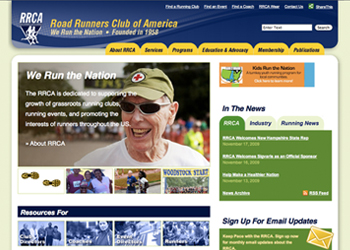
    Matrix Group partnered with Road Runners Club of America (RRCA) to launch a redesigned Web site which includes full integration with MatrixMaxx.  The goal of the redesign was to increase RRCA’s membership by appealing to a broader audience, while maintaining its brand identity.  In addition, RRCA wanted an updated member database, allowing RRCA staff to easily manage membership recruitment and renewals, update the calendar of races, and keep the directories current.

    Matrix Group:

    • Redesigned RRCA’s new site to reflect the vibrancy of the organization and running community.
    • Created user profiles that guided the design and development process with an understanding of who the visitors are, as well as their needs and motivations.
    • Developed a navigation structure and site design that highlights RRCA’s member benefits, programs, services, events and races.
    • Integrated the new Web site with association management software MatrixMaxx, making it possible for staff to manage the association’s back-office and for running clubs and members to post their events to the Web site, use the Find a Coach directory, and renew their membership.

    Visit the New Road Runners Club of America Web site

  • The New Facebook Privacy Changes: A Primer and To Do List

    The New Facebook Privacy Changes: A Primer and To Do List

    On December 9, Facebook rolled out new privacy options to its 350 million users. When I logged onto Facebook that Wednesday, I was greeted by a message that asked me to review the new privacy policy and review my privacy settings. Facebook Founder Mark Zuckerberg blogged about the new changes, which were greeted with raised voices on both sides. Here are some of the major changes:

    • You have always been able to limit what information from your profile was public and private.  But now, Facebook lets you control access to every status update, link, photo, video, etc.
    • When controlling access, you can grant access to different people or groups: Everyone (as in the world), All Friends, Friends of Friends, and specific friends or lists of friends, or deny access/hide from specific friends of lists of friends.
    • Facebook eliminated regional networks, which allowed users to unwittingly share their profiles to entire cities, states, countries, etc.

    Advocates for the new privacy changes praised the simplified settings and the increased control over every single post.  Critics, however, are livid over the fact that the default option was to make nearly everything on a person’s profile available to Everyone (that is, until users edited their settings and posts) and the fact that some information is strictly public and can’t be edited.  For example, you can no longer limit who can see your list of friends and your public profile always shows the Facebook pages that you are a fan of.  I know I was ticked off that even though I edited my privacy settings so that my photo albums are globally only available to Friends, Facebook made my existing photo albums publicly available until I edited each one manually.

    If the new privacy settings and changes confuse you, here are my recommendations:

    • Review your Privacy Settings by clicking on Settings, then Privacy Settings in the top right menu. Ignore Facebook’s Guide to Privacy and privacy recommendations and set-up your settings they way you like.  Facebook, for example, recommends that “Everyone be able to see information that will make it easier for friends to find, identify and learn about you. This includes basic information like your About Me description, Family and Relationships, Work and Education Info, and Website, as well as posts that you create, like photo albums and status updates.”  For me, this is way too much information for the public to see.
    • (more…)

  • Why Matrix Group Didn’t Send Paper Holiday Cards This Year

    Why Matrix Group Didn’t Send Paper Holiday Cards This Year

    For the past ten years, it’s been a Matrix Group tradition to send out holiday cards to clients, partners and friends and have staff sign the cards personally.  This year was different.  For the first time ever, we didn’t send out snail mail holiday cards and instead sent a holiday e-card.

    You’d think that sending out an e-mail over paper would be an easy choice.  But the holiday cards were a big deal.  Each staff member signed the cards for all the clients they supported and partners they worked with.  The new biz, net admin and administration teams signed every single card.  I am famous for signing every card and writing notes on many of them — yep, nearly 900 of them last year!  Clients and friends have told us that they love the Matrix Group holiday card precisely because they are signed by the staff who support them.

    So what happened this year that we abandoned a decade-old tradition? I was meeting with Jaime, my Director of Administration, to pick the card design and go over numbers.  It hit me that we were about to spend close to $2,500 on cards.  It seemed like a lot of money.  I also thought about how many of our charities and non-profit clients struggle to raise every dollar and consider gifts of $250, $500 or $1,000 major gifts.
    (more…)

  • Forget Blu-Ray Discs? Movies on Demand is Here

    Forget Blu-Ray Discs? Movies on Demand is Here

    Blu-Ray disc The Washington DC area is expecting a huge snowstorm this weekend but I’m not worried.  I have a fridge full of food and an endless supply of movies through my Apple TV and PS3.

    Over the past year, content on demand has matured a lot.  I can now rent and purchase movies, many of them in HD, using iTunes on my Mac, on my Apple TV, and my PS3.  The Apple and Sony networks each have a large database of movies, although the Apple inventory seems larger and the shopping and viewing experience is far superior on iTunes and the Apple TV.  Movies become available on my devices the same time they become available through Netflix and my  neighborhood Hollywood Video.

    Which makes me wonder if the Blu-Ray vs. HD battle almost missed the mark.  Blu-Ray is a storage format and scripting platform and it’s fabulous.  But when I purchase or rent an HD movie from a content on demand network, Blu-ray is irrelevant because I don’t need a storage format; I get the movie directly to my drive.

    Don’t get me wrong.  I love Blu-Ray.  My new Sony VAIO laptop plays Blu-Ray discs and I love, love, love the clarity of the audio and video, as well as all the cool extras on the discs.  So for now, I will continue to buy my favorite movies on Blu-Ray, but for the random movie rentals, I will likely go online and have my movies of choice downloaded to my Apple TV or PS3 in 20 minutes.

    How about you?  Are you buying or renting movies online?  Who is your preferred vendor?  Are you still buying movies on disc?