Matrix Group International

Tag: Marketing

  • Intentional Marketing: Who Should Attend Your Next Conference or Convention?

    Intentional Marketing: Who Should Attend Your Next Conference or Convention?

    Woman on PhoneEarlier this week, I hosted a roundtable discussion with a group of select clients to discuss the future of trade shows. Instead of sending a blast email to our entire list, my marketing team sat down with me to discuss who we wanted at the discussion. We only wanted clients that have trade shows and wanted a mix of trade associations and professional societies. We also wanted Director level or higher. We sent out the first email. We got one response.

    Rather than continue to send emails, we decided I should make phone calls to the Directors, VPs and CEOs who we most wanted at the event. I called, left messages and spoke with a few people. And then I re-sent the promo email. The response was terrific. Nearly all of the organizations we targeted sent a representative.

    When clients ask us to help them increase meeting registrations and/or exhibit sales, we ask: Who do you want at the meeting? Anyone? A specific slice of your membership? Or do you want members that meet certain criteria, like members in a specific geographic area or members at risk of canceling? And then we ask: how we can let this group of companies or individuals know that you want them at your meeting?

    No, I don’t believe sending a generic, blast email is enough. In our experience, a mix of blast emails, personal emails, phone calls, and direct mail works best.

    When Matrix Group is planning its webinar series, I sit down with my team and ask them: Which clients should attend this webinar on Sitefinity, cybersecurity, design, Twitter or x topic? If my marketing team is doing its job right, they will have a list and that list gets a personal email from me, a Director or a Project Manager, or a phone call from my Cultivation Manager, in addition to getting the blast emails. We get the best response from the personal emails and the phone calls and I bet you’re not surprised by this finding.

    The next time your organization is planning a campaign to promote a meeting, publication or show, ask your team these questions:

    • Who do want to target and why?
    • What is the best way to reach them and why?

    In the end, it’s easy to just send another set of emails to your entire list but I believe you must be intentional with your marketing to get the best results.

  • Want More Views and Clicks In Your Emails? Make Your E-Newsletters Responsive!

    Want More Views and Clicks In Your Emails? Make Your E-Newsletters Responsive!

    As marketers, we’re obsessed with metrics. And since email is a primary means of Responsive Emailcommunicating with our members, customers, prospects and partners, it only makes sense that we track open rates (the number of people who actually open and read our emails) and click rates (the number of people who click on a link). Here at Matrix Group, we’ve been working with lots of clients to make their emails responsive because in most industries, more email is read on a mobile device than on a desktop email client.

    Responsive design refers to the practice of designing and implementing a website so that it “responds” to the user’s device. Looking at a website on a wide screen over broadband? You might get a full screen, 4-column layout with high resolution images. Surfing a website on your phone? You should get a slimmed down version of the site with a single column of content, text that is large enough to read without pinching, and lower resolution images.

    But what about emails? Responsive email pretty much works the same way as responsive websites. Reading an email through Outlook on your desktop? You might see a nice layout, with 2 columns, images aligned to the right and left of content, a nice header, yada, yada. Browsing the mail on your phone? That same email gets simplified. It goes to 1 column, images are center aligned, content is shorter.

    Why bother making your emails responsive?

    • Users are more likely to delete an email they cannot read easily on their phones. Source: ExactTarget
    • There is a growing segment of the population that is mobile only, that is, they access the Web and email only through mobile devices.
    • Responsive emails are more readable on a phone. Period. End of story.

    We’re tracking the results of responsive e-newsletters for our clients and so far, the statistics are promising. Clients are increasing open rates in absolute terms by 1-4%, and clickthroughs an average of 2%. A few percentage points doesn’t sound like much but when you consider that most organizations get a 20% open rate and a 2 or 3% click rate, these numbers are significant. Consider this: one Matrix Group client saw an increase of 4% overall; since they have an email list of 100,000, an extra 4,000 people are now reading their emails!

    I think it comes down to this. Your emails are getting looked at on a phone. Your customer’s decision to open and click is influenced by many factors, including subject line, who the email is from, and whether or not the email is mobile-friendly. It only makes sense to make your emails mobile-friendly. And if in doubt, do some testing and learn more about your customers’ email preferences.


  • Answer Customer Questions On Your Website and Reap the SEO Benefits

    Answer Customer Questions On Your Website and Reap the SEO Benefits

    Content is KingA couple of months ago, I had the pleasure of attending a powerful presentation on content marketing by Marcus Sheridan, CEO of The Sales Lion. His main message: Your customers and potential customers have thousands of questions about your product and industry. Answer those questions through your website and blog!

    Here are some key takeaways from Marcus’ presentation.

    What Makes Us Fall in Love with a Website?

    • Good information
    • Easy to find information
    • Good aesthetic
    • Fresh content
    • Valuable information that saves time and money

    It’s All About the Content

    • Good content keeps visitors on your website because they are getting the information they want and need.
    • Search engines love good, fresh, authentic content. Websites that get updated encourage the search engines to keep coming back.
    • Quality content that gets clicked, shared and linked gives you better search engine rankings.
    • Gone are the days of just talking about ourselves and our companies. Prospects and clients expect and demand rich, quality content that will answer their questions. For free, of course.

    Answer the Questions People Type into Google

    According to Marcus, there is usually a set of questions prospects always ask. These questions are often about price, scope, timeline, quality, comparisons with other products, etc. So why not answer those questions on your website so that prospective customers/members/partners can be educated and the search engines can get busy referring traffic to your site? Some examples:

    • A florist might blog about what types of floral arrangements are appropriate for a wedding/funeral/baby shower/etc., how much one should expect to pay for flowers at a wedding/funeral/baby shower/etc., and how much in advance one needs to place an order.
    • A pediatric orthodontist might have content about when a child needs braces, how much it generally costs, how long treatment takes, the different types of braces, talking to your child about braces, etc.

    If You Invest in Content Marketing

    According to Marcus, investing in content marketing has these benefits:

    • Your company brand and voice will grow
    • Sales cycles will go down
    • Your prospects will solicit fewer competitive bids
    • You will have stronger relationships with clients
    • Certain individuals and talents within your staff will rise and shine
    • Your team will grow stronger through the process of developing such great content

    Marcus says “Content is the greatest sales and trust-building tool in the world. Period. End of story.” I have to agree.


  • Who Should Be In Charge Of Your Redesign Project?

    Who Should Be In Charge Of Your Redesign Project?

    So your organization has decided to redesign its website. Who should be involved? Who should be in charge? And who should make the decisions? I get these questions a lot from senior executives who want to know how to structure their web team, who should be ultimately responsible for the success of the project, and how much staff time should be allocated to the effort.

    Who Should Be Involved?

    Figure looking at org chartSince websites represent your organization online and visitors expect to interact with all departments, it makes sense that there be involvement from throughout the company. But how to achieve this without creating committee gridlock? My recommendations are:

    • Invite as many people as you can to the kickoff meeting. The kickoff tells the whole company that the project is happening, what you want to achieve, and that you need their help. If possible, the CEO or someone suitably senior should be in attendance; this will let everyone know that the project is important and they should pay attention.
    • Arrange to interview at least one person from every department, functional group or constituency. These interviews will give you valuable insight AND build support for the project.
    • Don’t involve a large group in the day to day workings of the project; this will only slow you down. Do, however, arrange for periodic reports to your larger web team. You don’t want someone, somewhere, bringing the project to a screeching halt because you “didn’t talk to them” or you didn’t keep them in the loop as you made decisions.
    • Ask for volunteer beta testers. You will likely not get a lot of volunteers but the ones who do volunteer will be motivated and proactive, so get their help!

    Who Should Be In Charge?

    This is a tricky issue. Some organization put IT in charge, while others put  Communications, Marketing, Customer Service or Membership in charge. I think it’s a mistake to put IT in charge. Yes, IT will have the most facility with the technologies, but putting IT in charge of a redesign is like putting IT in charge of your membership marketing or print materials because they involve databases and computers.

    At Matrix Group, our most successful projects have been ones where:

    • There was a trio in charge, each representing an important constituency: subject matter experts, IT and senior leadership.
    • or IT was in charge of the process but subject matter experts were heavily involved and made the final decisions.
    • and the project manager on the client side was well connected in the organization, well liked, ran a great meeting, and able to help groups achieve consensus.
    • and there was high level senior sponsorship of the project. These senior staff members kept the senior leadership team informed and paved the way for resources from throughout the organization to be made available to develop content, test the website, etc.

    Who Should Make the Decisions?

    Another tricky issue. The answer is usually “it depends on the decision to be made.” In our experience:

    • It works well to get buy-in from a larger group when discussing navigation and content elements.
    • It works well to have the larger web team review and approve the overall design direction, copy writing style and content strategy. It’s really, really important that the *entire* organization be on the same page here.
    • The CEO or Chief Marketing Officer (or equivalent) should make the decision on the design and copy writing direction. And it’s always a good idea to brief the CEO and senior leadership team at regular intervals during the project.
    • The smaller web team should make the hundreds of decisions about layout, content placement, search, etc. Getting a committee to agree on these minute details will make the site build process torture.
    • Give each department the final say on their portion of the website, as long as their changes fall within the overall design parameters of the project. Which  means GR or Convention can’t decide to use a different font or color palette.

    How about you? Who do YOU think should be in charge? What has worked for your organization?


  • How Can Your Organization Use Crowdsourcing To Increase Member and Customer Benefits?

    How Can Your Organization Use Crowdsourcing To Increase Member and Customer Benefits?

    lego-minecraftMy family went to New York for Spring Break. During the obligatory visit to the flagship FAO Schwarz store, my husband caved and bought our 8-year old a LEGO Minecraft kit. Don’t know about Minecraft? As far as I can tell, Minecraft is THE hot game for boys, who play it on computers, tablets and phones, basically any device they can get their hands on. Minecraft is a game that allows players to build anything out of blocks (buildings, lakes, plants, etc.). At night, the zombies come out so your house or castle better be safe. Anyway, back to my story. We shelled out $44 for a LEGO Minecraft that wasn’t designed by LEGO.

    For the past few years, LEGO has been accepting models from amateurs through their Cuusoo crowdsourcing platform. The model is simple enough: anyone can build and share a model. If your model gets 10,000 supporters, LEGO HQ reviews it and decides if it should become an official product. If your model goes into production, you get 1% of total net sales. Is that crazy or what? LEGO has managed to tap into the creative consciousness of its loyal fan base, who will undoubtedly bring their knowledge and interests to LEGO, at nearly zero cost to LEGO. Think of the buzz that a new kit has already generated by the time it reaches 10,000 supporters. That’s 10,000 nearly guaranteed sales! More craziness: my 8-year old has already brought his Minecraft kit to school for show and tell and he’s made a YouTube video that will join the thousands of other YouTube videos on Minecraft.

    The question is, how can non-manufacturers use crowdsourcing to generate new product ideas, generate customer and member love, and increase revenues? Here are some ideas:

    • Many professional societies accepts submissions to speak at a conference. These submissions get reviewed and voted on by an elite panel of members. What if the society blew open the submission process and let the entire membership vote? The top submissions would then get to speak at the conference.
    • How about a soliciting ideas for publications and research to be funded by your Foundation? And then let the membership vote and you fund the top vote getters.
    • Want to connect with your members? Ask them what topics they’d like your CEO to address during a live chat or in blog posts, then get the membership to vote on the topics. Your CEO would then address the top topics during a meeting, call or in blog posts.
    • Thinking about staff retention? Ask your staff for their best non-financial benefits and rewards and then get the entire staff to vote.

    It’s easy to associate crowdsourcing with websites like KickStarter, where entrepreneurs submit their ideas and people support the ideas with their money. But I think crowdsourcing can be a powerful engagement tool for organizations of all sizes, in all industries.


  • How To Get Your Brand Pages Ready for the New Facebook News Feed

    Facebook logoEarlier this month, Facebook announced that users’ home page will soon be transformed into a revamped newsfeed. If you’re the administrator for a brand page, here are some things you should know about the new News Feed.

    Facebook Will Let Users Choose the Feeds They Want To See. Today, Facebook tries to guess what posts, images and links will most interest you. It’s called EdgeRank and it’s based on a complex algorithm that’s based on four factors: whether you’ve interacted with a friend or brand before (including frequency), other people’s reactions to a post (i.e., if lots of your friends are commenting on a post, chances are you’ll see that post in your feed), your interactions with posts of that type in the past (i.e., if you seem to like photos, you’ll see more photos), and whether or not a post has received complaints. With the new News Feed, Facebook will let you choose the feeds you want to see: Friends, Photos, Music, Following, Games, etc. So is EdgeRank dead? At least a few Facebook experts think so.

    Images and Video Will Rule. The Facebook News Feed will be all about photos and videos. Newsfeed will be bursting with large images and videos, including videos from third party sites. As I’ve noted above, Facebook will let users view just photos from friends and pages they like. So what happens if your organization tends to post Facebook updates with no images? Your updates will probably be largely ignored. Bottom line: think big, bold images because they will dominate the News Feed.

    Third Party Content Regains Status. If you’ve got great content on a blog, community site, YouTube, Pinterest or Instagram, for example, Facebook will let you feature those links and posts prominently, especially if they have nice images.

    How to get ready for Newsfeed?

    • Read more about the new Facebook News Feed
    • Join the waiting list so you’ll be one of the first to get Newsfeed. Go here and scroll to the bottom of the page.
    • Have a photo strategy for your website and your Facebook posts.

    Are you ready for the new News Feed? It’s coming and you want to be sure that your followers continue to WANT to read your posts and allow your posts to be featured in their feeds.


  • Why Rebranding Is Really Hard and Takes a Really Long Time

    Why Rebranding Is Really Hard and Takes a Really Long Time

    new-brandA couple of days ago, a Matrix Group client, a major trade association was quoted in a a major news story. The news organization quoted a statistic that the association promotes through its website, about the benefits of working with its members. The trouble was this: the name of the organization was wrong in the news story. You see, the organization had rebranded with a new name five years ago, but the news story still used the old name. This, despite a major effort to educate the industry, the press, trade publications, yada, yada. Ugh.

    For many years, I chaired a benefit auction for a local non-profit. The benefit was successful and well-known but one year, we were close to panic when ticket sales were much lower than anticipated. We quickly organized a phone campaign and found out something startling: many longtime benefit attendees did not recognize the name of the organization on the envelope. You see, the organization had rebranded with a new name three years earlier and we figured it was time to use the new name (on its own, without the “formerly” name) on the return address. Guess we were wrong.

    These stories point to the difficulties and challenges associated with rebranding campaigns, especially campaigns that involve a name change. Most organizations do a fine job communicating the changes via their websites, letters, postcards, emails, email signatures, voice on hold messages, advertisements in trade publications, and on and on. Trouble is, people aren’t necessarily paying attention. The letter, ad or postcard doesn’t register until your customer, partners and prospects decide they want to interact with your organization, on their terms, on their timeline.

    So what are the lessons here?

    • Know that rebranding is a long-term effort, it’s going to require constant and intense communications, and some people are still going to miss the message.
    • Use every communications vehicle possible to communicate the changes: website, email, letter, postcard, magazine article, magazine ad, banner ads, voice on hold message, email signature, video, news stories, etc.
    • Renew the old domain name and point it to the new site for as long as you can bear.
    • Make sure there are plenty of references to the old name on your website so that search engines will associate your new name with the old one.
    • Keep reminding your audiences of the reasons for the rebranding and reinforce the new name and images.

    How about you? Has your organization rebranded? What communications challenges did you face and how did you overcome them?

  • Is Blogging Passe?

    During the Fall and Winter, I meet with many clients to help them formulate their web plans and budgets for the following year. During many of these meetings, I suggested to clients that they consider a leadership blog to raise awareness of their industry’s issues, make leadership more accessible and approachable, and showcase their thought leadership. Surprisingly, a couple of clients recently remarked, “Blogging, isn’t that passe?”

    My initial reaction was “no way!,” but since several clients had made the comment, I decided it was worth doing more research.

    If you google “is blogging passe,” you’ll get nearly 150,000 results, many of them with the exact title of “is blogging passe?” Some of these articles and posts go back as early as 2008. The general thinking goes like this: with the rise in popularity of Facebook and microbloggins platforms like Twitter, putting up and managing a corporate blog is passe. Put another way, since it’s much easier to create short-form content on social networks, long-form content creation (blogging) is dead.

    So is blogging passe? Here’s why I think blogging is not dead. In fact, I think niche blogging with high quality content is more important than ever.

    Casual bloggers have migrated to social networks, leaving the blogosphere to more committed bloggers intent on developing and sharing quality content. When blogging first appeared on the web scene, everyone started blogging. People blogged about their pets, they posted photos, they shared links. This type of casual blogging is now found mainly on Facebook, Instagram, Reddit, Twitter, etc.

    Blogs by experts and thought leaders continue to be very popular. We’re actually seeing that people prefer corporate, association and non-profit blogs to corporate, association and non-profit websites because of the perspective and the voice that come from blogs. Blogs simply feel and sound more human than corporate websites, which is why they often get more traffic than corporate websites. Webbiquity says corporate blogging is more important than ever.

    Producing unique, original and useful content is the only way these days to approach the myriad changes in the search algorithms being put in place by Google and Bing. In other words, the search engines like blogs because they tend to have unique and original content that searchers are looking for.

    Google is about to roll out Author Rank. With Author Rank, Google wants to make it easier for users to find the work of specific writers, and leverage its ability to use authors as an element for ranking pages and sites. Author Rank means you have a blog, you connect it to your Google+ account, you get verified, and your blog content contributes to page rank, which directly affects where your site shows up in Google search results.

    Blogs continue to be a great way to educate your members and customers. I tell clients that blogging requires a greater commitment than Twitter or Facebook, but it provides more benefits. If your organization is not yet blogging, I hope you’ll ignore the hype and consider a timely, niche blog that speaks directly to your target audiences


  • Are the App Stores Devaluing Your Organization’s Products?

    Are the App Stores Devaluing Your Organization’s Products?

    Image of the App Store Icon My favorite handwriting curriculum company (Handwriting Without Tears) just released an app through the iTunes store. It’s called Wet Dry Try and it helps kids practice writing their upper case letters and numbers. The app is great. It responds nicely, it’s got a nice reward system and it teaches really great habits. The app costs $4.99.

    What I find interesting are some of the comments about how expensive the app is. One person said $4.99 was really expensive and he wished the app did more. In my mind, the app is a bargain. I paid $4.99 for a Blue’s Clues book that my 2 year old and I will read a dozen times (okay, maybe more, he loves Blue’s Clues). I paid $15 for a workbook we’ll use for a couple of weeks. My lunch today was nearly $6! We’ll use this handwriting app for months and if it teaches my little one good writing habits, it will be worth 100 times the $4.99 I paid!

    So I got to thinking. Most of the apps I see in the app store are free, $.99 or $1.99. So by comparison, the WetDryTry app at $4.99 seems expensive.

    But if I were to sell a book or software program at a brick and mortar bookstore or even Amazon.com, $4.99 would seem like nothing.

    So it’s all about context and comparison. This is what worries me about the app stores. When so many items are priced at $.99, how can my association clients possibly release publications and services at prices close to what they would charge in their normal stores?  Consider this: Keynote, Apple’s presentation software that competes with PowerPoint, is about $100 for the desktop version and $9.99 for the iPad version. Sure, the products do different things and I can’t do everything on the iPad version that I can in the desktop version. But the iPad version is feature-rich and amazing. Is Apple just trying to give Keynote away or are they making money on volume?

    I’ve decided that most organizations are much better off with a free or promotional strategy.

    •  Organization should opt for “free” appss that promote or showcase the organization, the membership and the industry. Examples might include a Find a Member app, a Code of Ethics app, or an industry news app.
    • Organizations should create apps that complement an existing product or service. For example, an association might create an app for their annual conference that complements the live experience of attending the meeting.
    • Companies that sell products or services can use an app to promote their offerings. For example, a kitchen and bath remodeler could create an app that shows what’s possible with tiles, counters, backsplashes, etc.
    • In the case of a company like Handwriting Without Tears, an app can introduce the company to a larger consumer audience and hopefully encourage more sales of its teaching and practice materials. For example, even though I think it’s cool that my child can “write” on a tablet, I still want to be sure he can actually write on a piece of paper.

    What about organizations that want to sell their publications through an app store? Today, I think they are better off selling an epub version through Amazon, or direct through their own stores.

    Are the app stores devaluing products and services? I think the jury is still out but I recommend that organizations think twice before putting their core products and services into apps that could lower their perceived value or lower perceived customer/membership value. What do YOU think?

  • Why Matrix Group Brought Back Its Email Newsletter

    Why Matrix Group Brought Back Its Email Newsletter

    A few years ago, Matrix Group stopped sending out a weekly email newsletter.Why? We were launching a company blog, we were getting more active on Twitter and Facebook, and other organizations were dropping their email newsletters. The marketing staff was spread thin, so killing the Matrix Missive seemed like the right thing to do. We didn’t abandon email; we still send emails about events and service announcements, we just didn’t have a marketing newsletter.

    Several months ago, we revived the Matrix Missive and just today, launched a new newsletter for our Association Management Software product, MatrixMaxx. Why?

    Our target audiences aren’t all on Facebook (shocking, I know.) After years of trying to get all of our clients and prospects to subscribe to the blog and follow us on social media, we’ve decided it’s just not going to happen. The disintermediation that the media keeps talking about is true. Even though we only have several thousand people in our database, they are all over the map in terms of web use, social media and blogging. Our CEO contacts are decidedly NOT on Twitter and Facebook.

    Social media isn’t great for direct marketing and selling. All the research shows that companies and brands that do nothing but sell on social media don’t get the follows they want. So on Twitter, Facebook, YouTube and even this blog, we try to provide really great, information-rich content. It’s great for thought leadership but not so terrific for direct marketing. Sometimes we really need to promote our design, development and mobile app expertise.

    Some topics are great in email, utterly boring in social media. On a regular basis, we need to tell clients about upcoming maintenance, new versions of CMS (content management system) software they’re using, upcoming CMS and AMS training, yada, yada. On our social media pages, this stuff is just boring, not at all interesting to a general audience. But to our clients, who need to know when we’re upgrading their systems and what’s in the latest release of the Sitefinity CMS, these communications are vital. Email is just better for certain types of messages.

    Our best response rate comes from email. Every organization is different but when we’re promoting our events and services, email just works best. For example, we offer a Spring and Fall webinar series on a variety of web topics. We promote these webinars through email to our house list, social media, and discussion lists around town. Hands down, most attendees come from our house email list.

    No matter what the platform, the challenge is getting views and clicks. Okay, so we’re back to sending out a regular email newsletter. We get pretty good open and clickthrough rates but as with social media, it’s all about generating good content that people want to read, good writing and a hot subject line.

    So here’s the challenge. How do we create something new and different with our emails that clients, prospects and partners will want to subscribe (and stay subscribed) to our emails and still subscribe to our blogs, follow us on Twitter, Facebook and YouTube, and view our photos on Flickr?

    I’ve blogged before about how we strive for a layered approach with our marketing efforts. We don’t simply post the same content across all channels. Rather, we strive for a layered messaging strategy that utilizes the capabilities of each platform and features different perspectives and voices will help us connect with clients and prospects better. With the relaunch of the Matrix Missive and the new MatrixMaxx newsletter, we’ve brought email back to the mix so that we can talk about projects, promote our events, comment on webtrends and share some fun websites.

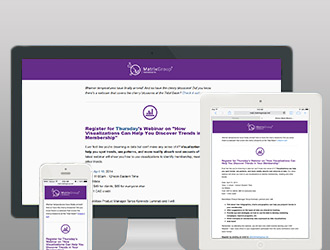
    BTW, here’s a sample of the new and improved Matrix Missive. I hope you’ll even consider subscribing!

    How about you? Do you still have an email newsletter? How is the content in your email newsletters different from your website and social media pages? How are you juggling the mix of platforms? What’s working?