
Matrix Group International

Tag: Marketing

  • Are You Suffering From Social Media Fatigue?

    Are You Suffering From Social Media Fatigue?

    Tired Woman Asleep In Front of Her KeyboardA friend asked me recently if I’m on Pinterest, the hot, new social network where users “pin” products, places and articles they like to Pinterest and explore the feeds from their friends. Confession: I’m on Pinterest and I have pinned exactly one thing as of this evening: a beautiful photo of Angkor War in Cambodia.

    BTW, I’m not on Banjo, Path, Glancee or Instagram. I’ve abandoned Amplify (which I just learned tonight is shutting down), Bebo and FoodBuzz.

    Yeah, I know, I blog about social media. I’m supposed to try out everything new, but the truth is, I’m suffering from a bit of social media fatigue. I tweet every day (most days anyway), I do a weekly YouTube interview, I blog for Matrix Group once a week, I blog occasionally as a mom, I post to Facebook personally and for Matrix Group, I try to post to my Google+ page, and I write for several other blogs. Today, there simply isn’t room in my schedule for another nifty site.

    I’m not alone. A recent study by JWT Singapore  found that “50% of young adults find it too time consuming to keep up with all their social media commitments.”

    And yet, 94% of marketers say they use Facebook in their marketing efforts, 74% use Twitter, 41% use blogs and 30% use YouTube.

    It’s clear that social media across a multitude of platforms is here to stay. So how do we, as marketers, prevent social media burnout? Here are some suggestions:

    • Create an editorial calendar that details the topics and themes you want to post about. This prevents a lot of wasted time worrying about what to blog or post about.
    • Develop a reasonable schedule. If you are on social media sites for business, it’s okay to NOT post on the weekends. And if you can’t tweet 10 times a day or update Facebook every day, scale back to a schedule you can manage and stick to.
    • Test out new platforms one at a time, at your own pace. Even though new platforms are coming online every day, you don’t need to be on every single one, unless you have the time and inclination. I like to try something new every few months; it takes that long to figure out how it works, what it’s good for, and if it will work for us or our clients.
    • Abandon platforms that aren’t working. For example, just because 200M people and businesses are tweeting doesn’t mean that you should be, too. If Twitter isn’t meeting your business needs, you’re not getting enough return, or you haven’t figured out how it can be useful in your marketing toolbox, stop using it for a while and evaluate whether your time could be better spent on another platform.
    • You don’t need to be on social media, all the time. I used to beat myself up when I missed tweeting for a day or two. Today, I realize that’s just part of the ebb and flow of my day and frankly, I don’t think my followers notice if I miss tweeting every once in a while. If I stop tweeting altogether, that’s a different story.

    How about you? Are you suffering from social media fatigue? What are you doing to combat it?


  • The Facebook Timeline is Coming on March 30 – Is Your Organization Ready?

    The Facebook Timeline is Coming on March 30 – Is Your Organization Ready?

    The much awaited Facebook timeline for brands is coming. On March 30, whether you like it or not, your organization’s Facebook page will convert to the new timeline format. Here’s what’s new:

    • It’s All About the Timeline. Facebook says the big, huge deal is the timeline. Facebook will automatically show a timeline on the right side of your page that shows previous months and years. Your fans will be able to click on a month or year and see updates and posts from that time period. Here’s the HUGE DEAL: you can customize the timeline to show events in your organization’s history pre-Facebook. For example, the New York Times’ timeline goes all the way to the 1800s!
    • Brand Image. Your new brand page will have a large cover photo at the top of the page. Instead of a tiny logo and a few photos, your brand page can and will feature a large branding image that you can design yourself. Coca-Cola’s brand image has images from their current advertising campaign, showing happy people of course.
    • Posts and Conversations. The rest of the page is divided into 2 columns to represent the passage of time AND separate your posts from conversations and messages. In the right column, you’ll see messages to your company, posts about you, etc.
    • No More Left Navigation. Many brand pages had multiple tabs along the left rail for their various apps like photos, videos, donation, yada, yada. In the new timeline page, your top 4 tabs will be visible; visitors will have to click to see all of your apps.
    • Messages Between Brands and Users. Finally! Brands and their fans can now have private conversations!
    • Featured Content. The old Facebook pages displayed all posts equally – you had an image, a title and a blurb. The new timeline page lets you feature content at the top of the page. Featured content is bigger and takes up 2 columns for added impact.

    Screen shot of the new Matrix Group  Facebook Timeline Page

    So how can you prepare for the new Facebook timeline? Here are our recommendations:

    • Preview your new Facebook page NOW. Don’t wait until March 29 to figure out what your new page will look like. Start looking at it now and making adjustments.
    • Create a cover photo that communicates your brand.  Use the period between now and March 30 to create the image and test it. You may need to make some adjustments. You can test how your cover photo looks by clicking the preview tab at the top of your page. BTW, only admins can see the preview.
    • Review your Facebook strategy. What kinds of posts will you feature? Which apps will be prominent? How will you communicate with your fans?
    • Start featuring posts. Highlight recent posts by hovering over the right hand corner of the post and clicking on the star. You can also remove it by clicking on the star.  If you want to promote a past post, you can actually move it up by hovering on the right hand corner of the post, clicking on the pencil tab in and selecting pin to top.
    • Check your insights page regularly. As a marketer, the Facebook insights leave me wanting for more, but there is more and better data now available, including who recently “liked” the page and recent comments.

    Are you ready for the new Facebook timeline pages? What’s your strategy for taking advantage of the new format and features?

  • Making Our Webinars More Social

    Matrix Group hosts two webinar series each year, one in the Spring and one in the Fall. Topics for this season’s series are Google Analytics, Integrating your CMS with your AMS (association management system), Advanced Twitter and Creating Content-Rich Mash-up Pages. Here’s the issue: although our webinars are pretty well attended and clients tell us that they love them, we weren’t getting many questions during the webinars nor were we getting many responses to the survey that we sent out after each webinar.

    So I challenged my marketing team to come with ways to make the webinars more interactive, more social. Here are some of the ideas that we recently tested during our most recent webinar on Google Analytics (GA):

    • A couple of days before the webinar, we sent out a survey to find out why people registered for this specific webinar and get questions in advance. Half of the attendees filled out the survey. We got great information that we used to customize the webinar.
    • Instead of the usual powerpoint presentation, we decided to use a case study/Q&A format. We compiled a list of most frequently asked questions about GA from the survey and from our recent calls and meetings with clients. The webinar became a conversation between me and my co-presenter, Eric Fair, the resident GA guru at Matrix Group. Instead of talking about what you can do with GA, Eric did a deep dive into the Matrix Group GA reports and showed attendees exactly how we are using campaigns, creating customized dashboards, driving traffic to our site through search and our blogs, yada, yada.
    • During the webinar, a marketing staff person was assigned to monitor the Webex chat and be on the lookout for questions. As a presenter, it’s too confusing to present, run the slides and monitor for questions, so it was helpful to have someone else monitoring the chat window. We got more questions during this webinar and I think the Q&A format made the difference.
    • At the end of the webinar, we announced that Eric Fair would take follow-up questions about GA on our Facebook page. This way, attendees who have a question after the webinar still get a chance to ask it AND we get more interactions on our Facebook page.

    These were small changes but I believe they made our webinar more engaging for attendees.

    How about you? What are you doing to make your events more social? What’s working?

  • I’m Losing the Good War Against Spam and the Fight for a Manageable Email Inbox

    I’m Losing the Good War Against Spam and the Fight for a Manageable Email Inbox

    Woman sitting in front of laptop, looking stressed and overwhelmedLate last year, I received an e-mail from my son’s school, letting me know that enrollment forms for next school year were going to be done electronically from now on and that I should be on the lookout for the e-mail with the information and link. Okay, I bet you know where this is going. I remember getting the e-mail in January that included the details, the URL and the deadline but since I’m accustomed to work things being electronic and school stuff being mostly offline, I just could not make the mental shift.

    Next thing I know, the Director of Admissions is calling to let me know that the deadline has passed and were we still interested in sending our child to their school. Egads. Imagine my horror when I realized that I had missed the deadline.

    The cold, hard truth is that I’m losing the war against spam and my email inbox is beyond out of control. I get hundreds of spam emails a day, not counting the hundreds more that the spam filter catches. In addition, I get lots of email newsletters, I’m cc’d on some client communications, and unlike client work that goes through our extranet, new biz follow-up is largely via email.

    I try to skim my emails every few hours, I beg the IT staff for more spam filtering, I diligently mark true spam as junk, I unsubscribe from what look to be legitimate newsletters that have added me to their lists, and I have a zillion email folders. Most importantly, as I scan/read my email, I try to handle each item just once by deleting unwanted stuff, responding instantly when I can, and filing other emails into To Do or To Read folders. All of this is still not working. I’m going to admit to the world that I have hundreds of unread emails.

    The spam is the worst. We have an aggressive anti-spam software the the net admins are constantly tweaking. A few months ago, we tried to get more aggressive against spam by blocking email from email servers that were on legitimate blacklists, didn’t have proper DNS records (like SPF records and reverse DNS looksups), and/or sent emails with improper headers. This helped a lot but then we started blocking email from clients! Lots of them! It seems that setting up email according to the latest protocols is not yet widespread, so after some internal soul-searching, we loosened our email requirements and that allowed a whole lot more spam to get through. <sigh>

    If I’m overwhelmed by email, I bet most other people are. So what does that mean for email communications, email marketing and personal productivity? My friend Ken Chaletzky, who runs Copy General, a digital printing company, says his company is seeing a surge in companies combining both print AND email marketing for higher conversions.I guess I’m not surprised.

    Email is not going away and dollar for dollar, it’s still an amazingly effective and low cost marketing and communications tool. Every week, Matrix Group shows clients how to write effective emails, designs email templates and sets up discussion or broadcast lists. If we could just figure out how to minimize the spam, life would be grand.

    So what happened to my son’s enrollment forms? The school wisely figured there would be a lot of stragglers so I was able to file the forms two weeks late and still get my son registered for next year. Phew. Thank goodness for the high touch phone call from the Director of Admissions!

    How about you? Are you winning or losing the war against spam? What are YOU doing to better manage your inbox?

  • The Personalized, Social Web or Why Your Organization Needs a Social Sharing Strategy

    The Personalized, Social Web or Why Your Organization Needs a Social Sharing Strategy

    SEO (search engine optimization) changed forever when Google integrated Google+ into its Google search results a few weeks ago. Basically, Google is now personalizing (to a much greater degree than before) its search results, based on the links and +1 recommendations of people in your Google+ network. Check out the example below.

    I did a search for Don Cornelius, creator of Soul Train, on Google. At the top of the search results, there’s a note that tells me here are 20 personal results, or 20 links or posts that mention Don Cornelius by people in my Google+ circles.

    If I click on personal results, I see the full search results list, but with the personal links at the top of the list. Holy smokes! That means that the Washington Post article on Don Cornelius, which was previously at the top of the page, just got overtaken by a link on nerdist.com because someone I follow and interact with a lot posted that link on his Google+ page!

    This is just another example of how Google is heavily favoring its Google+ social network and another giant reason to:

    • Create a Google+ page
    • Encourage social sharing of your content across all social media platforms (e.g., Facebook, Twitter, Google+), but especially Google+

    A study by Nielsen back in 2009 found that 90% of people 25,000 people surveyed “trust recommendations from people they know, while 70 percent trusted consumer opinions posted online.” This makes intuitive sense. Think of all the people in your Facebook network who ask for recommendations for a contractor, camera or pediatrician. And consider the crazy, huge influence of mommy and wedding bloggers.

    So, what’s your social sharing strategy? It could be as simple as making sure there is a Share This link on all of your articles, meetings and products. Or you could actively ask your customers and members to recommend your products and service to their networks in your e-mails, tweets, and e-newsletters.


  • How a Nation Got Educated About SOPA and PIPA

    How a Nation Got Educated About SOPA and PIPA

    The PROTECT IP Act (Preventing Real Online Threats to Economic Creativity and Theft of Intellectual Property Act of 2011 or PIPA), which was introduced by Senator (D-VT)  on May 12, 2011, aims to give the US government and copyright holders additional tools to curb access to “rogue websites dedicated to infringing or counterfeit goods”, especially those registered outside the U.S. On the House side, the Stop Online Piracy Act (SOPA) was introduced by Rep. Lamar S. Smith (R-TX) on October 26, 2011. The bills had bipartisan support and were expected to sail through Congress.  But today, passage of the bills are is looking more and more unlikely as SOPA and PIPA opponents’ voices grow louder and members of Congress are flooded with calls and e-mails about the bill.

    Unless you live under a rock, you’ve no doubt read about, heard about and discussed the SOPA blackout that’s happening all over the Web. Web giant Wikipedia has gone dark to protest SOPA and PIPA, while others like Craigslist, Google, Wired, WordPress and dozens of other sites have put prominent messaging and graphics that clearly show opposition to the proposed legislation. Wired and WordPress show large portions of their home pages blacked out as if they have been censored.

    Wow. Let’s just stop and consider the reach of these Web site giants.

    Google is ranked by Alexa as the number 1 site in the US and is visited by half of ALL global Internet users daily. So at least half of us today got messaging from Google about SOPA and PIPA. If you use the search tool embedded in your browser, you missed the black censor bar over the Google logo and the simple plea to: Tell Congress: Please don’t censor the web!, but the Google logo is still blacked out in the top left corner of all pages.

    If you ignored Google’s censor logo and call to action, you probably did a search on Google and found a link to Wikipedia, which was blacked out for the day (just the English version). Alexa says Wikipedia is the 6th most popular site on the Web, so millions of us didn’t get to use Wikipedia to look up names, places and things.

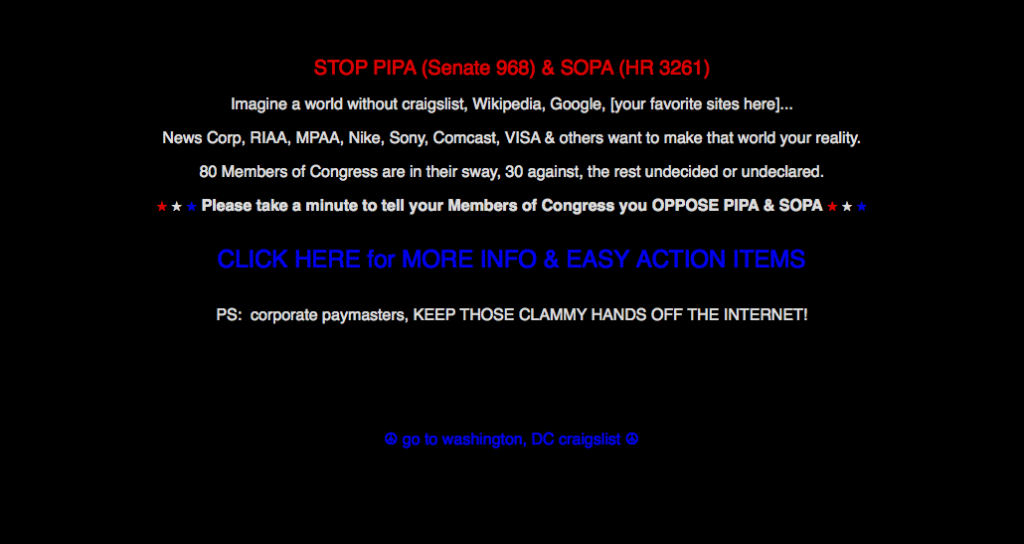
    If you were looking for a job, car or apartment today, you probably went to Craigslist, the 9th most popular site in the US. Although Craigslist did not go completely dark, an intro page urges everyone to oppose SOPA and PIPA.

    And oh yeah, even though Facebook and Twitter didn’t join the dozens of sites that participated in the SOPA blackout, the conversations on these sites were dominated by SOPA and PIPA.

    And then of course, there was the overwhelming coverage about the SOPA blackout by mainstream press, alternative press and bloggers.

    All of this means that today, January 18, I would bet that the vast majority of American got some kind of exposure to SOPA and PIPA, most of it negative. And if just a fraction of the millions of Google, Wikipedia, Craigslist, Reddit, Wired, WordPress (and on and on) users took action and contacted their representatives and Senators, today was a very busy day on Capitol Hill.

    That’s one heck of a grassroots movement. How about you? How many sites did you visit that had some mention or call to action re: SOPA and PIPA? Did you contact your representative in Congress?


  • Does Your Organization Have a Social Sharing Strategy?

    According to a study by ShareThis, the social sharing widget that you see on many websites, Facebook accounts for 38% of sharing traffic on the web. And that’s just the percent of people who click through. If you add links shared but not clicked, the number goes up to a whopping 56%. Which means that if we (the collective “we” since there are over 700 million of us now on Facebook) want to share a link with the world, we do it through Facebook.

    This totally makes sense to me. When I find something new, cool, interesting, amazing or whatever, I immediately post it to Facebook and Twitter (increasingly, Google + as well, but more on that in a future blog post).  And I rely on my network of friends, co-workers, clients and business colleagues to find out about other new, cool, interesting and amazing things.

    So I got to thinking. If social sharing is an important means by which we (again, the collective “we”) learn about new sites, we can’t and shouldn’t leave this sharing to chance. Sure, most websites now have a ShareThis widget, but is this enough? I say no. I think every organization needs a social sharing strategy that includes the following:

    • What you want people to share. Do you want visitors to share your home page? Individual articles? Donation pages?
    • How you want people to share. Do you want visitors to send an e-mail, post to their social networks, save to their social bookmarking pages, all of the above?
    • Regular review of analytics to find out what and how people are sharing links on your site. Be sure to review your usage reports, ShareThis account and other reports to find out what’s popular, how people are sharing, and learn why certaini articles or posts generate activity.
    • Design and CSS guidelines that make your site shareable. For example, if you share a link on Facebook, Facebook automatically indexes the images and allows you to cycle through the images and select one to include with the link. If your organization logo is set up as a background image in your CSS or the logo is not whole, your logo can’t be included in the link.
    • Calls to action to encourage sharing. While many of us will share our favorite links on our own, other won’t unless prompted, so I think it’s important to have calls to action to encourage sharing. It’s also a good idea to test calls to action on a regular basis to find out which calls to action work best.

    The design and front-end team at Matrix Group has developed a set of guidelines for setting up web pages so that titles are complete and the proper images are included in links. Be sure to test the shareability of your site on a regular basis and address issues with your web design or maintenance team.

    How about you?  What’s your platform of choice for sharing links?

  • Your Organization’s Voice Should Be Different Across Platforms

    If you’ve attended any of my webinars or follow this blog, you know that I advocate strongly against posting the same updates and information across different communications channels. I think it’s a waste when organizations simply post their press release headlines to their Facebook or Twitter pages. But Joanna, you say, “what if I want to educate my members and the public about one, burning issue or I want to promote a new event or publication? What if I WANT to talk about one thing across, print, online and social media for a while?”

    My answer is this: post about that one topic but change the perspective, voice and interactions depending on the platform.

    Say your organization is pushing for a piece of legislation on Capitol Hill. You could issue a policy statement and repeat that statement across all platforms. A more effective strategy would be to:

    • Post the policy statement on the website. This policy statement will likely have a formal tone and reflect the position of the entire organization.
    • Write a press release on the policy statement and send it to your media list. This, too, will have a more formal tone.
    • Post links to the policy statement on Twitter, but with differing headlines, highlighting different aspects of your policy. You could also post third party stories, facts and figures that support your position; in this instance, you would be curating relevant content to bolster your position.
    • Feature interviews with members and customers talking about why they support (or oppose) the proposed legislation on YouTube and your blog. These interviews will feature member perspective in their own voices.
    • Have the CEO write a blog post about why the issue is important to the industry and members. The tone of the blog post should be conversational and personal.

    If you are promoting a new publication or report, you could:

    • Feature the publication in your online store and what’s new section of your website. These descriptions should be compelling but more formal.
    • Post an audio excerpt on your YouTube channel and iTunes. The excerpt could be done by the author.
    • Post key findings and highlights to Twitter. The most effective tweets are thought-provoking and compelling.
    • Feature the publication on Facebook and sponsor a discussion with the author for a 7-day period. A discussion will allow a dialogue about the issue and foster a different kind of member interaction.

    Finally, if you are marketing a convention or event, you could:

    • Mail a 4-color brochure with full meeting information.
    • Mail and e-mail postcards (e-cards) that showcase the different benefits of attending the event. The tone of these pieces should be urgent and compelling.
    • Tweet conference news (number of exhibitors, confirmation of keynote speakers, etc.) and third party news that highlight the importance of the issues to be covered at the event
    • You could test different calls to action in e-mails and posts. Some calls to action could focus on benefits, some could inspire fear, while others could discuss opportunities.
    • Feature YouTube interviews or presentation highlights from the featured speakers.
    • Offer a hosted discussion with the speakers for a 7-day period on Facebook.

    Our jobs as marketers are so much harder because we are marketing to multiple generations, there is no one platform that allows us to reach all audiences, and people are motivated by different things. Having a layered messaging strategy that utilizes the capabilities of each platform and features different perspectives and voices will help you reach and connect with your audiences better.

    How about you? How are you marketing your products and services? And how does your message or approach change with each platform? What’s working?

  • The Matrix Minute is Born!

    The Matrix Minute is Born!

    Even though Matrix Group has had a YouTube account for years now, we weren’t doing much with it. Well this past week, we finally, fully integrated this platform into our overall marketing and social media strategy by launching a new series called The Matrix Minute.

    Why so late to the YouTube game? As I’ve explained before in previous blog posts and webinars, I believe that it’s important to create a layered experience across different media. In other words, don’t just post the same stuff to Facebook, Twitter, your website, YouTube, your blog, etc. Have an overall strategy, but take advantage of each site’s capabilities and culture to maximize followers across all platforms.

    Until recently, we didn’t have a clear idea of how we wanted to incorporate YouTube into our marketing, sales and client engagement strategy. We had videos from Matrix Group staff events, but we had reserved our Facebook page for information and posts about the project we’re working on and corporate culture. I didn’t want to use YouTube as another place to promote corporate culture. And until we hired a new Marketing Coordinator, we didn’t have the bandwidth to staff an active YouTube channel properly.

    But this past week, we launched The Matrix Minute, which is a series of interviews with in-house and outside experts who discuss web technologies, mobile technologies, social media, design and web development. Occasionally, we’ll feature local CEOs who will talk about leadership and what their organizations are doing to stay relevant and vibrant.

    Here’s how the Matrix Minute fits into our overall sales and marketing strategy:

    • As a company, we’re extremely committed to ongoing education for staff and clients so content-rich interviews make sense for us.
    • It’s a way to showcase the expertise we have within the staff.
    • It’s a way to leverage the expertise of our clients and partners.
    • It’s a way to continue demonstrating thought leadership.
    • We get to show off our video production capabilities.
    • YouTube is owned by Google and Google favors keyword-rich videos and descriptions so the channel is good for search engine optimization (SEO).
    • It’s a way to layer YouTube into our strategy in a way that’s new and different from what we’re doing on our website and social media.

    The Matrix Minute has also been a lot of fun.  So far, I’ve been doing all of the interviews and I’m learning a ton. Ray Stankiewicz, New Biz Manager at Matrix Group, is the producer and Melissa Bader, Designer at Matrix Group, does the video editing.

    We’ve got a half dozen interviews already online. For example, Jill Foster of Live Your Talk talks about videoblogging. Jennell Evans of Strategic Interactions shares her tips for managing remote teams. And Sherrie Bakshi of Matrix Group talks about why 2011 is the year to start a corporate blog.

    BTW, we call it The Matrix Minute, but the interviews are usually 2-3 minutes long. 1 minute just didn’t provide enough time for a meaningful interview and Matrix Minutes sounded goofy.

    I hope you’ll check us out on YouTube (http://www.youtube.com/MatrixGroup) and you’ll rate, comment and subscribe. Tell us what you think of our latest initiative!

  • Give Me a Reason To Give or Join

    Give Me a Reason To Give or Join

    My husband and I attended my son’s Cub Scout Blue and Gold Banquet earlier this week. At the end of the banquet, a representative from the National Capital Area Council of the Boy Scouts of America made a pitch for supporting the Boy Scouts with a financial gift. She did a nice job but what really convinced me was the brochure she handed out, which said:

    For every 100 youth who join scouting

    • 1 will use his Scouting skills to save a life
    • 1 will use his Scouting skills to save his own life
    • 18 will develop hobbies that will last throughout their adult life
    • and on and on

    Who are Boy Scouts?

    • 72% of Rhodes Scholars
    • 65% of the US Congress
    • 65% of male college graduates
    • 26 of the first 29 astronauts were Boy Scouts
    • and on and on

    Wow. With statistics like that, I’m keeping my son in Boy Scouts forever and I’m giving them money every year!

    Here’s another compelling statistic I heard recently. I’m a member of Vistage, which is a membership organization for CEOs. Vistage says that their member companies consistently outperform non-member companies. Based on the coaching and resources I get from Vistage, I believe it. Vistage is a big commitment of time and money, but totally worth it.

    How about you? What compelling statistics or facts can you share with your prospects to make them join your organization, become a customer or donate money?

    • If you’re an accrediting body, can you point to the top organizations that are accredited and how accredited companies have better safety/graduation/success rates?
    • If you’re a trade association, can you point to the top companies in the field that are members, your legislative record, and the success rate of your companies?
    • If you’re a professional society, can you point to the job rate and salary levels of your members, your contributions to the profession, and your profession’s rank as a top career?
    • If you’re a charity, can you point to your success in changing systemic problems?

    In thinking again about the Boy Scouts, what was effective about the pitch was this: I wasn’t being sold on the activities of the Boy Scouts, I was being sold on the outcome. The message was clear: Enroll your son in Boy Scouts and this is what he can become. I’m sold.