Matrix Group International

Author: Joanna Pineda

  • Maybe We Should Stop Trying to Generate More Traffic to Government Affairs Web Pages

    Maybe We Should Stop Trying to Generate More Traffic to Government Affairs Web Pages

    STOP_sign_smI attend a lot of redesign kickoff meetings. Clients almost always list as one of their top goals,
    “Increase traffic to the website.” Sounds reasonable, right? Organizations are competing for eyeballs, so traffic means organizations are getting attention and their content is being read and hopefully appreciated.

    Indeed, nearly every client I work with has a government affairs department that laments the low number of visits to the government affairs portion of their site. Indeed, many government affairs departments don’t post much meaningful information on their portions of the website, preferring to communicate with members and legislators via email and phone.

    So during every redesign, we discuss ways to drive members to the government affairs portion of their sites and increase engagement via the web. Again, makes a lot of sense.

    But does it? I’m told that government affairs staff at companies across the US are busy, they travel a lot, they rely on email and phone, and they are demanding. When they need information, support or guidance from their association, they pick up the phone or they send an email. Indeed, across nearly all Matrix Group clients that have a government affairs function, government affairs newsletters get the highest open rates when compared with the regular membership newsletters, journals or magazines. Moreover, they have the highest involvement in committee conference calls on important issues.

    So let’s get this straight: members interested in government affairs call and email, behaviors that are consistent with high engagement. Why are we trying to change this behavior? Is it because email and phone are high touch, labor intensive interactions? Or do we simply believe more traffic is better?

    I think the goal instead should be to get more members involved in government affairs, across the board, in the way they want to interact with the association. Getting more members interested in government affairs will likely mean getting them on the website to learn more about an organization’s issues and positions, which will result in more traffic to the website. BUT, engagement in government affairs will ultimately end up looking like traditional government affairs involvement: via phone, email and events. The challenge then becomes measuring the number of people involved with government affairs, measuring their level of involvement and getting to know them so as to move them across the continuum toward more active engagement.

    In the end, if an association has high government affairs involvement from the membership and those interactions don’t involve the website much, we should be okay with that.


  • Why This Mom Loves Pokémon Go

    Why This Mom Loves Pokémon Go

    Pokemon Go | www.TheMatriXFiles.com
    Here I am, catching a Bellsprout Pokemon in my neighborhood.

    Unless you’re living under a rock, you’ve heard about Pokémon Go. Pokémon Go is an app that lets you use your phone’s GPS and clock to detect where you are in the game and make Pokémon “appear” in your physical world so you can catch them, level them up, and battle your Pokémon against other Pokémon. It’s an augmented reality version of the Pokémon games on the Nintendo devices (e.g., Nintendo DS, GameCube, etc.) where players run around, catch Pokémon, level them up and battle against other trainers and their Pokémon.

    Pokémon Go is the brainchild of Google spinoff Niantic, which is based in San Francisco. Niantic partnered with Nintendo, the creators of Pokémon, to create Pokémon Go. The Niantic connection is an interesting one and very telling. When you play Pokémon Go, you are presented with a map of your surroundings; this map data comes from Google Maps and Google Earth. When you run around looking for gyms and Pokéstops, you’re really looking for Ingress portals. Ingress is the other blockbuster app created by Niantic several years ago. Here’s a fascinating story about Pokémon Go’s mapping service on Mashable.

    Anyway, my son heard about the game through YouTube and asked his dad to download the app the minute it became available in the US last Thursday, July 7 (the game was released earlier in Australia and New Zealand the day before, God only knows why). Trouble was, CJ could not get connected to the server. And no wonder, Pokémon Go topped the US App Store “Top Grossing” list within 24 hours of its release. I finally got him connected on my iPhone on Friday night and he begged me to go outside with him to go hunt Pokémon. We were supposed to watch a movie at home, but what the heck, it was an opportunity to be outside on a beautiful summer evening. My two sons and I ended up staying outside for nearly an hour as we hunted Pokémon all over our neighborhood.

    The next day, CJ could not contain himself. At every opportunity, he was running around the neighborhood, looking for and trying to catch Pokémon, getting Pokéballs and other gear at Pokétops, and doing battles at a “gym” in our neighborhood. On Sunday, he begged me to invite some friends over for an afternoon of Pokémon. By 1pm, two of his best buddies were over and they were outside until 6:30pm. Armed with water bottles and slathered in sunscreen, they went tromping all over the neighborhood for more than five hours! Five hours! Normally, they would have been parked in front of YouTube or Minecraft and I would have had to beg them to spend a little time outside.

    Monday was more of the same. CJ and two friends spent pretty much  all day outside, catching Pokémon and doing battle. I sure enjoyed their shrieks as they caught Legendary and Rare Pokémon. The restaurant in my neighborhood was the scene of many battles and depending on which team won a specific battle, that gym turned blue, yellow or red.

    Yep, the news is already full of the scary stuff associated with Pokémon Go, including gangs using “lures” to attract Pokémon Go users, people walking in front of cars, and a girl finding a dead body. Yep, I have duly lectured the boys on street safety, not falling prey to “lures” where a crowd is gathering, keeping their stranger danger antennas up, and checking in with the adults in charge of them that day every couple of hours.

    But this mom loves, loves, loves that Pokémon Go is getting my son excited about being outside. He’s walking, walking, walking because the eggs he found need to be incubated, and you can only incubate eggs by walking; the app can tell if you’re in a car by the speed of your travel. Nice! He’s running because that Gengar down the street might be gone anytime. And he’s interacting with his friends, not via chat, but in person. Imagine that!

    Pokémon Go is so fun that I’m thinking of starting my own account and going hunting with some mom friends. CJ says I need to be on the blue team. My avatar will definitely have spikey, purple hair.

    Want to know more about Pokémon Go? Here are some good resources:

    How about you? Are you playing Pokémon go? What level are you and which team are you playing for?

  • Getting Started with Facebook Live

    Getting Started with Facebook Live

    A couple of Saturdays ago, my friend, co-worker and Director of Biz Dev, Bryan Clark, was taking his first-degree TaeKwonDo black belt test. I was attending as a black belt to help with the sit ups and push ups, to cheer Bryan on since he’s my sparring and workout buddy, and to post updates to the studio’s social media pages.

    In the past, I’ve taken photos and videos and posted them to Facebook in a continuous stream during the event. As I was leaving work on Friday night, a co-worker asked me to wish Bryan good luck and please stream the test live so she could watch from Pennsylvania. Live stream? Could I do it through Facebook Live on Be Ryong’s Facebook page? I decided to give it a try.

    Over the course of the next three hours, I live streamed snippets of the test, I took photos, I shot video, I used my iPhone 6 and my DSLR camera to document the test, and I helped out with the test. I texted friends and co-workers to let them know I was live streaming the event, and I posted updates to Bryan’s Facebook page to let HIS friends know about the test and the live updates.

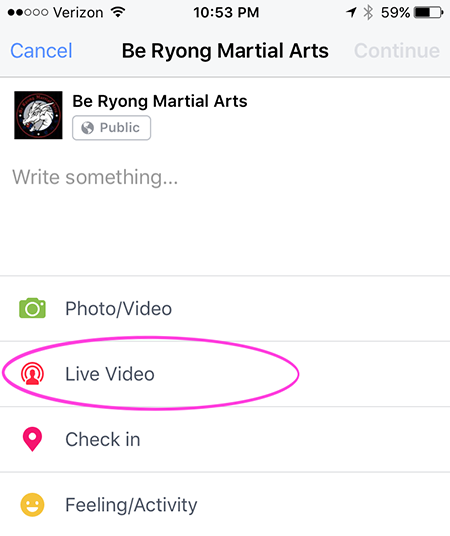
    Facebook Live is ridiculously easy to do. From your personal page or a brand page that you manage, press Publish, then select Live Video.

    You’ll be asked to enter a description. Once you’re ready, you click Go Live. Yes, it’s that easy.


    FBlive-circle_sm FBlive_2

    Things I Learned

    Here’s what I learned from using Facebook Live during the test and during a few classes since then:

    • Be sure to advertise that you’ll be streaming your event live well in advance of the event so that people know to tune in. The decision to live stream was sort of made on the fly, and I could have built up excitement and views if I had done more promoting ahead of time.
    • Make sure you have a good Internet connection. Turns out that one side of the studio had better WiFi than the other, so I stayed on the good side. When I ventured to the bad WiFi side, the video suffered.
    • Have a stand or other means for holding your phone or tablet up and steady. Because I was holding my phone and panning to get the full layout of the studio as the students moved around, the video got a little shaky at times. If I had had more time, I would have set up my phone on a stand in one part of the studio and just occasionally zoomed to get better coverage of a student or routine.
    • Your video will be live in near real time, but not instantaneously. Out of curiosity, I asked a friend to check the studio’s Facebook page while I was live streaming. We discovered the stream was about 30 seconds behind, which we thought was pretty darn great. I remember the days of needing a fiber or satellite connection, a camera, a real-time encoder, yada, yada. And here I was, live streaming with my phone!
    • If you want a copy of the video, shoot the video with your phone or camera, don’t live stream it. I didn’t realize it until later, but I ended up without a local copy of the videos I live streamed because they were uploaded directly to Facebook.
    • If you want HD video, shoot the video from a quality digital camera. The quality of the live stream is good but not HD. Some of the streams were actually fuzzy. So for the breaking part of the test, I chose not to live stream. Instead, I took HD videos and then uploaded them afterward to Facebook. The quality is better, AND I have copies to give to the students.
    • For short bursts of activity, you can choose to live stream OR shoot video and then upload. Uploading video to Facebook is so ridiculously easy, especially if videos are a couple of minutes or less. For these short videos, Facebook Live is less compelling.
    • Facebook will archive your live streams so even if your followers don’t watch in real time, they can still watch on demand.

    All in all, Facebook Live is fabulous tool for live streaming your events. Want family overseas to watch your daughter’s wedding from afar? You can live stream on Facebook. But just be sure get a quality, HD archive as well.

    If you want to see samples of Facebook Live streams from the black belt test, visit the BeRyong Facebook page. I’d love to hear about your Facebook Live adventures!

  • The Great Banana Bread Experiment: Are People Really Reading Your Emails?

    The Great Banana Bread Experiment: Are People Really Reading Your Emails?

    bread_500pxA couple of weeks ago, I sent out an important message to my entire staff about IT support. We had recently put in some technologies to make it easier for staff to request IT support during business and non-business hours, and some of our procedures had changed. The subject line began with PLEASE READ, and it came directly from me, Joanna Pineda, CEO and the person who signs everyone’s paycheck.

    The email was longish so I decided to do a test. At the very bottom of the email, I wrote:

    “BTW, if you read all the way down to this message, send me an email with the words “banana bread” in the subject line. I’ll bring in banana bread for you next week and for God’s sake, don’t give this away on Slack or any other method. Curious to see how many people will read this message. Cheers.”

    So how many people sent me a banana bread email? Out of 40 people, seven people sent me emails. Seven – that’s it!

    To be fair, the IT team already knew the procedures. And I had discussed the procedures with a few staff before sending the emails.

    kate_bread_smDuring staff meeting last week, I asked everyone if they had: read but not responded, skimmed and not read my banana bread message, or if they didn’t read the message at all. I gave everyone amnesty if they told me the truth. I got these responses:


    • I already know the policies
    • I skimmed the part about the policies to make sure I knew what I needed to know
    • Too long, didn’t read
    • I don’t like banana bread
    • I didn’t see the email

    I conducted a similar experiment a couple of months back when I sent an email to my son’s Cub Scout pack, of which I’m the committee chair. The email contained information about the next pack meeting, an upcoming camping trip… Yada, yada – if you’re a Scout parent, you understand me. At the bottom, I said:

    “Okay, thanks for reading this far. If you got this far, email me and put the word “magnet” in the subject line and I’ll give you a Friends of Scouting magnet at the next meeting.”

    Out of 60 people on the list, three responded. Two said they’d take a magnet and one said, “Magnet – but I don’t need a magnet. What fun!”

    I know this wasn’t a scientific test, and the emails weren’t life or death, but I think these experiments are pretty illustrative of what really happens when we send out emails. We look at our open and click rates and pray that those who opened actually read the message. Are they actually reading your message in its entirety? God, most likely not.

    What are the takeaways here? For starters:

    • Keep your emails short(er)
    • Don’t bury important calls to action at the bottom of your message
    • Test your campaigns

    If you’ve read all the way to the bottom of this blog post, submit a comment on this post using the word SWAG, and I’ll send a Matrix Group pen to the first 25 people. And if you decide to bury an Easter Egg in your next email newsletter, please write the results of your experiment in the comments as well or send me an email.

  • Make Sure You Have Good Inputs Going Into Your Google Analytics

    Make Sure You Have Good Inputs Going Into Your Google Analytics

    Close up of hands on table, one holding tablet with data visualizations on itI was in a meeting with a client last week and he complained that their Google Analytics (GA) reports just aren’t that useful. I asked why, and he said, “GA tells me the top pages visited on my site and that Google is referring a lot of traffic, and that’s about it.”



    Hmm… I decided to get curious.

    So here’s the deal with GA. If all you do is put the code snippet in your header, you’ll get generic data from GA. But if you give GA better input about where people are coming from and why, you’ll instantly get better GA reports. Here’s how to do that:

    • Never, ever send out a URL without UTM codes.

    UTM stands for Urchin Tracking Module. Urchin is the company that created what is now Google Analytics; Google purchased the company many years ago. A UTM tag is a tracking marker appended to a URL, and is recognized by Google Analytics as a dimension. For example, if you send out a link to a new item on your website in an email newsletter, you could use a UTM code for source = 04-17-2016-newsletter. If anyone clicks on that link, GA will report that traffic as having come from your email newsletter. Voila! All of a sudden, you have better tracking and you know whether or not your email newsletter is generating views on your website. Yes, your blast email provider probably gives you open and click data, but it’s most likely not connected to your overall website analytics reporting. Use this handy URL builder from Google to build data-rich URLs

    • Create redirects for your print URLs.

    So what about your convention brochures? You can’t exactly expect readers to type in a URL that has 100 characters. In this instance, you should create a vanity URL for each print piece (e.g., /2016convention for the brochure and convention 2016 for the postcard) and use your CMS to create a redirect for the actual page, with UTM codes that will attribute traffic to the actual print piece.

    • Use Google Analytics Annotations.

    GA lets you add little notes to your GA reports, attached to specific dates. For example, my marketing team enters annotations every time we send out an email newsletter, post a new event on Facebook, etc. This way, if we see a spike in traffic, we can look to see if that traffic might have been generated by something we did. Of course, we then verify using the Source dimensions in GA.

    • Set up Google Tag Manager.

    Google Tag Manager is an upgrade to Google Analytics and it helps you keeps track of the tags on your website and when they are triggered. For example, Tag Manager will let you track whether and how many people are clicking on the slider in your branding area, the number of downloads of your PDF annual report, etc. The best thing about Tag Manager is that once it’s setup, you don’t need to mess with the CSS on your site again; you then use a Google interface to setup tracking.

    You don’t need to be a developer or a CSS wizard to do the things I mention above. I will be blogging in the future about more advanced things you can do with Google Analytics, enhancements that require some programming. But in in the meantime, if you improve your inputs to Google Analytics, your analytics will be better.

    BTW, Matrix Group has an Analytics practice. If you need some training, help with a specific campaign, or help getting started, give us a call.

  • Does Your Website Need a Redesign or Refresh?

    Does Your Website Need a Redesign or Refresh?

    Woman setting before Mac screens, man reaching in front of her to point at something on screenA couple of weeks ago, I attended a meeting with a client who was interested in redesigning their website. “Why?” I asked. The site looks pretty good, the site is mobile-friendly, and the analytics are pretty good. So what’s driving the desire for a redesign?

    The answer: They wanted to make a few changes to the home page, the content throughout the site, and a bunch of the photos. Even though a redesign would have brought Matrix Group a large project, I recommended a website refresh, not a redesign.

    When should a website be redesigned? It’s always going to to depend on the circumstances, but I recommend a full redesign when:

    • The organization is going through a rebranding because of a name change, shift in focus, drastic changes in programs and services or rethinking of its mission and market position.
    • The organization feels that the website no longer represents the organization.
    • The navigation doesn’t have any bearing on what the organization stands for.
    • The design doesn’t reflect who the organization is today.
    • The organization wants to update a large percentage of the content.

    When should a website refresh be done? Again, it’s going to depend, but I recommend a refresh when:

    • The organization is largely the same: same mission, same values, same general program offerings.
    • The website largely works, but it could use some tweaks to the navigation, the images need updating, and the content needs to be refreshed.
    • There are key pieces of the site that don’t work, but they’re not necessarily related to the overall site. For example, many prospects come to us saying that their site search is broken or they need a new member directory or store.

    Sometimes, a client wants to redesign because they hate their CMS and want to move to something different. With a CMS migration, it makes sense not to just to migrate the exact site. Since we’ll be touching every page, it makes sense to ask if it’s also time to rethink navigation, design, integrations and search.

    Matrix Group recently refreshed portions of our website. The analytics on the home page weren’t where we wanted them to be, so we challenged ourselves to update just the home page. It worked. I was also not happy with our Careers landing page. Since we are always looking for the best people, it made sense to redesign just that landing page. During all this, we didn’t do a redesign. We were largely happy with the overall design, navigation, color palette and tone of the content.

    I happen to think it’s important to tweak and refresh your website regularly, at least annually. In fact, some clients do such a good job of evolving their sites that redesigns may be a thing of the past for them.

    What are YOU doing this year? A redesign or a refresh?

  • Why I Traded in My Black Belt for a White Belt

    Why I Traded in My Black Belt for a White Belt

    HapKiDoA couple of weeks ago, I took the plunge and signed up for HapKiDo. HapKiDo is sometimes called the “anti-martial art” because it emphasizes deflection and leverage. HapKiDo techniques use joint locks, strikes and dynamic kicking.

    I’m a black belt in TaeKwonDo. Why embark on another martial art, especially when my TKD journey has just begun and I’m far from expert on the many TKD techniques?  Or, as my husband asks, “Why embark on a whole new journey of pain?”

    The short answer is that I’m curious. The HapKiDo workouts are really intense, the HKD students are really good friends and they have this stance that says “don’t mess with me.” Yeah, I want some of that.

    This isn’t the interesting part of this story.

    What’s more interesting is the story behind my decision to finally sign up. You see, I had been flirting with the idea about six months ago. I took a couple of trial classes, and they were hard, but they were terrific. But I just couldn’t bring myself to sign up. My excuses were myriad and valid to anyone who inquired: “I’m busy enough, the classes are too late, the HKD guys are always injured, yada, yada.”

    But in my quiet moments, when I was honest with myself, those excuses sounded lame. The real reasons were deeper and had more to do with my sense of who I am than with anything else. You see, starting a new martial art means becoming a white belt all over again. It means not knowing anything, making lots of mistakes, looking silly, feeling embarrassed, feeling slow, standing at the end of the line. Was I ready for that? It was going to be uncomfortable and a lot of hard work – who needs that?

    Turns out my martial arts journey parallels my professional journey in many ways. You see, Matrix Group is getting disrupted. A little background: We build fantastic, effective, user-friendly websites, e-commerce sites, customer/member portals, intranets, etc. We’ve been doing this a long time, we’re great at it, you could even say we’re black belts at it, maybe even 2nd- or 3rd-degree black belts. Trouble is, there are about a zillion agencies in the DC area, indeed the country, that look like us. So over the past couple of years, we’ve been undergoing a process of reinvention. Not only have we been asking, “what’s next?” we’ve been working on ways to bake “what’s next?” in to our day-to-day lives. This process has been hard, uncomfortable, even heartbreaking at times. It has meant closing down product lines, saying good-bye to people, and testing out new products and services that will resonate with the company, my staff and our clients.

    In essence, a couple of years ago, we had to become white belts, learn some new skills and get beat up in the process. In the past few years, as we’ve been developing our mobile offerings, we’ve had fits and starts. We’ve changed frameworks, made mistakes, and done things the “wrong” way. But now we’re cruising with mobile. Every website is responsive by default, responsive isn’t taking as much time as it used to and testing is easier. Our mobile app business is booming.

    Being a white belt is hard and frustrating, but it’s also exhilarating. At work and at the dojang (martial arts studio in Korean), I’m learning fast, I’m feeling good, and I’m feeling strong. And it turns out my TKD experience is coming in handy. I have good endurance, I know a lot of the kicks, and I can take a hit. So I’m not exactly  starting from ground zero. And so it goes at work. Our expertise in design, user experience, browsers, database development, and membership databases only benefit us when we build new association membership experiences for a phone. This experience will be a good foundation when we start building virtual reality apps in the next year or so.

    So, what’s my martial arts week like these days? It’s TKD 2-3 times a week (where I’m a black belt and building on what I know) and HKD 2 times a week (where I’m a white belt and everything is new.) It’s a mix that works for me.

    How about you? What will be your white belt experience this year?

  • What Does Kung Fu Panda Have To Do With a Performance Review Process?

    What Does Kung Fu Panda Have To Do With a Performance Review Process?

    What Does Kung Fu Panda Have To Do With a Performance Review Process? | www.TheMatriXFiles.netA couple of months ago, I was on YouTube, and I came across a trailer for the upcoming “Kung Fu Panda 3“. The opening lines are by Master Shifu, who says, “Po, if you only do what you can do, you’ll never be more than you are.”

    I have always been a “Kung Fu Panda” fan, but I was blown away by this line. I’ll repeat it: If you only do what you CAN do, you’ll never be more than you are.

    What the heck does this mean?

    Well, it’s performance review time at Matrix Group and I’m Chief Cheerleader for this process. Only we call our process Performance Management and it’s more a conversation between staff and manager about the kind of year the staff person wants to have, their hopes and dreams, the experiences and skills they hope to achieve, and the person they want to become in the next year, in the next five years.

    In “Kung Fu Panda 3”, Master Shifu tells Po it’s now Po’s turn to be the master and the teacher. Po basically says, “No way, what do I know about teaching and mastering chi?” And that’s when Master Shifu tells him to be more than he is.

    As managers and leaders, isn’t that ultimately our job – to help our staff become more than they are? To be honest, I see some less-than-inspiring goal sheets for the coming year. And that’s not good enough. If my staff aren’t reaching for a stretch year, they will become obsolete in a couple of years, and the same will happen to Matrix Group. So I’ve asked my managers to make sure each production staff person has goals related to learning new languages/frameworks/platforms, beefing up their front-end skills, and building mobile apps.

    If we only do what we can do, we’ll never explore new content management systems, platforms and frameworks; we’ll only bid on projects we can comfortably do; and we’ll never explore the brave, new world of mobile, virtual reality and wearables.

    If you only do what you CAN do, you’ll never be more than you are. Love this.

  • Web Design Can and Should Be CMS-Agnostic (and why we love WordPress more and more)

    Web Design Can and Should Be CMS-Agnostic (and why we love WordPress more and more)

    webdev_smHere at Matrix Group, we use a variety of platforms and frameworks to build client applications. On the content management system (CMS) side, we really like Sitefinity and WordPress for building websites, although we have worked with other platforms, including DNN, Expression Engine, and Kentico. WordPress has come a long way in recent years, and we’re doing more and more with it. We love its flexibility, extensibility, and clean code, to name just a few things.

    During a client meeting the other day, I was pitching doing a magazine website in WordPress. The client was surprised and said, “WordPress, the blogging CMS? Isn’t that too simple for our needs?” I explained that no, WordPress has come a long way, it powers so much of the web these days, and it is perfectly capable of the complex functionality she needs. She countered with, “So show me a site that you did in WordPress that doesn’t look like a WordPress site.”

    So I did. I showed her Endocrine News, the magazine of the Endocrine Society, the website for e-discovery firm eTera Consulting, and a convention site for the National Electrical Contractors Association.

    But then I got curious. Does my front-end team design differently based on the CMS platform? I asked my Creative Director and Senior Designer, “Do you take CMS into consideration when creating designs?”

    The response: “Heck no, half the time, we don’t even know the platform that will be used.”

    So then I asked my Lead Front-End Developer, “Does the CMS platform affect what we can and can’t do?”

    The response: “Nope. Some things are easier in WordPress, other things in Sitefinity. Just depends.”

    I know I’m involved in many Information Architecture projects, and I no longer wonder if a platform can do something I’m envisioning in a wireframe.

    I hadn’t really thought about it but it appears we are now CMS-agnostic when it comes to designing the front-end of our websites. Does that mean every CMS can do everything? Probably, at least in the arena we play in. But we definitely express favorites, and choice of platform can affect HOW a specific requirement is implemented, as well as price and timeline.

    Makes me think of a wise client who said to me some time ago, “Joanna, I don’t care what system you use to build my site, as long as it does what I want, it’s easy to use, and you can maintain it easily.”

  • Why Your House, Office, and Website Need a Refresh and Spring Cleaning Every Year

    Why Your House, Office, and Website Need a Refresh and Spring Cleaning Every Year

    Why Your House, Office and Website Need a Refresh and Spring Cleaning Every Year | www.TheMatriXFiles.netA couple of weeks ago, I held a Town Hall meeting with my staff to discuss office space. Our office lease is expiring in less than 2 years, so our Realtors recommended that we look at space around town but also consider how we would like to improve our current space should we decide to stay. During the Town Hall meeting, I asked staff for their blue-sky ideas. If time and money were no object, what would our office look like? How would it be configured? How would it encourage the type of interactions and collaboration that we seek? How do we meld cool with functional?

    We came up with some ideas that are probably way out of our price range. Everything from a completely configurable office with movable walls, desks and chairs, to blowing out the ceiling, to all-glass walls that provide privacy with a push of a button.

    But we also came up with ideas that are totally within reach. Today. With minimal budget. So we have set about implementing many of the ideas because, regardless of whether or not we move, we’re going to be at 2711 Jefferson Davis Highway for another 18 months. We might as well improve our working space. What have we done? We:

    • Gave the kitchen a makeover by putting in matching furniture, tossing out the clutter, and reconfiguring the storage space.  We also put in some new artwork.
    • Cleaned up the game room and made it cool again. Honestly, it was looking downright dumpy and not fun-friendly.
    • Created a new space for the morning stand-up meetings. One where we can actually stand and write on the walls.

    If you’ve been following my blog all these years, you know that I often draw parallels between managing a website and managing a home or office. Here’s what our new office envisioning process reminded me:

    • Don’t wait until you need to do a major redesign to make improvements to your site. Think in terms of optimizing and improving sections of your site every quarter. At Matrix Group, we take a section of our site, review the analytics and make tweaks every quarter.
    • Declutter on a regular basis. Old, outdated content and run-of-the-mill clutter is deadly. After a while, you don’t even see it anymore. So on a regular basis, look at your website with fresh eyes. Is your website just a dumping ground for old content? Get rid of it. Old content simply clutters your search results, confuses visitors and makes your site feel outdated.
    • Ask your staff and members what’s working and what’s not. Get a few concrete ideas for making individual sections or a page better, then act on them quickly. Be sure to let your stakeholders know that you listened and implemented some of their ideas.
    • Experiment with inexpensive ideas to test out different concepts. For example, my staff have asked for different collaboration areas. But they’re also asked for isolation rooms where they can work uninterrupted for periods of time. Before we invest in construction, we’re testing out some ideas using empty office space. Before investing a lot of money in community tools, databases, etc., think of el cheapo ways to test out ideas.
    • Paint does wonders. It’s been a couple of years since we painted walls and touched up scuff marks. It’s amazing what a fresh coat of paint will do to a space. Same goes for your website. Update the photos. Redo some headers. Update the tired conference template. Your members will notice and pay attention to your marketing messages with fresh eyes.

    I’m going out with the Realtors this week to look at space. I don’t know what the Matrix Group office Version 5 will look like, but I predict there will be lots of purple.