
The best of the best recipes, techniques and kitchen tools. They improve on classics, debunk myths and make it easy to cook like a chef.
Blog
-

The Facebook Timeline is Coming on March 30 – Is Your Organization Ready?
The much awaited Facebook timeline for brands is coming. On March 30, whether you like it or not, your organization’s Facebook page will convert to the new timeline format. Here’s what’s new:
- It’s All About the Timeline. Facebook says the big, huge deal is the timeline. Facebook will automatically show a timeline on the right side of your page that shows previous months and years. Your fans will be able to click on a month or year and see updates and posts from that time period. Here’s the HUGE DEAL: you can customize the timeline to show events in your organization’s history pre-Facebook. For example, the New York Times’ timeline goes all the way to the 1800s!
- Brand Image. Your new brand page will have a large cover photo at the top of the page. Instead of a tiny logo and a few photos, your brand page can and will feature a large branding image that you can design yourself. Coca-Cola’s brand image has images from their current advertising campaign, showing happy people of course.
- Posts and Conversations. The rest of the page is divided into 2 columns to represent the passage of time AND separate your posts from conversations and messages. In the right column, you’ll see messages to your company, posts about you, etc.
- No More Left Navigation. Many brand pages had multiple tabs along the left rail for their various apps like photos, videos, donation, yada, yada. In the new timeline page, your top 4 tabs will be visible; visitors will have to click to see all of your apps.
- Messages Between Brands and Users. Finally! Brands and their fans can now have private conversations!
- Featured Content. The old Facebook pages displayed all posts equally – you had an image, a title and a blurb. The new timeline page lets you feature content at the top of the page. Featured content is bigger and takes up 2 columns for added impact.
So how can you prepare for the new Facebook timeline? Here are our recommendations:
- Preview your new Facebook page NOW. Don’t wait until March 29 to figure out what your new page will look like. Start looking at it now and making adjustments.
- Create a cover photo that communicates your brand. Use the period between now and March 30 to create the image and test it. You may need to make some adjustments. You can test how your cover photo looks by clicking the preview tab at the top of your page. BTW, only admins can see the preview.
- Review your Facebook strategy. What kinds of posts will you feature? Which apps will be prominent? How will you communicate with your fans?
- Start featuring posts. Highlight recent posts by hovering over the right hand corner of the post and clicking on the star. You can also remove it by clicking on the star. If you want to promote a past post, you can actually move it up by hovering on the right hand corner of the post, clicking on the pencil tab in and selecting pin to top.
- Check your insights page regularly. As a marketer, the Facebook insights leave me wanting for more, but there is more and better data now available, including who recently “liked” the page and recent comments.
Are you ready for the new Facebook timeline pages? What’s your strategy for taking advantage of the new format and features?
-

Draw Something for iOS
Draw something on your iPhone or iPad and invite a friend to guess what you just drew. Cool videos of your work. Totally addicting.
-

Words With Friends
Matrix staff can’t get enough of this app. There is often complete silence in the kitchen at lunch time, as everyone is engrossed in the game!
-

I’m Losing the Good War Against Spam and the Fight for a Manageable Email Inbox
Late last year, I received an e-mail from my son’s school, letting me know that enrollment forms for next school year were going to be done electronically from now on and that I should be on the lookout for the e-mail with the information and link. Okay, I bet you know where this is going. I remember getting the e-mail in January that included the details, the URL and the deadline but since I’m accustomed to work things being electronic and school stuff being mostly offline, I just could not make the mental shift.Next thing I know, the Director of Admissions is calling to let me know that the deadline has passed and were we still interested in sending our child to their school. Egads. Imagine my horror when I realized that I had missed the deadline.
The cold, hard truth is that I’m losing the war against spam and my email inbox is beyond out of control. I get hundreds of spam emails a day, not counting the hundreds more that the spam filter catches. In addition, I get lots of email newsletters, I’m cc’d on some client communications, and unlike client work that goes through our extranet, new biz follow-up is largely via email.
I try to skim my emails every few hours, I beg the IT staff for more spam filtering, I diligently mark true spam as junk, I unsubscribe from what look to be legitimate newsletters that have added me to their lists, and I have a zillion email folders. Most importantly, as I scan/read my email, I try to handle each item just once by deleting unwanted stuff, responding instantly when I can, and filing other emails into To Do or To Read folders. All of this is still not working. I’m going to admit to the world that I have hundreds of unread emails.
The spam is the worst. We have an aggressive anti-spam software the the net admins are constantly tweaking. A few months ago, we tried to get more aggressive against spam by blocking email from email servers that were on legitimate blacklists, didn’t have proper DNS records (like SPF records and reverse DNS looksups), and/or sent emails with improper headers. This helped a lot but then we started blocking email from clients! Lots of them! It seems that setting up email according to the latest protocols is not yet widespread, so after some internal soul-searching, we loosened our email requirements and that allowed a whole lot more spam to get through. <sigh>
If I’m overwhelmed by email, I bet most other people are. So what does that mean for email communications, email marketing and personal productivity? My friend Ken Chaletzky, who runs Copy General, a digital printing company, says his company is seeing a surge in companies combining both print AND email marketing for higher conversions.I guess I’m not surprised.
Email is not going away and dollar for dollar, it’s still an amazingly effective and low cost marketing and communications tool. Every week, Matrix Group shows clients how to write effective emails, designs email templates and sets up discussion or broadcast lists. If we could just figure out how to minimize the spam, life would be grand.
So what happened to my son’s enrollment forms? The school wisely figured there would be a lot of stragglers so I was able to file the forms two weeks late and still get my son registered for next year. Phew. Thank goodness for the high touch phone call from the Director of Admissions!
How about you? Are you winning or losing the war against spam? What are YOU doing to better manage your inbox?
-

Your Employees as Brand Ambassadors
Last week, Matrix Group launched a new staff blog – SnackOClock.net. SnackOClock came out of an internal town hall meeting I held with staff late last year about recruiting. As a company, we decided to launch a staff blog to showcase our expertise, highlight cool projects, discuss innovative techniques we’re implementing on client sites, and demonstrate thought leadership among our peers. SnackOClock launched last week and half of the company is now blogging.The idea of a staff blog has shocked many of my CEO friends who tell me that SnackOClock will simply facilitate poaching of my stellar staff, and that I am giving my employees a platform to show off their talents and then go make more money elsewhere. Pretty serious stuff and I admit that I had to think hard about this when the idea was first discussed.
But here’s what I realized: identifying and poaching (attempted, at least) of my staff is already happening. Most of my staff are on Twitter and LinkedIn where it’s ridiculously easy to find employees at specific companies. Heck, Facebook even lets companies target employees of just certain organizations when taking out Facebook ads. Finally, Matrix Group already encourages staff to be involved in their local tech communities by participating in e-mail discussions and attending meetups.
So, after some hard thinking and weighing of the pros and cons, I decided to embrace the idea of Matrix Group staff as brand ambassadors. Whenever one of my employees posts to a list, attends an industry event, tweets or blogs, they are representing themselves and the company. This is because Matrix Group is in their e-mail signature, they hand out business cards, and they mention the company in their profile. By creating an official platform, SnackOClock, that allows staff to show off their expertise, I’m harnessing their knowledge and expertise for the good the company — on a platform owned, managed and edited by the company.
SnackOClock has only been online for just over a week (we had a soft launch last week, the official announcement to the world is this week), but here are the results so far:
- Most staff are blogging or intending to blog.
- Staff love that they can blog when they want to and get editorial and writing support, which makes it easy for new bloggers to get going.
- There’s a ton of excitement among the staff about the blog and it’s infectious.
- The entire company is sharing individual blog posts to their social networks, so we’re achieving our goal of wide distribution of posts, which can only be good for recruiting and prospecting.
- Blogging was on many staff members’ “want to do” list, so the company is facilitating their professional development through the blog.
- SnackOClock is promoting knowledge-sharing within the company.
SnackOClock has exceeded my expectations regarding the quality of the posts and the coolness of the design. I loved Liz’s post on SiteFinity 4.4, Rich’s post on Ghostery, Eric’s post on real-time Google Analytics, and on and on. Check out SnackOClock.net for yourself. I hope you’ll subscribe to the RSS feed, comment on posts and share individual posts to your social network.
How about you? Does your company see staff as brand ambassadors or gems to keep hidden away? What do YOU think of employees as brand ambassadors?
-
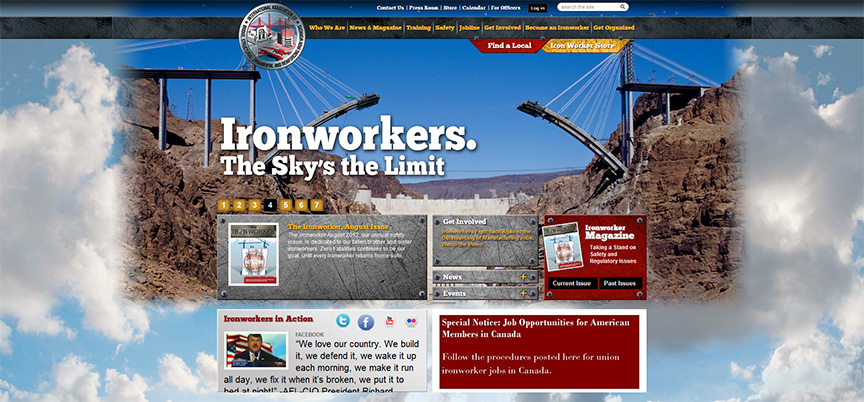
International Association of Bridge, Structural, Ornamental and Reinforcing Iron Workers Union Redesign
International Association of Bridge, Structural, Ornamental and Reinforcing Iron Workers Union is a trade association representing 120,000 members in North America. The union dates back to the 1890s, and prides itself on the contributions its members have made to the continent’s infrastructure over the centuries. Members have helped construct bridges and buildings that are now considered national icons. These include: the Golden Gate Bridge, Sears Tower, the St. Louis Arch, the World Trade Center and now Freedom Tower.
Matrix Group collaborated with the Trade Association a website redesign that showcased ironworking as an invaluable profession to both its members and those interested in becoming ironwokers, as well as demonstrated the strength and impact the industry makes on building our country.
Matrix Group:
- Developed a robust taxonomy and wireframesby indentifying site’s visitors and their anticipated behaviors through user personas.
- Crafted an inspiring design based on the craftsmanship and skill of ironworking.
- Implemented the website in the Sitefinity content management system.
- Created an officers’ login for members to allow memberssearch for district council members, individual members, etc in an online database. They also had access to a number of resources and tools to help them hone their skills and knowledge.
- Integrated the association’s social media into the website. Matrix Group plugged in the association’s Facebook and Twitter updates, as well as YouTube for member recruitment and retention.
-
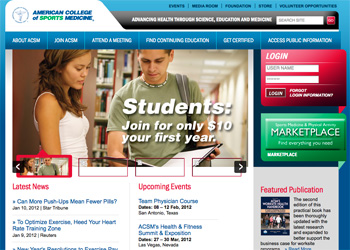
The American College of Sports Medicine Redesign
The American College of Sports Medicine (ACSM) is the largest sports medicine and exercise science organization in the world. Its membership represents all types of sports medicine professionals. The redesign of ACSM’s website could not have come at a better time. With healthcare and preventative medicine at top of many people’s minds, ACSM leveraged the website redesign as an opportunity to reinforce its position as setting the “gold standard of sports medicine”, brand itself as a dynamic organization, and share its wealth of information to its members, the public and the media.
To support ACSM’s vision and goals, Matrix Group:
- Implemented a CMS driven by a robust taxonomy, allowing visitors to search by health related issues and topics as well as keywords — from yoga to heart attack prevention.
- Designed a comprehensive navigation, making information easily accessible to visitors and
- Crafted a beautiful design that evokes the energy and showcases the diversity of the sports medicine fieldand ACSM’s membership.
- Integrated the website with ACSM’s membership database, creating single sign-on for members to access protected member content.
-
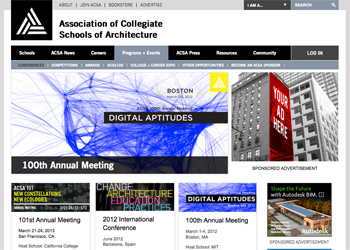
The Association of Collegiate Schools of Architecture Redesign
The Association of Collegiate Schools of Architecture (ACSA) is a nonprofit membership association founded in 1912 to advance the quality of architectural education. Its membership consists of architectural students, faculty, and other professionals in the architecture field.
As the leading voice for the ever-changing architectural landscape, ACSA focuses on inspiring current architects and future generations to redefine the industry. They do this through thoughtful discussions around the many architecture disciplines, foster public awareness around architectural education, support research in teaching and other creative works, and recognize students and professionals through its prestigious awards.
To support ACSA’s vision and goals, Matrix Group:
- Designed a website that was visually appealing to members and the public, showcasing the organization as elegant and forward-thinking.
- Implemented the website with the Sitefinity content management systemfor staff to maintain the website.
- Incorporated interactive design elements conveying the creativity of the industrythat it represented and enhanced the site’s usability with a robust navigation.
- Implemented the MatrixMaxx AMS to manage several critical components of ACSA’s business model including, membership, events, e-commerce, and financial reporting.
Visit The Association of Collegiate Schools of Architecture Website.