Matrix Group International

Blog

  • JP Rule #10: Never Deliver Bad News Via E-mail or IM. Never.

    Just as our moms and Miss Manners tell us to never to break up with someone via email or Facebook, I tell my Project Managers to never, ever deliver bad news to clients or staff via e-mail or instant messenger (IM).

    Delivering bad news via email or IM is just plain bad business so why do people do it? They do it because they’re pressed for time. Or they don’t want to face the client and answer tough questions. Or they’re clueless and think sending an email will fix the problem. Or they don’t know how to deliver the bad news and negotiate a solution. Here’s what I tell my team:

    • If you have bad news, you owe it to the other side to deliver the bad news by phone, if not in person. This shows respect and thoughtfulness. Most importantly, a meeting or call is a two-way conversation, not a one-sided delivery.
    • Bad news is any news that might upset someone. The news could be monumental, e.g., Mr. client, we need more time to test the new database. Or less so, e.g., Ms. staffer, you can’t take off next Friday because we have a new site gong live.
    • Some news, even if it’s not bad, deserves a call or meeting. For example, we made the changes the client requested to the home page designs and they don’t look great so we want to discuss alternatives.
    • Email messages, no matter how carefully crafted, can be easily misinterpreted because they don’t have benefit of tone, body language or conversational context.
    • Staff deserve the same thoughtfulness and regard as clients. In other words, don’t assume that because someone works for you, you can deliver bad news via email or IM.
    • In general, IM is a bad way to communicate complex messages and a bad medium for a discussion.
    • When in doubt, pick up the phone or get advice from your manager.
    • Clients and staff aren’t Facebook friends you can post updates to. They are people and they deserve your time and attention.

    I have actually found that it’s our ability to turn around a mistake or a bad situation that cements our client relationships. If we have bad news, it’s an opportunity to explain how we got there and what we’re going to do to make the situation better. This can never, ever be done via email or IM.

    How about you? Have you ever received bad news via email or IM? What did you do?
  • National Association of Episcopal Schools Website Redesign

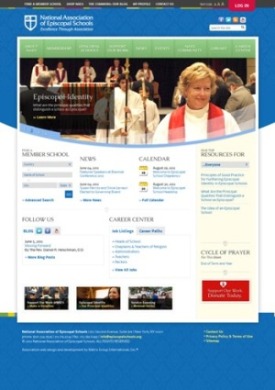
    National Association of Episcopal Schools Website Redesign

    The National Association of Episcopal Schools (NAES) is an independent, voluntary membership organization that supports, serves, and advocates for the vital work and ministry of 1,200 Episcopal schools, early childhood education programs, and school establishment efforts throughout the Episcopal Church.

    NAES wanted to redesign its website to enhance the value of its membership, promote the unique character of an Episcopal education among the general public and communicate its new, fresh identity.  As part of the website redesign, NAES wanted to add more functionality to the website, allowing members to register for events, make donations online, have more access to online resources, and participate in thoughtful discussions.

    To help make their vision into a reality, Matrix Group:

    • Created a fresh, new design that reflected the association’s re-branding.
    • Re-vamped the website’s navigation to address the needs of its users, as well as educate the public on the value of the Episcopal school education.
    • Expanded their library to included publications and meetings.
    • Implemented the website in the Sitefinity content management system (CMS), giving  NAES the ability to update every portion of their site.
    • Expanded integration with the site’s association management software to allow donations.

    Visit the National Association of Episcopal Schools Website.

  • So What Happens If Your Laptop Is Lost or Stolen?

    So What Happens If Your Laptop Is Lost or Stolen?

    Photo of a thief running away with a purse and a laptopA couple of months ago, a NASA laptop containing personal information about employees was stolen. Apparently, this is not a rare occurrence. If you google for “stolen laptop containing personal information,” you get thousands of hits. Ugh.

    I used to lose sleep at night because so many of my staff use laptops as their primary work machine. All of my Project Managers, New Biz team members and Directors carry laptops. We even have Netbooks that staff can check out if they are headed to a meeting. The risks are obvious. Laptops contain company confidential proposals and reports. They have passwords stored in browsers to make it easier to visit websites. They store passwords so we can VPN into our intranet and check e-mail.

    While Matrix Group has an amazing track record of zero loss/zero theft of laptops and PCs (knock on wood), I still lost sleep. What would happen if a laptop were lost or stolen? Forget the cost of the machine. What would it take to recover from the loss? How quickly could credentials be changed? How much damage would we suffer if confidential information were released publicly? Would we even know about all of the passwords that would need to be changed?

    Today, all Matrix Group laptops have encrypted hard drives. Windows laptops use TrueCrypt, a free, open source tool for encrypting hard drives. Mac users take advantage of the built-in encryption capabilities through FileVault2. Yes, laptop users need to login to their machines twice: once to unencrypt the hard drive and a second time to login to the machine/network. We also use strong, long passwords so it takes a few extra seconds to type our passwords. And yes, there is a bit of lag while we wait for the hard drives to become available.

    Is encrypting the hard drives worth the effort, hassle and wait time?

    Absolutely! My encryption password is 34 characters long and contains letters, characters and numbers. While I know that any password can be cracked but it will take a really, really long time to crack my password. So, for all intents and purposes, if my laptop were to get lost or be stolen, the machine would be a nice paperweight until the hard drive is reformatted. Although I love my Sony laptop (I have a nice one with a carbon fiber body and a solid state drive), I can always get another one. It’s the data that I really care about.

    The Ponemon Institute last year reported that 329 organizations surveyed lost more than 86,000 laptops over the course of a year. The Institute further calculated each loss to be worth $49,246, which meant these 329 companies alone lost over $4 billion! (Can you even imagine how 329 companies lost 86,000 laptops? What are they doing to these things?)

    So, my question to you is: what would happen to you and your organization if your laptop were lost or stolen?

    Addendum to this blog post from December 7, 2016: In 2014, development on TrueCrypt was discontinued. When I upgraded my laptop to Windows 10, I started using device encryption from Microsoft. Here’s a great article from comparitech that answers questions about TrueCrypt and provides alternatives for encrypting your drives. Whatever you do, use something to protect your drives, especially laptop drives. Don’t just “hope” your laptop doesn’t get stolen and “hope” that the folks who steal your laptop don’t care about your data.

  • Window Crayons

    Window Crayons

    Lucky enough to have a window? Turn your window into a work of art or organizing board with these washable markers.

  • Artomatic

    Artomatic

    1,300 artists and performers take over an 11-story building in Crystal city and turn it into the DC area’s biggest creative event.

  • Time to Audit Your Facebook Settings Again

    Time to Audit Your Facebook Settings Again

    Like many people I know, I view my Facebook personal page (versus the Matrix Group brand page) as the place where I connect with friends, share personal updates, post photos of my family, yada, yada. While Twitter and this blog are part of my public, professional persona, Facebook is more a part of my personal life.

    Which is why I review my Faceobok account and privacy settings on a regular basis. If you haven’t done so recently, I suggest you do it now. Facebook settings change all the time and you might be surprised to discover, for example, that a bunch of albums containing your childrens’ photos are now public (which is exactly what happened to me). Here are settings that I recommend you review right now:

    How to Check Your Settings

    After logging into Facebook, click on the down arrow in the top right corner of the page, next to Home. Most of what you want to do will be under Account Settings and Privacy Settings.

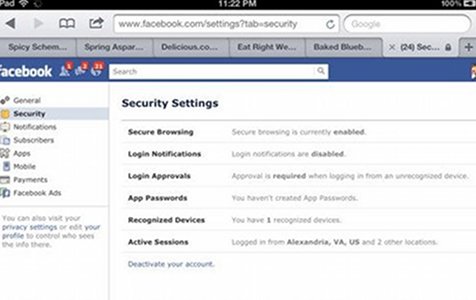
    Account Settings >> Security

    Select Account Settings, then go to Privacy in the left hand navigation. I recommend editing your settings to Enable Secure Browsing when possible. This means that when you go to www.facebook.com, you’ll be redirected to https://www.facebook.com, which means traffic between your computer and the Facebook servers will be encrypted. I think this is sensible and important given how many of us post a lot of personal information to Facebook, including birthdays, names of family members, hometown, etc.

    I recommend making Login Approvals Required when logging onto Facebook from an unrecognized device. This means that you’ll have to approve a login from a new and unrecognized device via your phone. Again, I think this is sensible. If someone ever tries to access your Facebook account from a different computer or phone that you don’t recognize, you’ll know that your account may have been compromised and you can act immediately and change your password.

    Privacy Settings

    If you’re not familiar with this page, I suggest going through all of the options on this page. Here are the settings you should pay most attention to:

    Default Privacy Setting. While you can select an audience for posts and photos, some apps don’t let you select. Choosing Public, Friends or Custom will provide a default privacy setting for these types of posts and apps.

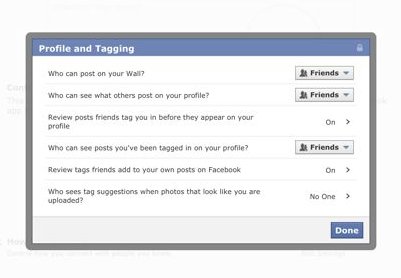
    Profile and Tagging. This is a biggie for me. I only let Friends post to my wall and only Friends can see what others post on my wall. I also have the setting turned on that allows me to review tags of me before they get posted.

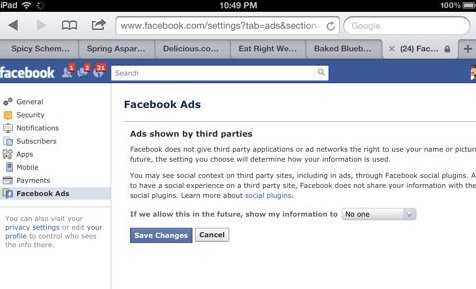
    Ads, Apps and Websites.  This is another important one. Facebook says that “people who can see your info can bring it with them when they use apps.” Which is why I limit the information that can be accessed to just my Bio, Website, Links and Education. I don’t provide access to my birthday, hometown, etc.

    Instant Personalization. If you have this enabled, on Facebok partner websites, you’ll get a personalized experience based on the information in your profile + your friends’ information. I have this turned off.

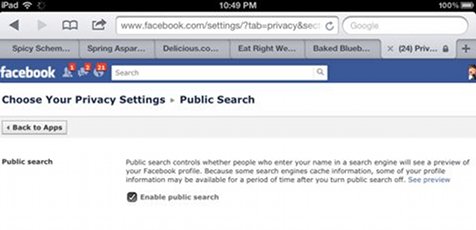
    Public Search. Although I’m fairly picky about who I will accept friend requests from, I do enable public search because I do want friends, former classmates and former co-workers from  years past to be able to find me. That is, after all, one of the charms of Facebook.

    Your Public Actions and Likes

    Know those Facebook and Google+ Like buttons that seem to be everywhere? For the most part, only people in your friend network can see your likes when they visit the page or your Facebook profile. But here’s the deal: if you like something on a third party, public site, I don’t believe you can have an expectation of privacy, so I recommend liking and commenting on third party sites with the understanding that all of this information can and will be public.

    I hope you’ll take the time to audit your security and privacy settings NOW. The Electronic Frontier Foundation did a timeline of Facebook’s eroding privacy policies over time. While Facebook has recently made changes as a result of government intervention, I still say be careful, audit your settings often, and for god’s sake, don’t post anything you wouldn’t want your mother to read on the web.

  • Bike Score

    Bike Score

    Bike Score measures whether a location is good for biking on a scale from 0 – 100.  Washington DC is #6 on the Most Bikeable Cities list!

  • Does Facebook Have Staying Power?

    Does Facebook Have Staying Power?

    Everywhere I turn, I’m hearing about Facebook’s IPO on Friday. The media, economists, pundits and the public are speculating about stock price, total valuation, and on and on. And of course, people are questioning whether or not Facebook will have staying power in the long run.

    Mark Evans from Forbes Magazine warns readers to “Stay away from the Facebook IPO” because of social media fatigue, Facebook is no longer hot and sexy, and Facebook has not figured out how to make money from mobile, which represents nearly half of Facebook’s users.

    A poll by AP-CNBC this month reports that half of Americans think Facebook’s appeal will fade. But if you look closely at the numbers, nearly 60% of those polled under 35 say Facebook is a good bet. And you know how we talk about the 800 pound gorilla? Facebook now reports that it has 900 million subscribers around the globe! Who can argue with numbers like that?

    Me, I’m influenced on this issue by an article written by Michael Mauboussin back in 2005 on ecosystems. Mr. Mauboussin is the Chief Investment Strategist at Legg Mason Capital Management. In the article, Mr. Mauboussin says that “the crucial battle is not between individual firms but between networks of firms.” Ultimately, “keystone companies—businesses at the center of a healthy economic ecosystem—are the most likely to deliver sustainable value creation.” In the article, Mr. Mauboussin was talking about eBay, which has created an entire ecosystem to support its business, including hundreds of thousands of sellers, drop off stores, auction service shops, and payment processors like PayPal.

    Is Facebook a keystone company? On the face of it, I think the answer is yes. There are hundreds of thousands of companies that have created business pages to promote their products and services, hundreds of companies have been formed entirely for the purpose of creating social, gaming and business apps for Facebook, Facebook has thousands of advertisers, thousands of companies are now selling their products through a Facebook store, and there have got to be hundreds of thousands of consulting companies helping clients take advantage of Facebook.

    Like eBay, I think Facebook will lose a lot of its hip and sexy aura, and Facebook will likely develop plenty of rivals. Will Facebook stick around for decades, even generations? No idea. But if people continue to spend a lot of their social time on Facebook and companies and advertisers continue to advertise and promote on the platform, I don’t see how Facebook can be a bad bet. Does this mean I’m going to buy a bunch of stock on Friday? Nope, I’m going to see where the stock settles and then I’ll give it more thought.

    How about you? Do you think Facebook has staying power? Are you going to buy Facebook stock? Do you think Facebook is a keystone company?

    P.S. If you want a copy of Mr. Mauboussin’s article, go to the LMCM Vault, then do a search by Author = Mauboussin and date range = 2005. Sorry, I could not figure out how to get a direct link to the PDF. I think the article is absolutely worth reading. I also highly recommend subscribing to Mauboussin on Strategy, a monthly publication. (Nope, I am not affiliated with LMCM, I don’t own their stock, and I’m not related to anyone there.)

  • Smashing Magazine

    Smashing Magazine

    If you’re a designer, front-end developer or developer, this is a must read. Every day, you’ll get tips, tools and inspiration.

  • Matrix Group SnackOClock.net Staff Blog

    Matrix Group SnackOClock.net Staff Blog

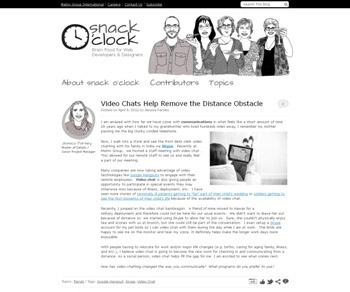
    As a result of a town hall meeting in early 2012, Matrix Group decided to launch a new staff blog – SnackOClock.net – featuring brain food for Web developers and designers. We launched the blog to showcase our expertise, highlight cool projects, discuss innovative techniques we’re implementing on client sites, and demonstrate thought leadership among our peers.

    Designed and developed by Matrix Group staff, the blog has proven to demonstrate our staff’s outstanding ability in more ways than one.

    Matrix Group Services:

    • Blog strategy and branding
    • Blog site design
    • Content plan

    Visit the Snack O’Clock Blog