Matrix Group International

Category: Content Marketing and Social Media

  • How We Doubled Our Facebook Fans and Raised Money for the Gulf Recovery Effort

    10 days ago, the Matrix Group Facebook fan page had 280 fans.  As of tonight, we have 576 fans, more than double our starting number. How did we do it?  We launched a campaign and created an incentive for people to “Like” us.

    The Background

    Matrix Group has had a Facebook fan page for a couple of years now and we had been slowly building up our fan base. We did all the usual things to generate new fans: we let our customers know about our Facebook page, we linked to it from our Web site and blog, we asked staff to invite their friends to “like” us, we included the link in staff e-mail signatures, and we asked our Twitter followers to fan us.

    I had recently read an article about how the Weekly World News got to 40,310 fans in 4 days (up from 3,244 fans!) and got inspired to launch our own campaign.  Weekly World News offered an exclusive video, they changed their ad daily, they did A/B testing on their ads and they leveraged their huge user base.  But what kind of incentive could we offer?  Unlike Snapfish, the photo printing site, which recently offered a coupon for a free 8 x 10 photo collage for “liking” its fan page, Matrix Group doesn’t have products to offer.  And we don’t have a customer base of tens or hundreds of thousands of people.

    The Campaign

    We decided to use good, old-fashioned corporate philanthropy to incentivize people to “like” us.  The campaign was incredibly simple:  we would donate $10 to a specific charity for every new fan we got between June 21 and June 30.  We selected the National Park Foundation’s (NPF) Disaster Recovery Fund in the Gulf to be recipient of our campaign.  NPF is a Matrix Group client and the entire Matrix Group staff, like the rest of the country, is upset about the Gulf oil spill.  Selecting this fund only made sense for us.  BTW, we put a time limit on the campaign because we know that people are more likely to act when they have a deadline; hence the June 30 end date for the campaign.
    (more…)

  • What’s Behind Those Long URLs? Tracking Codes, Of Course!

    What’s Behind Those Long URLs? Tracking Codes, Of Course!

    Every day around 3pm, I get my afternoon update of The Washington Post via e-mail.  Each update contains a summary of about a dozen stories and links to the full story on the Post Web site.  Every time I get an update from Facebook about a message from a friend or a comment on one of my updates, I get a URL to click on.

    Have you ever noticed how long these Web addresses are?  Ever wonder why these URL are so long?

    The answer is simple: tracking codes. Tracking codes are strings of text added to the end of a URL that let you track the source of a click.  For example, if your organization has an e-mail newsletter and you want to know how many people click on the links in your e-mails, you add tracking codes to the URLs.  Your usage tracking software will almost always treat the URLs with the tracking codes as unique from the same URLs without the tracking codes.  So, when looking at your usage reports, you can look at usage overall to specific pages and then figure out how much of the traffic came from the e-mail newsletter.

    If you usage Google Analytics for usage tracking, Google has a terrific URL builder that create properly formatted tracking codes to track the source of clicks, specific campaigns, even the duration of your campaign.  Here’s an example of how it works:

    Let’s take the URL to my recent blog post on magazine subscriptions on the iPad.  The URL looks like this if I navigate directly to it:
    http://www.thematrixfiles.net/blog/am-i-really-going-to-pay-4-99-for-one-issue-of-time-magazine/

    When my marketing team promotes this blog post e-mails, Twitter, Facebook, etc., we use the Google URL builder to add tracking codes.  Here’s a sample URL:
    http://www.thematrixfiles.net/blog/am-i-really-going-to-pay-4-99-for-one-issue-of-time-magazine/?utm_source=Twitter&utm_medium=SM&utm_campaign=ceoblog
    (more…)

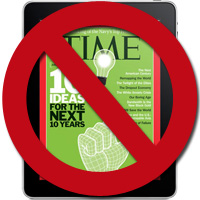
  • Am I Really Going to Pay $4.99 for One Issue of Time Magazine?

    Am I Really Going to Pay $4.99 for One Issue of Time Magazine?

    I blogged last week about how excited I am that some of my favorite magazines are now available on the iPad.  Last week, I discovered that TIME Magazine has a free iPad app.  Turns out, the app is free, but issues are not.  Each issue is $4.99.  $4.99!  When a print subscription is $20 through Amazon!

    A recent article in Ad Age Daily tries to explain why we should expect to pay more for online subscriptions on the iPad.  According to Ad Age, we should expect to pay $4.99 for an issue of TIME, Popular Science, Maxim, Popular Photography, Sound and Vision, Transworld Skateboarding and Islands because publishers are suffering, there are fewer tablet PC owners, and magazines are still burdened by their huge editorial costs.

    But here’s the rub: I purchased an issue of TIME for $4.99 and discovered that the content was the same as my print issue!  C’mon, TIME.  I pay about $0.50 for a print issue, but you want me to pay $4.99 for the same thing!  If you’re going to charge me a whole lot more, I expect a different experience and additional content I can’t get elsewhere.

    This reminds me of publishers that put up PDF versions of their print publications and post them to the Web site.  It’s easy to do and gets the job done.  Problem is, the Web is a different medium from print.  Have you ever tried to read a PDF of a print magazine?  Try going from page 2 to page 36 on a Web browser.  Try reading a two-column page that scrolls up and down past two screens on a monitor.    And now companies are putting out software that will take print files and convert them to iPad apps!  Once again, ignoring the usability and user experience capabilities of the device and merely re-purposing content.  How does this create value?
    (more…)

  • Are You Ready to Ditch Your Paper Subscriptions?

    Are You Ready to Ditch Your Paper Subscriptions?

    More and more of my clients are making the decision to eliminate their print magazines and newsletters. They’re choosing digital versions of their publications over print to eliminate printing and mailing costs, achieve immediate delivery, and occasionally, create personalized versions based on customer preferences.

    All of this makes sense to me.  I get most of my information via e-mail these days, and I’m subscribed to dozens of newsletters via e-mail and RSS.  And in an effort to minimize the “piles” at home, I have canceled all but a few paper subscriptions.

    But I got to thinking:  Am I ready to ditch ALL of my paper subscriptions? Am I ready to cancel my print subscriptions to my favorite magazines, namely TIME, Smithsonian and Stanford magazines?

    Here’s my concern about all digital publications:  it’s easy to ignore an e-mail newsletter as just another e-mail in the hundreds I get every day.  Consider this:  when my copy of TIME magazine arrives on Saturday, it ends up in my “to read” pile. This pile gets shuffled around from dining room table to coffee table to bedroom side table.  Each issue sticks around until I read or skim it, then toss.  But here’s what happens with some of my e-mail subscriptions:  if I have the time, I read them on the spot.  If I don’t have the time, I may leave them in my inbox or move them to a “read” folder for later reading.  Trouble is, with the flood of e-mail that I get, I rarely get to my e-mail read pile. And sometimes, in an attempt to gain back control of my inbox, I delete a huge group of e-mail newsletters and start over.

    Ugh, so much for the future of publishing.  What is the balance that content organizations should try to achieve between print and digital?  And if digital is your only future, how do you ensure delivery and readership? I have some thoughts:
    (more…)

  • What’s All the Fuss About Facebook’s Open Graph and Privacy Policies?

    Remember when Facebook was a closed network, open only to college students? Then Facebook went mainstream and everyone could create a profile. But even back then, Facebook remained a closed network: you had to have a Facebook profile to see other profiles and connect with friends.  Facebook was closed to Google and other search engines, which meant Facebook profiles and pages never showed up on search results.

    Back in 2005, Facebook’s privacy policy clearly stated the following:

    No personal information that you submit to Facebook will be available to any user of the Web Site who does not belong to at least one of the groups specified by you in your privacy settings.

    The Evolution of Facebook’s Privacy Policies

    But then, slowly and over time, Facebook’s privacy policies changed.

    • In 2007, Facebook made your name, school name and profile photo available to the search engines unless you specifically prohibited this in your privacy settings
    • In 2009, Facebook revamped its privacy settings and gave users more control over who gets to see which aspects of their profile.  Trouble was, the default gave “everyone” access to information.
    • In April 2010, Facebook made the decision to make specific elements of all profiles public (name, hometown, school, interests and fan pages), and eliminate the ability to limit access to these fields.  If you didn’t want those elements to be public, Facebook recommended that you delete the information from your profile.
    • In April 2010, Facebook also launched the Open Graph, which shares user profiles with third party sites so that visits to those third party sites can be personalized based on a person’s Facebook interests.  On the flip side, Facebook opened up its API (application programming interface) so that third party sites can add a Facebook “Like” button to their pages; when clicked, the information would be saved back to a user’s profile.

    The Electronic Frontier Foundation has a great timeline of Facebook’s privacy policies, including links to archived versions of Facebook’s policies.

    (more…)

  • “Become a Fan” Has Been Replaced with “Like” on Facebook Fan Pages

    “Become a Fan” Has Been Replaced with “Like” on Facebook Fan Pages

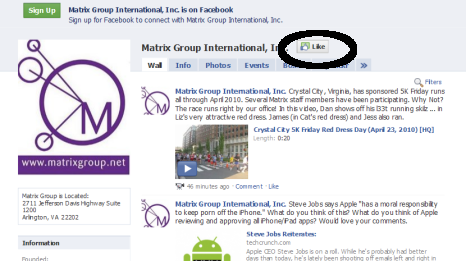
    In late March, Facebook announced that “Become a Fan” would be replaced by “Like” on Facebook fan pages.  The change rolled out in early April and today, the ubiquitous Facebook “Like” button is on all Facebook fan pages, next to the company/organization/page name.

    Image of Matrix Group Page on Facebook

    Facebook’s Rationale for the Change to “Like”

    Facebook says it changed “Become a Fan” to “Like” to offer businesses a more light-weight and standard way to connect with people, things and topics in which you are interested.

    In addition, changing to “Like” aligns with Facebook’s overall strategy of populating the Web with “Like” buttons so that Web surfers can announce their like of pages anywhere around the Web and have these “likes” posted to their personal Facebook pages.  (More on this in a future blog post.)

    It seems Facebook wants to corner the “Like” market.

    For the Most Part, Facebook Pages are NOT Changing

    Aside from changing the language in the button from “Become a Fan” to “Like,” the Facebook pages aren’t really changing.

    • Status updates on Facebook pages will still appear on fan (er liker) profiles.
    • Facebook page owners can still call people who like their pages “fans.”
    • When a Facebook subscriber “likes” a page, it will show up in their Profile under Info –> Pages.

    What IS Changing About Facebook Pages

    • Facebook now allows you to customize the order in which Pages appear on your profile. You can even move some Pages behind a “See all” link, so that you can still connect to Pages without displaying all of them prominently on your profile.
    • Instead of seeing a random selection of fans + a link to See All, there are now two boxes:  “xx Friends Like This” tells you how many of YOUR friends also “like” a page while “xx People Like This” tells you the total number of likers or fans.

    (more…)

  • Twitter, Facebook, MySpace, LinkedIn, Amplify, Posterous – Which Social Networks Should You Be On?

    Twitter, Facebook, MySpace, LinkedIn, Amplify, Posterous – Which Social Networks Should You Be On?

    I’ve been on Twitter, Facebook, and LinkedIn for some time now.  I’m also on FoodBuzz, Plaxo, Delicious and StumbleUpon.  Most recently, I signed up for FourSquare, Amplify and Buzz.  FourSquare is a location-based social network that allows  subscribers to check-in from their current location using their mobile phones and provides tips and recommendations.  Amplify asks “users to share news and information they find thought provoking and conversation-worthy,” not anything and everything about their lives, status and locations.  Buzz is the latest offering from Google that lets you share updates, links, photos and videos.

    Now that I’m signed up for all of these services, I’m asking myself these questions:

    • Which social networks should I be on personally and professionally?
    • Most of the social networks let me share out updates from one network to another; should I share out my tweets or does that defeat the reason to be on multiple networks?
    • Am I reaching a different audience on each network or will I be talking with the same group of social network-obsessed friends and colleagues?
    • Just how many networks is practical for me to keep updated without losing my mind?

    To try and get some perspective on these questions, I turned to my friend Jill Foster, social network guru, video blogger, and co-founder of DC Media Makers.  Jill has over 5,000 followers on Twitter, nearly 600 Facebook friends and she’s prolific on what seems like every major social network.  Here’s what she has to say about being active on at least a half dozen platforms:

    There are online networks where my content may overlap but that’s intentional and less frequent.

    Twitter:
    It’s my central hub of online conversation plus a place to observe other users’ content –  and share content I produce.  Twitter frankly goes beyond a business platform for me.  Twitter is a liberal arts engagement pool (with a water cooler chat mentality mixed in) that never stops.

    Twitter Search:
    If I want to virtually attend a conference – I follow that conference’s hashtag or the feeds for those able to attend in person.  Also, to observe and engage on core topics of interest with people, I keep certain Twitter feeds active, e.g., women entrepreneurs, public figures, public speaking, social media.
    (more…)

  • Why Do We Get So Upset When Facebook Changes Its Interface?

    Why Do We Get So Upset When Facebook Changes Its Interface?

    In the last twelve months, Facebook has made some major and minor changes to its interface. Each time they did this, there was hundreds of blog posts decrying or applauding the changes.  There’s even a group called “I Automatically Hate The New Facebook Home Page.”

    Why do we get so upset when Facebook changes its interface?

    In looking at some of the blog posts and news articles, I can understand many of the complaints. For my part, I cannot figure out the difference between News Feed and Live Feed. But I love that it’s easier to get to my Inbox and see which of my friends is currently online. I also think that Facebook generally does a great job of explaining why they have implemented specific changes.  I thought this Guide to the new Facebook Home Page was especially good.

    Psychologists tell us that most humans are averse to change. With over 350M users, any change then to Facebook, no matter how small, is bound to upset some segment of the user base. And if just 1% is unhappy and vocal, that’s still 3.5M people.  If 0.1 were unhappy, that would be 350,000 people!

    All of this got me thinking. Matrix Group is in the business of redesigning Web sites. We work with clients who want to redesign their sites for all kinds of reasons: name change, the navigation is not intuitive, the company’s focus has changed, yada, yada. But if Facebook users are any indication of how averse we are to change, no matter how rational, articulated or needed, there is always going to be a segment that is unhappy. This unhappy user base may be vocal about it, which I think is a good thing because then you have an opportunity to respond to the concerns.  If the user base is unhappy and silent, then you’re in trouble because you don’t know you have a problem.
    (more…)

  • Companies Beware! Unhappy Customers are Turning to Social Media

    Companies Beware! Unhappy Customers are Turning to Social Media

    Last week, I blogged about how a social media site like YouTube represent the future of advertising. But social media can also represent the anti-advertisement: bad reviews from unhappy customers who are eager to spread the word about a company’s failings. Witness the following:

    • My friend Tanya runs a blog called NitpickyConsumer.com.  Tanya blogs about good and bad customer service, companies that don’t seem to care, companies that just don’t get it.
    • This disillusioned Dell customer created a Dear Dell rant on YouTube that has garnered over 32,000 views and nearly 1,600 comments!
    • Check this one out.  Dave Caroll wrote a song and created a video about United Airlines breaking his guitar.  The video has been viewed over 8 million and generated nearly 43,000 ratings (average 5 stars).  Ouch.
    • And don’t forget the millions of updates that subscribers to various social networks fire off every day about their experiences.  Many are about lousy customer service.  Do a search on Twitter for “comcast sucks” or “verizon sucks” and you’ll never run out of tweets.

    As marketers, we’re always trying to position or brand our companies.  But Harvard Business Review says your brand is no longer your own” because anyone can go online and talk about your company and its offerings. And when our family, friends and colleagues talk, we listen.  A recent survey sponsored by Tealeaf.com found that “74% of online adults said negative comments read online have an influence on whether they will do business with a company.”  Wow.
    (more…)

  • The Future of Advertising

    It’s got to be tough being in the advertising business these days. DVRs (digital video recorders) are allowing viewers to skip commercials, premium channels offer fewer advertising opportunities, circulation numbers for print publications continue to spiral downwards, and research shows that most users avoid anything that looks like a banner ad on a Web page.

    Ugh, so what’s an advertiser to do?

    This morning, I had the pleasure of seeing Dave Nelsen, President of Dialog, talk about social media for business.  While discussing YouTube, Dave showed us a video that he called “the future of advertising.”  The T-Mobile Dance is a 2:41 minute video of commuters at Liverpool Station in England dancing their hearts out.  As more and more people join in, onlookers snap photos, take video and share the experience with their friends through their T-Mobile phones, of course.

    Dave made the point that this video represents the future of advertising because:

    • The company got me to willingly watch a loooong ad. This would never happen on TV!
    • Because YouTube allows comments, over 16,000 people have commented on this video, creating incredible buzz and feedback for the company.
    • The video was so successful that T-Mobile created a YouTube channel for its “Life’s for Sharing” campaign.  Fans can even create their own videos and T-Mobile posts the best of the bunch.  There’s a video of a Korean baby singing Hey Jude and a singer jamming from atop a bus. How’s that for a user-generated content strategy?

    (more…)