Matrix Group International

Category: Content Marketing and Social Media

  • The Personalized, Social Web or Why Your Organization Needs a Social Sharing Strategy

    The Personalized, Social Web or Why Your Organization Needs a Social Sharing Strategy

    SEO (search engine optimization) changed forever when Google integrated Google+ into its Google search results a few weeks ago. Basically, Google is now personalizing (to a much greater degree than before) its search results, based on the links and +1 recommendations of people in your Google+ network. Check out the example below.

    I did a search for Don Cornelius, creator of Soul Train, on Google. At the top of the search results, there’s a note that tells me here are 20 personal results, or 20 links or posts that mention Don Cornelius by people in my Google+ circles.

    If I click on personal results, I see the full search results list, but with the personal links at the top of the list. Holy smokes! That means that the Washington Post article on Don Cornelius, which was previously at the top of the page, just got overtaken by a link on nerdist.com because someone I follow and interact with a lot posted that link on his Google+ page!

    This is just another example of how Google is heavily favoring its Google+ social network and another giant reason to:

    • Create a Google+ page
    • Encourage social sharing of your content across all social media platforms (e.g., Facebook, Twitter, Google+), but especially Google+

    A study by Nielsen back in 2009 found that 90% of people 25,000 people surveyed “trust recommendations from people they know, while 70 percent trusted consumer opinions posted online.” This makes intuitive sense. Think of all the people in your Facebook network who ask for recommendations for a contractor, camera or pediatrician. And consider the crazy, huge influence of mommy and wedding bloggers.

    So, what’s your social sharing strategy? It could be as simple as making sure there is a Share This link on all of your articles, meetings and products. Or you could actively ask your customers and members to recommend your products and service to their networks in your e-mails, tweets, and e-newsletters.


  • How a Nation Got Educated About SOPA and PIPA

    How a Nation Got Educated About SOPA and PIPA

    The PROTECT IP Act (Preventing Real Online Threats to Economic Creativity and Theft of Intellectual Property Act of 2011 or PIPA), which was introduced by Senator (D-VT)  on May 12, 2011, aims to give the US government and copyright holders additional tools to curb access to “rogue websites dedicated to infringing or counterfeit goods”, especially those registered outside the U.S. On the House side, the Stop Online Piracy Act (SOPA) was introduced by Rep. Lamar S. Smith (R-TX) on October 26, 2011. The bills had bipartisan support and were expected to sail through Congress.  But today, passage of the bills are is looking more and more unlikely as SOPA and PIPA opponents’ voices grow louder and members of Congress are flooded with calls and e-mails about the bill.

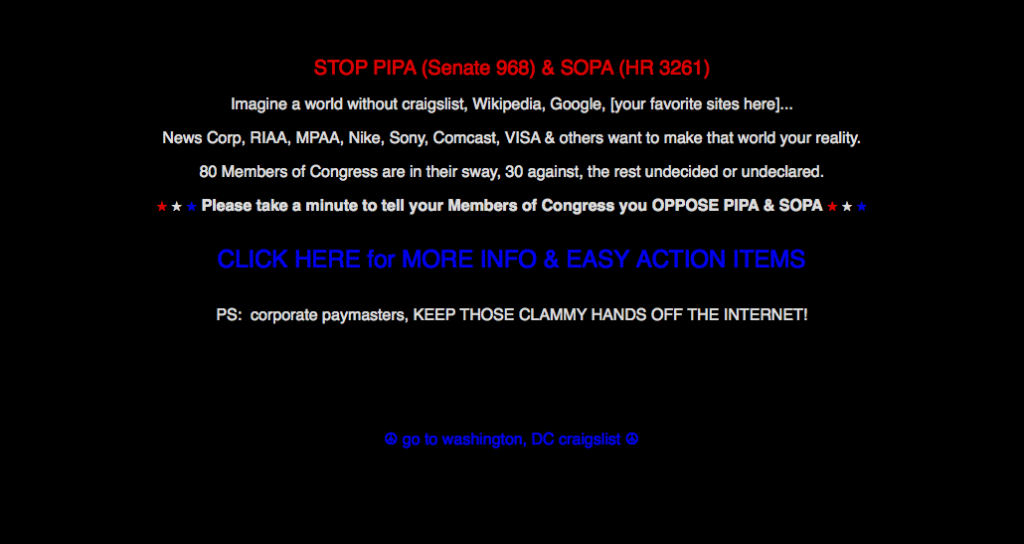
    Unless you live under a rock, you’ve no doubt read about, heard about and discussed the SOPA blackout that’s happening all over the Web. Web giant Wikipedia has gone dark to protest SOPA and PIPA, while others like Craigslist, Google, Wired, WordPress and dozens of other sites have put prominent messaging and graphics that clearly show opposition to the proposed legislation. Wired and WordPress show large portions of their home pages blacked out as if they have been censored.

    Wow. Let’s just stop and consider the reach of these Web site giants.

    Google is ranked by Alexa as the number 1 site in the US and is visited by half of ALL global Internet users daily. So at least half of us today got messaging from Google about SOPA and PIPA. If you use the search tool embedded in your browser, you missed the black censor bar over the Google logo and the simple plea to: Tell Congress: Please don’t censor the web!, but the Google logo is still blacked out in the top left corner of all pages.

    If you ignored Google’s censor logo and call to action, you probably did a search on Google and found a link to Wikipedia, which was blacked out for the day (just the English version). Alexa says Wikipedia is the 6th most popular site on the Web, so millions of us didn’t get to use Wikipedia to look up names, places and things.

    If you were looking for a job, car or apartment today, you probably went to Craigslist, the 9th most popular site in the US. Although Craigslist did not go completely dark, an intro page urges everyone to oppose SOPA and PIPA.

    And oh yeah, even though Facebook and Twitter didn’t join the dozens of sites that participated in the SOPA blackout, the conversations on these sites were dominated by SOPA and PIPA.

    And then of course, there was the overwhelming coverage about the SOPA blackout by mainstream press, alternative press and bloggers.

    All of this means that today, January 18, I would bet that the vast majority of American got some kind of exposure to SOPA and PIPA, most of it negative. And if just a fraction of the millions of Google, Wikipedia, Craigslist, Reddit, Wired, WordPress (and on and on) users took action and contacted their representatives and Senators, today was a very busy day on Capitol Hill.

    That’s one heck of a grassroots movement. How about you? How many sites did you visit that had some mention or call to action re: SOPA and PIPA? Did you contact your representative in Congress?


  • Time to Create a Google+ Page for Your Organization

    Time to Create a Google+ Page for Your Organization

    On Monday, Google opened up Google+ and allowed companies and brands to create corporate pages. Previously, only individuals could create Google+ profiles (believe me, we tried to create a corporate page and were thwarted by Google!).

    If you haven’t done it already, I encourage you to create a page for your organization, company, brand or initiative by going to the Google+ Create Page.

    Even if you don’t know how or what you’re going to do on this new social media platform, I think you need to be on it because:

    • Google+ has 40 million subscribers and that number is growing fast. It’s nothing compared to Facebook’s 800 million subscribers, sure, but 40 million is still a big number.
    • Google+ users tend to be early adopters. According to Target Marketing, in the first few months of the network’s presence, the users were mostly young men, a third of users were between 25 and 34 years old and 59 percent of all visitors were male. This will surely change over time.
    • Just as there isn’t one TV network or channel that dominates anymore, chances are your organization’s target audiences are on various social networks so you probably need a presence on all the major platforms.
    • Google likes to drive traffic to its web properties, like YouTube and Blogger, so having a corporate presence on Google+ will be good for search engine optimization.
    • Google likes to integrate its offerings, so there will surely be really neat tools to tie together Google+ with Google Analytics, Google search, AdWords, Google Reader, Gmail, etc. For example, there’s already a way to +1 an article in Google reader. +1 is Google’s version of the Facebook “like.” I’m especially excited about Ripples, which is an interactive graphic of the public shares of any public post on Google+ to show you how a post has rippled through the network and help you discover new and interesting people to follow.

    My dilemma right now is that I don’t know how the Matrix Group Google+ page will be the same and different from our presence on Facebook. If you’ve ever heard me speak or if you follow this blog closely, you know that I preach a layered approach to social media where each platform has a different purpose and content strategy. There is overlap to be sure, but it’s best to have a different strategy for each platform to encourage your target audiences to follow you in multiple ways.

    As your marketing team ponders this same question of market positioning for your Google+ page, be sure to create your page early to reserve the name and have a presence for the early users who will be looking for you.

    Have you created your company’s Google+ page? How will you be using it to connect with your customers, prospects or members?

  • Why Your Receptionist Is Your Company’s Most Important Brand Ambassador

    Why Your Receptionist Is Your Company’s Most Important Brand Ambassador

    I was on the phone with a company receptionist the other day, trying desperately to reach someone in sales or customer service. Trouble is, the person I was speaking with could not have cared less about me or my needs. She kept repeating that she had no idea where anybody was, she could not leave her desk and all she could do was put me through to voice mail. You can imagine how that encounter made me feel about the company and their products.

    In the corporate world, it’s conventional to believe that the person answering the phone is the lowest person on the totem pole. Worse yet, many companies believe we can replace receptionists with automated attendants: ring the doorbell for service or dial by extension.

    Me, I’ll always have someone answer our main line because most people calling Matrix Group are customers who need help or prospects who need our services. So you better believe I want a warm, friendly, knowledgeable and committed person answering our phones! And because it’s not always clear to people who does what in a Web agency (do you talk to the programmer or a front-end developer or the PM about an error on your admin site?), a good receptionist can field and route calls efficiently.

    My Creative Director Alex Pineda says that every employee is a brand ambassador for the company. So my receptionist, as the person who perhaps has the most contact with the most people, is arguably the most important brand ambassador I have. Which is why her title is First Impressions Officer. The other admins in the office, who also share customer interaction responsibilities, are equally important brand ambassadors.

    Scott Spanbauer defines a brand as “more than just your company image. It also includes your customers’ experience and the expectation you set when doing business with your company. In short, it is (a) promise.”

    As a CEO, I may set the tone for our corporate culture and brand, but it’s my staff who live and reinforce it with our customers. Company owners everywhere, remember that your customers’ experiences start with the person who answers the phone and greets people at the door.

  • How Are You Integrating Google Plus Into Your Life?

    How Are You Integrating Google Plus Into Your Life?

    So I’ve been on Google Plus for a while now. Actually, I’ve had an account for a while now, having received an invitation early, but I rarely post updates and I rarely read updates from my various circles. I’m simply struggling to integrate it into my life.

    It’s not that I don’t like Google Plus. On the contrary, I like the interface, I like that it’s so easy to add people to circles and post updates to only specific circles, and I like that the interface is (for now, at least) nice and clean, not cluttered with ads.

    It’s just that I’m feeling saturated. I already have my routine of posting interesting news items to Twitter, posting personal updates on Facebook, uploading my weekly video interviews to YouTube, checking into FourSquare when I go out to eat or visit a new place, and blogging once a week.

    The question for me has become: what place should Google Plus occupy in my life?

    I guess I could simply post the same updates to a bunch of social networks, but that doesn’t make sense to me. If I’m connected with the same people on multiple networks, they would see the same posts and that’s no fun and a waste of time.

    Perhaps Google Plus will become, like Twitter, another public persona for me, whereas Facebook is the network I reserve for family, friends and close network.

    Sean Parker, a co-founder of original music file-sharing service Napster and a prominent Facebook shareholder, says that, “power users have gone to Twitter or to Google+.” Could this be true? In my case, my techiest of friends and co-workers seem to be more active on Google+ these days but my network is still firmly on Facebook. And yet, Google+ is grabbing subscribers fast. GooglePlusWiki says that there are now over 20M people on the network.

    After pondering this issue for a while now, here’s where what I’m thinking. Although the majority of my network is still not on Google+, I need to be on it. Because no one network will dominate and it will be hard to ignore Google+. Just as I tell clients that they need to be on Facebook, Twitter, YouTube, LinkedIn and Flickr because their audiences are on these networks, I know that I need to be on all the major networks personally. I will figure out where to find the time to post to Google+. I will repeat some posts because there is some overlap in connections but it’s not 100%. I will hope that HootSuite will soon let me post to Google+ in addition to Twitter and Facebook. And I will figure out what brainspace Google+ will occupy.

    How about you? Are you on Google+? What is Google+ doing to your Facebook and Twitter updates? Are you posting different things? How are you integrating Google+ into your day?

  • Why Your Organization Needs a Mobile Strategy

    Why Your Organization Needs a Mobile Strategy

    Woman on a mobile phoneDuring a meeting with other CEOs last month, I noticed that nobody pulled out their laptops; instead, every person with a device was using an iPad. At least two of my clients have said they’ve turned in their laptops in favor of tablets. And a mom friend says she manages her entire household with her blackberry.

    In case you hadn’t noticed, the world is going mobile. Check out these amazing statistics:

    Which is why I think every organization needs a mobile strategy. Here are my top recommendations for getting started:

    Include Mobile in All Of Your Marketing and IT Activities

    Over a dozen years ago, I urged clients to be the person in the room who always said, “what about the Web?” Today, appoint yourself as the person who says, “what about mobile?” Know what tools you have available in your mobile toolbox, including mobile stylesheets, mobile sites, text messaging, and apps. Talk to your customers and ask them if, how and when they access your website and e-mails on a mobile device.

    Budget for Mobile Initiatives

    I believe mobile needs its own line item in your budget or it needs to added to your marketing and IT activities. For example, do you have the hardware you need to view your website on an iPad, Android phone, iPhone, iPad or Android tablet? Be sure to ask your Web partner (like Matrix Group!) to help you budget for mobile, whether it’s developing an app for your convention, designing a mobile version of your website, or using text messages to generate traffic at your exhibit hall.

    Planning a Website Redesign? Plan for a Responsive Design!

    Here at Matrix Group, we’re really excited about building websites that look and behave differently depending on the size, platform and orientation of the device, including widescreen monitors, standard size monitors, tablets and smartphones. Responsive Web design uses a mix of flexible grids and layouts, images and javascript to customize the experience for the device. For example, if I’m looking at a website on a smartphone, the large branding area could disappear and the horizontal navigation might turn into vertical text navigation. If your organization is thinking of redesigning your website, please consider a responsive design. You will spend more time and money on wireframes and design, but the results will be worth it. Just imagine: less pinching and squinting for smartphone users and lots of gestures and swipes on tablets.

    Pay Attention To Your Mobile Stats

    As always, pay attention to your usage reports. Google Analytics has a whole, new set of reports that tell you what your mobile users are doing and what devices they are on. I’m using our usage reports to figure out what functions to include in a new mobile version of our MatrixMaxx software since we don’t believe mobile users want to use ALL database function.

    How about you? What’s your organization’s mobile strategy? How are you getting started? What kind of results are you seeing?

  • Does Your Organization Have a Social Sharing Strategy?

    According to a study by ShareThis, the social sharing widget that you see on many websites, Facebook accounts for 38% of sharing traffic on the web. And that’s just the percent of people who click through. If you add links shared but not clicked, the number goes up to a whopping 56%. Which means that if we (the collective “we” since there are over 700 million of us now on Facebook) want to share a link with the world, we do it through Facebook.

    This totally makes sense to me. When I find something new, cool, interesting, amazing or whatever, I immediately post it to Facebook and Twitter (increasingly, Google + as well, but more on that in a future blog post).  And I rely on my network of friends, co-workers, clients and business colleagues to find out about other new, cool, interesting and amazing things.

    So I got to thinking. If social sharing is an important means by which we (again, the collective “we”) learn about new sites, we can’t and shouldn’t leave this sharing to chance. Sure, most websites now have a ShareThis widget, but is this enough? I say no. I think every organization needs a social sharing strategy that includes the following:

    • What you want people to share. Do you want visitors to share your home page? Individual articles? Donation pages?
    • How you want people to share. Do you want visitors to send an e-mail, post to their social networks, save to their social bookmarking pages, all of the above?
    • Regular review of analytics to find out what and how people are sharing links on your site. Be sure to review your usage reports, ShareThis account and other reports to find out what’s popular, how people are sharing, and learn why certaini articles or posts generate activity.
    • Design and CSS guidelines that make your site shareable. For example, if you share a link on Facebook, Facebook automatically indexes the images and allows you to cycle through the images and select one to include with the link. If your organization logo is set up as a background image in your CSS or the logo is not whole, your logo can’t be included in the link.
    • Calls to action to encourage sharing. While many of us will share our favorite links on our own, other won’t unless prompted, so I think it’s important to have calls to action to encourage sharing. It’s also a good idea to test calls to action on a regular basis to find out which calls to action work best.

    The design and front-end team at Matrix Group has developed a set of guidelines for setting up web pages so that titles are complete and the proper images are included in links. Be sure to test the shareability of your site on a regular basis and address issues with your web design or maintenance team.

    How about you?  What’s your platform of choice for sharing links?

  • Your Organization’s Voice Should Be Different Across Platforms

    If you’ve attended any of my webinars or follow this blog, you know that I advocate strongly against posting the same updates and information across different communications channels. I think it’s a waste when organizations simply post their press release headlines to their Facebook or Twitter pages. But Joanna, you say, “what if I want to educate my members and the public about one, burning issue or I want to promote a new event or publication? What if I WANT to talk about one thing across, print, online and social media for a while?”

    My answer is this: post about that one topic but change the perspective, voice and interactions depending on the platform.

    Say your organization is pushing for a piece of legislation on Capitol Hill. You could issue a policy statement and repeat that statement across all platforms. A more effective strategy would be to:

    • Post the policy statement on the website. This policy statement will likely have a formal tone and reflect the position of the entire organization.
    • Write a press release on the policy statement and send it to your media list. This, too, will have a more formal tone.
    • Post links to the policy statement on Twitter, but with differing headlines, highlighting different aspects of your policy. You could also post third party stories, facts and figures that support your position; in this instance, you would be curating relevant content to bolster your position.
    • Feature interviews with members and customers talking about why they support (or oppose) the proposed legislation on YouTube and your blog. These interviews will feature member perspective in their own voices.
    • Have the CEO write a blog post about why the issue is important to the industry and members. The tone of the blog post should be conversational and personal.

    If you are promoting a new publication or report, you could:

    • Feature the publication in your online store and what’s new section of your website. These descriptions should be compelling but more formal.
    • Post an audio excerpt on your YouTube channel and iTunes. The excerpt could be done by the author.
    • Post key findings and highlights to Twitter. The most effective tweets are thought-provoking and compelling.
    • Feature the publication on Facebook and sponsor a discussion with the author for a 7-day period. A discussion will allow a dialogue about the issue and foster a different kind of member interaction.

    Finally, if you are marketing a convention or event, you could:

    • Mail a 4-color brochure with full meeting information.
    • Mail and e-mail postcards (e-cards) that showcase the different benefits of attending the event. The tone of these pieces should be urgent and compelling.
    • Tweet conference news (number of exhibitors, confirmation of keynote speakers, etc.) and third party news that highlight the importance of the issues to be covered at the event
    • You could test different calls to action in e-mails and posts. Some calls to action could focus on benefits, some could inspire fear, while others could discuss opportunities.
    • Feature YouTube interviews or presentation highlights from the featured speakers.
    • Offer a hosted discussion with the speakers for a 7-day period on Facebook.

    Our jobs as marketers are so much harder because we are marketing to multiple generations, there is no one platform that allows us to reach all audiences, and people are motivated by different things. Having a layered messaging strategy that utilizes the capabilities of each platform and features different perspectives and voices will help you reach and connect with your audiences better.

    How about you? How are you marketing your products and services? And how does your message or approach change with each platform? What’s working?

  • The Matrix Minute is Born!

    The Matrix Minute is Born!

    Even though Matrix Group has had a YouTube account for years now, we weren’t doing much with it. Well this past week, we finally, fully integrated this platform into our overall marketing and social media strategy by launching a new series called The Matrix Minute.

    Why so late to the YouTube game? As I’ve explained before in previous blog posts and webinars, I believe that it’s important to create a layered experience across different media. In other words, don’t just post the same stuff to Facebook, Twitter, your website, YouTube, your blog, etc. Have an overall strategy, but take advantage of each site’s capabilities and culture to maximize followers across all platforms.

    Until recently, we didn’t have a clear idea of how we wanted to incorporate YouTube into our marketing, sales and client engagement strategy. We had videos from Matrix Group staff events, but we had reserved our Facebook page for information and posts about the project we’re working on and corporate culture. I didn’t want to use YouTube as another place to promote corporate culture. And until we hired a new Marketing Coordinator, we didn’t have the bandwidth to staff an active YouTube channel properly.

    But this past week, we launched The Matrix Minute, which is a series of interviews with in-house and outside experts who discuss web technologies, mobile technologies, social media, design and web development. Occasionally, we’ll feature local CEOs who will talk about leadership and what their organizations are doing to stay relevant and vibrant.

    Here’s how the Matrix Minute fits into our overall sales and marketing strategy:

    • As a company, we’re extremely committed to ongoing education for staff and clients so content-rich interviews make sense for us.
    • It’s a way to showcase the expertise we have within the staff.
    • It’s a way to leverage the expertise of our clients and partners.
    • It’s a way to continue demonstrating thought leadership.
    • We get to show off our video production capabilities.
    • YouTube is owned by Google and Google favors keyword-rich videos and descriptions so the channel is good for search engine optimization (SEO).
    • It’s a way to layer YouTube into our strategy in a way that’s new and different from what we’re doing on our website and social media.

    The Matrix Minute has also been a lot of fun.  So far, I’ve been doing all of the interviews and I’m learning a ton. Ray Stankiewicz, New Biz Manager at Matrix Group, is the producer and Melissa Bader, Designer at Matrix Group, does the video editing.

    We’ve got a half dozen interviews already online. For example, Jill Foster of Live Your Talk talks about videoblogging. Jennell Evans of Strategic Interactions shares her tips for managing remote teams. And Sherrie Bakshi of Matrix Group talks about why 2011 is the year to start a corporate blog.

    BTW, we call it The Matrix Minute, but the interviews are usually 2-3 minutes long. 1 minute just didn’t provide enough time for a meaningful interview and Matrix Minutes sounded goofy.

    I hope you’ll check us out on YouTube (http://www.youtube.com/MatrixGroup) and you’ll rate, comment and subscribe. Tell us what you think of our latest initiative!

  • Thank Goodness Someone Bought Delicious or Why I’m a Prolific Social Bookmarker

    Some of you know that I’m a prolific social bookmarker. I use a social bookmarking site called Delicious to store and organize my Web bookmarks. I don’t use the bookmarking function in my Web browser because I use too many devices every day: my Sony laptop when I’m at work, my Apple laptop when I’m at home, and my iPad and Palm Pre smartphone from everywhere. By using a social bookmarking site, I have access to all of my bookmarks from anywhere.

    But what’s even cooler about social bookmarking is that my bookmarks are public (unless I mark specific links private, which I do when they’re links to sites related to my children or my friends), which means I can easily share my bookmarks with others. For example, I use the RSS feed from my Delicious account (www.delicious.com/jmpineda) to share my bookmarks on this blog (check the bottom, right column), and I encourage my staff to access my bookmarks when they’re looking for Internet statistics or case studies.

    Finally, I love that I can create a taxonomy for my bookmarks. I’ve carefully created a list of categories that I’m interested in and whenever I bookmark a link, I associate that link with one or more categories. For example, I categorized an article on optimizing your Facebook page for search engines under the tags of Facebook and SEO. I have 148 tags and I bookmark sites nearly daily.

    So I was very happy to learn that social bookmarking of choice, Delicious, which had been bought by Yahoo! several years ago and then put on the block recently, had been purchased by the founders of YouTube. You see, I started my social bookmarking life on a platform called Magnolia. I loved Magnolia and still think the user interface is better than that of Delicious, but January 2009, Magnolia suffered a huge data loss and I nearly lost all of my bookmarks. So I switched over to Delicious and I never looked back. If Delicious had gone under (which was a possibility if no buyer were found), I could have exported my bookmarks, but it’s always hard switching platforms and getting used to a new interface.

    If you haven’t yet discovered social bookmarking, I encourage you to give it a try. Not only are my bookmarks easily accessible, I have found amazing resources by checking Delicious’ top links and exploring the bookmarks of other people. It’s fascinating when thousands of other people have bookmarked your same links and equally interesting when you’re the first person to save a bookmark.

    How about you? Are you a social bookmarker? What’s your platform of choice?