Matrix Group International

Blog

  • National Electrical Contractors Association Website Redesign

    National Electrical Contractors Association Website Redesign

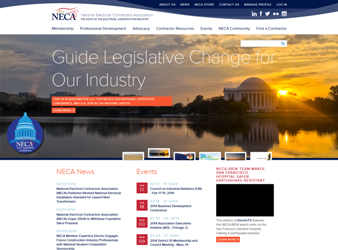
    The National Electrical Contractors Association (NECA)  is the voice of the $130 billion electrical construction industry that brings power, light, and communication technology to buildings and communities across the United States.

    NECA’s previous website had served its members successfully for more than four years, but the way electrical contractors do business is now changing and NECA wanted to ensure that they were providing members with information and resources they needed to grow.

    NECA joined forces with its longtime web partner, Matrix Group, to create a more robust, functional website that met the needs of its membership base. The new site:

    The new site:

    • Features a new “Contractor Resources” section.
    • Is now mobile-friendly. W
    • Is a user-centered design, using imagery that captures the diversity of the industry and what NECA members do.
    • Is implemented in the Sitefinity content management system.

    Check out the newly redesigned website at www.necanet.org.

  • Food Allergy Research & Education Website Redesign

    Food Allergy Research & Education Website Redesign

    Food Allergy Research & Education, Inc (FARE), is a nonprofit organization based in McLean, VA, that works on behalf of the 15 million Americans with food allergies, and was formed in 2012 as the result of a merger between the Food Allergy & Anaphylaxis Network and the Food Allergy Initiative. FARE aims to ensure the safety and inclusion of individuals with food allergies and to pursue a cure.

    FARE wanted to unify its brand, its mission, and its message under FARE, and to increase engagement with their members and the public.

    Here’s what we did:

    • Interviewed FARE leadership and members, including researchers, educators, parents and individuals living with food allergies, to ensure we had the most up-to-date, pertinent information to share.
    • With FARE, researched the websites of FAAN and FAI to determine how to most efficiently merge the site’s taxonomy and functionality.
    • Created new branding for FARE, uniting the themes of food, health care, and education.
    • Crafted a clean, user-friendly design for the new website, organizing the vast amount of information in an intuitive way, simplifying the experience for all visitors.

    Visit the redesigned site at www.foodallergy.org.

  • American Counseling Association Website Redesign

    American Counseling Association Website Redesign

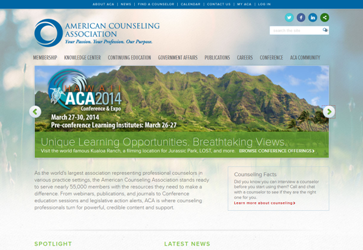
    The American Counseling Association (ACA) is a not-for-profit, professional and educational organization that is dedicated to the growth and enhancement of the counseling profession.

    As the world’s largest association exclusively representing professional counselors, ACA needed to redesign its website to support the demanding needs of counselors who serve in various practice settings worldwide.

    Matrix Group worked with ACA to completely revamp its website. Based on extensive interviews with counselors, ACA leadership and staff (part of our user-centered design process), Matrix Group updated the navigation, created a new design that reflected the association’s brand, implemented the website into a content management system and integrated it with ACA’s technology partners.

    The new ACA site:

    • Features dynamic topic pages in the Knowledge Center. 
    • Achieved single sign-on (SSO) between the Sitefinity CMS, the iMIS association management software, Wiley Publishing and Higher Logic‘s community platform.
    • Features a new MyACA section that gives counselors a snapshot of their profiles and makes recommendations for things to do and purchase.
    • Is now mobile-friendly. Counseling.org is responsive to users’ devices, whether it’s a smartphone, tablet or desktop computer.
    • Features a tutorial that introduces visitors to the site and teaches them how to use the site to get the most out of their membership.

    Check out the new ACA website at www.counseling.org

  • IRS2GO

    IRS2GO

    Tax season is here! This app plugs you in to the IRS on the go so you can access your existing tax records, as well as check the status of your 2012 return after it’s filed.

  • Why Rebranding Is Really Hard and Takes a Really Long Time

    Why Rebranding Is Really Hard and Takes a Really Long Time

    new-brandA couple of days ago, a Matrix Group client, a major trade association was quoted in a a major news story. The news organization quoted a statistic that the association promotes through its website, about the benefits of working with its members. The trouble was this: the name of the organization was wrong in the news story. You see, the organization had rebranded with a new name five years ago, but the news story still used the old name. This, despite a major effort to educate the industry, the press, trade publications, yada, yada. Ugh.

    For many years, I chaired a benefit auction for a local non-profit. The benefit was successful and well-known but one year, we were close to panic when ticket sales were much lower than anticipated. We quickly organized a phone campaign and found out something startling: many longtime benefit attendees did not recognize the name of the organization on the envelope. You see, the organization had rebranded with a new name three years earlier and we figured it was time to use the new name (on its own, without the “formerly” name) on the return address. Guess we were wrong.

    These stories point to the difficulties and challenges associated with rebranding campaigns, especially campaigns that involve a name change. Most organizations do a fine job communicating the changes via their websites, letters, postcards, emails, email signatures, voice on hold messages, advertisements in trade publications, and on and on. Trouble is, people aren’t necessarily paying attention. The letter, ad or postcard doesn’t register until your customer, partners and prospects decide they want to interact with your organization, on their terms, on their timeline.

    So what are the lessons here?

    • Know that rebranding is a long-term effort, it’s going to require constant and intense communications, and some people are still going to miss the message.
    • Use every communications vehicle possible to communicate the changes: website, email, letter, postcard, magazine article, magazine ad, banner ads, voice on hold message, email signature, video, news stories, etc.
    • Renew the old domain name and point it to the new site for as long as you can bear.
    • Make sure there are plenty of references to the old name on your website so that search engines will associate your new name with the old one.
    • Keep reminding your audiences of the reasons for the rebranding and reinforce the new name and images.

    How about you? Has your organization rebranded? What communications challenges did you face and how did you overcome them?

  • Shamrock Shake

    Shamrock Shake

    Only available for a limited time around St. Patty’s day, this shake is a guilty, but delicious, pleasure of mine. It’s not March without one!

  • I’ve Seen the Future and It’s Full of Screens

    I’ve Seen the Future and It’s Full of Screens

    I had the great luck to attend xPotomac, the fabulous conference about the future of the Internet, communications and social media earlier this week. One of the presenters  was Ken Yarmosh and he gave a great talk on how the future will be full of screens. Someone predicted that in the future, cities will be more like Japan, full of mobile devices of all kinds and digital billboards everywhere. Ken talked persuasively about 5 factors that will change how we interact with screens.

    Screen pervasiveness

    We are going to have more screens in our lives, screens of all kinds. Remember when every home had just one TV? Today, many homes have multiple TVs, tablets, smartphones, etc. New screens are coming: screens in our cars; refrigerators with touch screens; screens on our coffee tables for magazines, photos and game;, screens in our conference rooms to see satellite offices; screens in our showers for watching TV. As the technology costs go down, we will have more screens.

    Screen persistence

    I love this prediction. Ken says that screen persistence will allow us to start something on one screen and continue on another. If you read books on the Kindle or Kindle app, you know that you can stop reading on your phone and pick up where you left off on your tablet. In the future, you’ll be able to start a phone call in your car, continue it on your phone when you arrive at your destination, switch seamlessly to video conferencing on the fridge when you get to your kitchen, and switch to your HD TV when you go to your living room or conference room.

    Screens that know about you

    Remember the scene in Minority Report where Tom Cruise, with a surgically transplanted eye from someone else, gets welcome to a department store by name (the other guy’s name) and encouraged to buy something? Ken says that in the future, screens of all kinds (billboards, large and small) will know who we are, our physical characteristics, our interests, our purchasing history, etc., and project a personalize ad or message. Perhaps when you turn on your TV at home, it will let you know which of you favorite shows have new episodes waiting. It’s clear that we’ll need some type of system to grant or deny access to our information by all these screens. It’s going to be a big privacy  mess but marketers will be all over the opportunities.

    Screens will know about themselves and interact with other screens

    Today, screens aren’t aware of other screens. But in the future, your iPad might automatically turn into a controller for a TV when you enter your living room. Or attendees at a conference can share content on their tablets while in the same meeting room. Related to screen persistence above, your device will pass calls and data seamless to each other. You’ll be able to start a game on one TV and then when dad comes home and wants to watch the game on that TV, your controller will let you continue your game on another TV.

    Screen interactions will change

    Today, we can type, swipe and do a little voice. In the future, we’ll be able to use voice commands to ask complicated requests of our devices. An example: “Pull up my 2015 tax return (which is presumably in the cloud somewhere) and tell me my effective tax rate back then.” You will be able to use your body to control screens (kind of like the Kinect, but more sophisticated). And touch commands like in Minority Report will become a reality.

    Project Glass from Google is an example of the new generation screen (it’s going to be a head mounted display, a pair of glasses) that will let us interact with the world in new and different ways.

    I don’t now about you but I am excited about this brave, new world that will be full of screens. Thanks, Ken, for sharing your predictions for the future! What prediction are YOU  most excited about?

  • Matrix Group Fundamental #4: Don’t Let Your Boss Make a Mistake

    I’ve blogged in the past about JP’s rules. After hearing a great presentation on company values by Dave Friedman to my CEO peer advisory group (i’m a member of Vistage) I decided to rename them Matrix Group fundamentals. The more I thought about it, the more I realized that JP’s rules are really a code of conduct, a set of rules that evolved over time and that provide guidance on “how to be” at Matrix Group.

    Dave says that while most companies have corporate values, most companies don’t do a good job of providing enough guidance about what those values really mean, how to interpret them and how to live them on a daily basis. So at his company, he started each week with an email to his staff about one of the fundamentals. He talked about what the fundamental meant to him and provided examples of how to live it. He then asked all staff to open each meeting with a quick discussion about the fundamental of the week.

    I’ve been following Dave’s advice for a few weeks now and I’m loving the results. A recent discussion about “It does or it doesn’t but never should” kicked off a lively debate at staff meeting and “Don’t let your client make a mistake” got the project managers talking. Here’s my most recent email about this week’s fundamental: Don’t let your boss make a mistake.

    Week of January 21, 2013
    Fundamental of the Week: Don’t let your boss make a mistake.

    One of the worst and saddest things for me is when I hear: well, I knew it was the wrong way to go, but I didn’t mention anything.” If I ever hear that, I know that the staff member, client or partner has checked out or is not committed to the success of the project. Or perhaps this person doesn’t feel they have the ability or power to say something because the person making the decision or talking at a meeting is a manager, VP, Director, or CEO.

    We are a company of experts. Each of us brings a unique blend of education, experience, background and skills to this company. Most of the time, most of us aren’t afraid to speak our minds; this is why we bring people together in meetings and have inter-disciplinary teams and projects.

    But what do you do when your manager just made the wrong call during a call with a client that *could* have long-lasting and negative consequences for us and the client?

    What do you when JP say something just totally wrong about what Sitefinity or the Google search can do?

    What do you when your manager says “this should take 2 hours” but you think it will be 4 or 6 or 8?

    In all of these cases, I believe that you all have an obligation to do something, say something. You clearly need to do it in a respectful way that doesn’t make your manager look bad or feel stupid, especially in front of a client. Here are some suggestions:

    After the call, ask for a few minutes and say to your manager, “hey, I have concerns about x. I think if we did that, this will happen. But if we do x, the client still gets what they want and the code will be x, y, z.” If you feel very strongly about a technical or artistic decision, you should feel free to bring this to Jason, Eric, Alex or even myself. Nobody will get thrown under the bus.

    If I ever say something totally wrong in a meeting, pull me aside after the meeting and say, “actually JP, Sitefinity does xx.” If it’s during the meeting and it’s important that the client have the info right there, you can always say, “excuse me, JP, but I’m pretty sure that the in a recent version of Sitefinity or CF or Google or whatever, that issue was addressed.” If you do it respectfully, you will actually make Matrix Group look good because a subject matter expert said something, contradicted the CEO and did it in a professional, respectful way. I will thank my lucky stars I brought an expert along!

    If you and your manager have completely different perspectives re: scope, then step back and say, “I think this will take much longer, here’s why. Can we chat for a moment to make sure we’re talking about the same scope of work?” Chances are, there’s been a miscommunication about the scope or the PM needs a little education. Either way, it never, ever hurts to clarify the work and the expectations.

    It turns out to be another time commitment to write what I hope are thoughtful emails on the fundamentals each week. But, as my coach Pete Schwartz always reminds me, one of my main jobs is to coach my staff and provide guidance for how to think and behave so that we are all in alignment and serving our customers well.

    How about you? What are your company’s fundamentals? How are you communicating your fundamentals to staff, especially new staff?

  • Time To Audit Your Privacy Settings – Everywhere

    Time To Audit Your Privacy Settings – Everywhere

    I got a new iPhone last year and configured it to upload photos to Facebook. Imagine my surprise when photos of me and my kids ended up public on Facebook, even though I have my settings set to all photos as viewable by Friends Only by default. So I dutifully reviewed all of my Facebook privacy settings, updated the viewing options for all of my photo albums and went on my merry way.
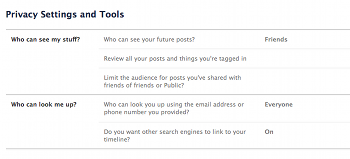
    I wouldn’t call myself paranoid about privacy and security on the web, but I do watch what I post online and I take advantage of privacy options, whenever available. Make it your New Year’s resolution in 2013 to audit your privacy settings on all social networks and think about what information you’re putting out on the web, private or not. Here’s my privacy punchlist to help you out:

    Be careful when uploading photos to Facebook via your smartphone. For some reason, Facebook sometimes doesn’t honor my default option to make photos Friends Only and I have to manually change the viewer settings on some photos.

    Beware of what other people can do to your posts and photos. Last month, Mark Zuckberg’s older sister posted a photo on Facebook that friends and friends of friends could see. A friend of a friend saw the photo, assumed it was public and tweeted it. What ensued was a very public conversation between Randi Zuckerberg and the tweeter Callie Schweitzer on Twitter. The media had a field day. Check out this story on Forbes.com. Folks, if you let them, friends and friends of friends can share your posts, share your photos, tag you in photos, yada,  yada.

    Remember that Facebook apps can access your personal information. Everyone seems to love birthdays and birthday greetings on Facebook. Well guess what? Even apps can access your birthday when you give them permission to access your Facebook account. And since knowing your birthday is a key piece in identify fraud, think about not sharing your account, or not putting your exact birthday (does that violate the Facebook terms of service?).

    Know that your company email account is not private.  Your personal gmail account is one thing, but all the courts have upheld the notion that corporations own employee accounts on corporate mail servers, which means they can audit and read your company emails at any time. Most companies even have policies saying they can and will do this when needed.

    But hey, even private email accounts aren’t always private. We might be shocked by the General Petraus affair, but equally of interest is how the FBI found the emails between General Petraus and Paula Broadwell in private gmail accounts. What started out as a cyberstalking investigation ended up bringing down a CIA Director! So assume that all of your emails could be made public and that they will exist on some computer or back-up for the next generation or two.

    Everything we do is  being tracked. When I stop to think about it, I cringe at the data that government and retailers are amassing about me. I use my American Express credit card for nearly all of my purchases, I use my rewards cards at places like Giant, Harris Teeter and Barnes & Noble, my E-Z Pass tracks where I’ve traveled on the toll road, Google tracks all of my searching history, Amazon knows what I like enough to buy, and Facebook knows where I’ve been, who my friends are and what I ate last Sunday. If you want to stop some of this tracking, don’t use a credit card, don’t use rewards cards, use a Do Not Track app on your computer (like Abine), logout of Google before doing searches, and turn off cookies or delete them regularly. For me, these steps aren’t exactly practical, but I offer them as suggestions for those who do want to limit tracking.

    Ultimately, I always try to remember that anything I do online on the web and in email could be made public at any time.

    How about you? How much do you care about privacy and security? Are you doing anything about your privacy settings or changing your behavior?

    Many thanks to my friend Shaun Dakin for his help with his post. Shaun is a huge online privacy expert and advocate. Find him on Twitter @shaundakin and Facebook at Dakin Associates.

  • National Geographic’s Photo of the Day

    National Geographic’s Photo of the Day

    Get a different, gorgeous photo every day, from around the world.