Matrix Group International

Tag: Strategy

  • Give Me a Reason To Give or Join

    Give Me a Reason To Give or Join

    My husband and I attended my son’s Cub Scout Blue and Gold Banquet earlier this week. At the end of the banquet, a representative from the National Capital Area Council of the Boy Scouts of America made a pitch for supporting the Boy Scouts with a financial gift. She did a nice job but what really convinced me was the brochure she handed out, which said:

    For every 100 youth who join scouting

    • 1 will use his Scouting skills to save a life
    • 1 will use his Scouting skills to save his own life
    • 18 will develop hobbies that will last throughout their adult life
    • and on and on

    Who are Boy Scouts?

    • 72% of Rhodes Scholars
    • 65% of the US Congress
    • 65% of male college graduates
    • 26 of the first 29 astronauts were Boy Scouts
    • and on and on

    Wow. With statistics like that, I’m keeping my son in Boy Scouts forever and I’m giving them money every year!

    Here’s another compelling statistic I heard recently. I’m a member of Vistage, which is a membership organization for CEOs. Vistage says that their member companies consistently outperform non-member companies. Based on the coaching and resources I get from Vistage, I believe it. Vistage is a big commitment of time and money, but totally worth it.

    How about you? What compelling statistics or facts can you share with your prospects to make them join your organization, become a customer or donate money?

    • If you’re an accrediting body, can you point to the top organizations that are accredited and how accredited companies have better safety/graduation/success rates?
    • If you’re a trade association, can you point to the top companies in the field that are members, your legislative record, and the success rate of your companies?
    • If you’re a professional society, can you point to the job rate and salary levels of your members, your contributions to the profession, and your profession’s rank as a top career?
    • If you’re a charity, can you point to your success in changing systemic problems?

    In thinking again about the Boy Scouts, what was effective about the pitch was this: I wasn’t being sold on the activities of the Boy Scouts, I was being sold on the outcome. The message was clear: Enroll your son in Boy Scouts and this is what he can become. I’m sold.

  • Does Your Organization Have a Groupon Strategy?

    Does Your Organization Have a Groupon Strategy?

    It seems everyone is hawking a good deal lately. A couple of people at Matrix Group recently got a 50% off deal from Groupon for a spa treatment. Earlier this week, AppSumo had a great deal on heat mapping software form CrazyEgg. Amazon has Daily Gold Box Deals. There are so many of these discount sites that there’s now a term for them: group coupon sites.

    A recent article in the Vancouver Sun reports that “frugality (is) the top consumer trend in 2011.” After this long recession and with many people still feeling uncertain about the economy, it only makes sense that we’re all trying to make our dollar go further by looking out for sales and coupons.

    I think that most people are looking for savings and value everywhere: when they’re shopping for clothes, booking travel, buying software, or registering for meetings. How does frugality affect your organization and what are you going to do about it? Here are some ideas:

    • Offer more for the same price. If you’re loathe to discount, I don’t blame you. But since most people are looking for a deal or extra value, what extra thing can you offer? Last year, when we announced the Matrix Group webinar series, we offered four webinars for the price of three to people who registered for the entire series. It worked really well for us because we got a lot of registrations to all four events and clients got a deal.
    • Create lightning deals. Most organizations offer an early bird registration fee. But what if you offered a steeper discount during just one day? Market the heck out of the deal, create some buzz and capture registrations early in the game. I call this the groupon strategy (I’m going to get sued for saying this, hope not).
    • Offer discounts for PR. When I got my haircut at Salon DeZen the other day, the stylist offered me 10% off my bill if I checked into Yelp. Owner Maria Burns knows that a check-in or a great review are worth way more than the few dollars off she’s giving away.
    • Create social deals. This idea isn’t new. In fact, it’s a classic campaign: refer a new member, registrant or purchaser and get a discount off your next bill. Encourage your clients and members to register for a meeting as a group and give them a break.

    I have a feeling that frugality is going to get even more chic and popular. How will YOUR organization take advantage of this trend? What’s your discount/value strategy? What’s worked for you?

  • Examples of Really Great Donation Pages

    Examples of Really Great Donation Pages

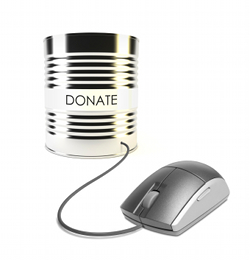
    mouse connected to a tin canEvery December, my husband Maki and I sit down and make decisions about our charitable giving. Once we’ve decided on the organizations and amounts, we go online and get everything done. What I’ve noticed is that most organizations have less than optimal donate pages or sections of their website. Here’s what I want from a Donate page:

    • Why I should give
    • What my money supports
    • An easy way to make a donation, preferably without having to create a login
    • If using a third party payment gateway or network, make it really clear to me what I’m going to see on my credit card statement
    • A statement that you won’t rent or sell my information to other charities

    Instead, what I usually find is a simple e-commerce form that simply asks me for my credit card information! What a waste of an opportunity to make the case for giving!

    So I scoured the Web and looked for effective donation pages. Here are some I love:

    Johns Hopkins Giving – This is a microsite devoted entirely to giving. I like the navigation: Why Give, Where to Give, How to Give, Calendar. I also like the branding area, which has great stories about Hopkins students and professors and doesn’t rotate too quickly.

    Humane Society – I like how the donation process starts on the home page through a simple form, then continues to a larger form. I think it’s effective to call donors heroes who stand up for animal rights.

    Meals on Wheels America – Without support from programs like Meals on Wheels, millions of seniors are forced to prematurely trade their homes for nursing facilities.

    Wounded Warrior Project – When you give to the WWP, you’re supporting an organization whose broad appeal reaches across demographic, geographic, and political boundaries. For us, it’s not about the war; it’s about the warrior.

    How about you? What are your favorite donation pages? Got any examples of donation page disasters?

  • Why Having a Baby Will Be Good For My Business

    Why Having a Baby Will Be Good For My Business

    I’m having a baby tomorrow (maybe sooner, we’ll see) and then I’ll be home with baby Marcus John.  For a few weeks at least, I’ll be dealing with lack of sleep, no set routine, and hundreds of diaper changes.  The big questions that always pop up when speaking with family, friends, staff, clients and vendors are:  How much time are you taking off and how will your office survive without you?

    The answer to the first question (how much time are you taking off?) is not clear cut.  When you’re a small business owner, you can’t exactly just disappear for a few months. When you’re the owner, the business is your baby, it’s part of your life and your identity.  That said, I’m giving myself the flexibility to work as much or as little as I want, come in when I feel I need to, and decide when I’m ready to come back to the office full-time.

    The answer to the second question (how will the office survive without you?) is “Just fine, thank you very much.”  In fact, just like the last time I was out with my first son, I expect the office to thrive. Here’s what I’ve done to prepare myself and the office for my absence:

    What Is It That Only I Do, or Can Do, At the Office?

    When I first announced to my management team that I was going to have a baby, the questions I asked of myself, the Directors and Project Managers was: “What is it that I do, that only I can do, that you rely on me to do?”  Then we got to work documenting the list and figuring out a plan for getting those tasks done in my absence.

    For example, I review the monthly billing reports after the Project Managers (PMs) have reviewed them to double check that we are properly marking work as billable or unbillable.  Over a period of a couple of weeks, I went over dozens of reports with the PMs, discussed why I question certain items and provided suggestions for how to handle ambiguous items and make sure clients are never surprised by their invoices.  The Director of Client Services will also now review invoices in my absence.

    Documenting What’s in JP’s Brain

    When you’ve been in the Web business for as long as I have (since 1994 but please don’t try to calculate my age!) and when you’re responsible for landing a lot of the company’s business, you just accumulate a lot of knowledge about clients, process, and projects. Even though I use our intranet religiously to document all of my communications with clients and prospects, there’s just a lot of knowledge that I carry around in my brain.

    So over the past few months, I worked with my team to document the strategies, best practices, and potential land mines I’ve encountered while working on myriad projects. I paid special attention to the project components that I tend to spearhead, including Goals and Personas, Content Strategy, Integration with a Back Office CRM (customer relationship management system) or AMS (association management system), CMS (content management system) reviews, and Social Media.  These are now called PM Guides and they live in our wiki. All staff are encouraged to modify them as needed.  The guides are reviewed before the start of each project, and the PMs are loving the sample agendas and notes for running meetings. (more…)

  • What Happens When Your Facebook Page or Blog Gets More Traffic Than Your Web Site?

    What Happens When Your Facebook Page or Blog Gets More Traffic Than Your Web Site?

    Every week, I check out the usage reports for the Matrix Group Web site and blog. I also look closely at the analytics reports from Facebook for our Facebook fan page.  In the last year, traffic on this blog has overtaken the traffic on the public Web site.  And as we increase the number of fans on our Facebook page, our interactions have grown steadily as well.

    A recent article in Ad Age explores how some of the top consumer brands have Facebook pages with a fan base and interactions that far outstrip that of their official Web sites. Starbucks has 12.9M fans; Coke has nearly 11M fans; Oreo has 8.9M fans.  Of the companies in the article, only Starbucks has steadily increasing Web traffic.

    All of this got me thinking:  What happens when an organization’s blog, Facebook, Twitter or other social media page gets more traffic than the official Web site? Is this the ultimate goal for marketers?  Is traffic on a social media site worth as much as traffic on a company Web site?  Does this increased traffic ultimately lead to more customers and sales?

    I have clients who worry about redirecting traffic to social media pages, for fear of losing control over the conversations, not owning the Web property, or that the interactions are not quite official enough.  Others hold their social media stats in the highest regard.  Most of us  wonder what it really means when somebody chooses to “like” our fan pages.

    How to make sense of all this?  Here are some thoughts:

    • If your Facebook page is getting increased traffic and interactions, while traffic on your regular Web site is on the decline, ask yourself, “What is it about my Facebook page that’s working?  What’s making people “like” us, click through to articles and comment?  What are the lessons for content and opportunities for interaction on our official Web site?”
    • Your goal should be to have your Web site, Facebook page, Twitter page, blog, e-mail campaigns, microsites, etc., all be part of an integrated strategy where each Web property is complementing the others and encouraging cross traffic.
    • Ultimately, the goal should be conversions, whether that means more sales, more subscribers, more members or more donations.  Your goals should never be about traffic on specific platforms; that’s just a tactic.
    • You need a way to track the effectiveness of followers, likes, clicks and fans across the different platforms.  Use tracking codes, cookies and marketing codes to determine which platforms are really helping your business to thrive.
    • (more…)

  • How We Doubled Our Facebook Fans and Raised Money for the Gulf Recovery Effort

    10 days ago, the Matrix Group Facebook fan page had 280 fans.  As of tonight, we have 576 fans, more than double our starting number. How did we do it?  We launched a campaign and created an incentive for people to “Like” us.

    The Background

    Matrix Group has had a Facebook fan page for a couple of years now and we had been slowly building up our fan base. We did all the usual things to generate new fans: we let our customers know about our Facebook page, we linked to it from our Web site and blog, we asked staff to invite their friends to “like” us, we included the link in staff e-mail signatures, and we asked our Twitter followers to fan us.

    I had recently read an article about how the Weekly World News got to 40,310 fans in 4 days (up from 3,244 fans!) and got inspired to launch our own campaign.  Weekly World News offered an exclusive video, they changed their ad daily, they did A/B testing on their ads and they leveraged their huge user base.  But what kind of incentive could we offer?  Unlike Snapfish, the photo printing site, which recently offered a coupon for a free 8 x 10 photo collage for “liking” its fan page, Matrix Group doesn’t have products to offer.  And we don’t have a customer base of tens or hundreds of thousands of people.

    The Campaign

    We decided to use good, old-fashioned corporate philanthropy to incentivize people to “like” us.  The campaign was incredibly simple:  we would donate $10 to a specific charity for every new fan we got between June 21 and June 30.  We selected the National Park Foundation’s (NPF) Disaster Recovery Fund in the Gulf to be recipient of our campaign.  NPF is a Matrix Group client and the entire Matrix Group staff, like the rest of the country, is upset about the Gulf oil spill.  Selecting this fund only made sense for us.  BTW, we put a time limit on the campaign because we know that people are more likely to act when they have a deadline; hence the June 30 end date for the campaign.
    (more…)

  • Sometimes It Pays To NOT Listen To Your Customers

    Sometimes It Pays To NOT Listen To Your Customers

    Photo of Joanna's iPadI got an iPad last week and I’m already in love with it. Yes, I already have an iPod Touch and I’m running a lot of the same apps on both devices, but somehow, the iPad experience is new and different.  Is it a tablet PC?  Not quite.  Is it a Netbook?  Definitely not.  So what is it and why do we need one?  More importantly, why do we want one?

    I find it fascinating that Apple has managed to capture the zeitgeist of our age and intuit our desires for computers and devices.  And yet, in a review of the iPad, Time Magazine reveals that, “(o)ne of the things that makes Apple unique is that it never holds focus groups. It doesn’t ask people what they want; it tells them what they’re going to want next.” 

    So how does Apple know what customers will want?  And what lessons can mere mortal companies learn from Apple’s product development process?

    A few years ago, the MatrixMaxx team at Matrix Group was developing the product road map for the coming year.  A couple of us were arguing for a total redo of the system’s user interface.  We also advocated a lot of new reports that basically repackaged data already available through exports.  The rest of the team argued that clients weren’t asking for these enhancements and it would be risky and a lot of time for little benefit to move forward with such a radical overhaul of our association management software.

    After a lot of bargaining re: scope and timeline, the entire MatrixMaxx team agreed to a redesign of the system’s user interface and a new export/report framework.  The effort ended up  behind schedule and it introduced a lot of bugs into the system.  And yet, when the dust finally settled and we got the bugs under control, the end result was fabulous and clients loved it.  The new interface makes it much easier to find information and gave the product a new vibrancy.  The export framework has been universally applauded by clients.
    (more…)

  • Why Do We Get So Upset When Facebook Changes Its Interface?

    Why Do We Get So Upset When Facebook Changes Its Interface?

    In the last twelve months, Facebook has made some major and minor changes to its interface. Each time they did this, there was hundreds of blog posts decrying or applauding the changes.  There’s even a group called “I Automatically Hate The New Facebook Home Page.”

    Why do we get so upset when Facebook changes its interface?

    In looking at some of the blog posts and news articles, I can understand many of the complaints. For my part, I cannot figure out the difference between News Feed and Live Feed. But I love that it’s easier to get to my Inbox and see which of my friends is currently online. I also think that Facebook generally does a great job of explaining why they have implemented specific changes.  I thought this Guide to the new Facebook Home Page was especially good.

    Psychologists tell us that most humans are averse to change. With over 350M users, any change then to Facebook, no matter how small, is bound to upset some segment of the user base. And if just 1% is unhappy and vocal, that’s still 3.5M people.  If 0.1 were unhappy, that would be 350,000 people!

    All of this got me thinking. Matrix Group is in the business of redesigning Web sites. We work with clients who want to redesign their sites for all kinds of reasons: name change, the navigation is not intuitive, the company’s focus has changed, yada, yada. But if Facebook users are any indication of how averse we are to change, no matter how rational, articulated or needed, there is always going to be a segment that is unhappy. This unhappy user base may be vocal about it, which I think is a good thing because then you have an opportunity to respond to the concerns.  If the user base is unhappy and silent, then you’re in trouble because you don’t know you have a problem.
    (more…)

  • What I Learned About Marketing From The Candy Man

    What I Learned About Marketing From The Candy Man

    bar of chocolateWhat do you do if you make candy, most of your sales in grocery stores are from the checkout lane, and RFID is poised to eliminate checkout lanes?

    I attended the holiday reception of the Grocery Manufacturers Association earlier this week.  In addition to mingling with GMA staff and other sister association staff, I got to meet reps from several GMA members, including Tom from The Hershey Company.  I told Tom that Matrix Group has got to be the biggest buyer of the dark chocolate Hershey’s kisses (the dark chocolate kisses are wrapped in purple foil).  Purple kisses are a staple at nearly every Matrix Group meeting because a) they’re purple and b) meetings always run better when there’s chocolate involved.

    Tom reported that Hershey’s chocolate is doing well because even during (or perhaps because of) the recession, chocolate is an indulgence most people can afford.  I asked him what’s new in the business of candy/chocolate marketing and he said candy makers are in for a rough ride in the next few years because the grocery store user experience is changing dramatically. Consider this:

    • Most candy sales in grocery stores come from the checkout line. Why? Because most people avoid the candy aisle, especially if they’re moms with kids.  So the checkout line becomes the most important place to market candy.
    • Grocery stores have been experimenting for years with self-checkout.  Shoppers Food Warehouse has had self-checkout for years.  Tom says we should expect self-check-out to be more common in the future.
    • Even with self-checkout, there’s a check-out lane.  BUT, RFID promises an end to the checkout lane as we know it. Last year, for example, Microsoft announced a digital grocery cart that lets shoppers access grocery lists created at home, receive targeted coupons, and scan products as they go into the cart.  With the digital shopping cart, the checkout lane becomes a payment lane; no more waiting, no more scanning.

    Yikes and wow!  So if you’re The Hershey Company, Mars or Wrigley, what do you do?  What kind of R&D and marketing initiatives do you start developing now — for the day when checkout lanes are gone forever or at least changed dramatically?
    (more…)

  • Who’s Afraid of User-Generated Content?

    Who’s Afraid of User-Generated Content?

    Users on ComputersFrom homemade movies on YouTube, to movie and book reviews, comments on blogs, and entries in Wikipedia, user-generated content (UGC) has changed the Web forever. I can’t imagine the Amazon shopping experience without comments and ratings from other moms, the posts from the 500 or so people I follow on Twitter could keep me occupied and interested all day, and I thank God every day for the thousands of homemade Thomas the Tank Engine movies on YouTube that keep my five-year old enthralled on a rainy day.  Mashable reported that more than 82 million people in the US created content online in 2008.

    So how come most organizations shy away from incorporating UGC on their sites? (more…)