
Matrix Group International

Tag: Strategy

  • Maybe We Should Stop Trying to Generate More Traffic to Government Affairs Web Pages

    Maybe We Should Stop Trying to Generate More Traffic to Government Affairs Web Pages

    STOP_sign_smI attend a lot of redesign kickoff meetings. Clients almost always list as one of their top goals,
    “Increase traffic to the website.” Sounds reasonable, right? Organizations are competing for eyeballs, so traffic means organizations are getting attention and their content is being read and hopefully appreciated.

    Indeed, nearly every client I work with has a government affairs department that laments the low number of visits to the government affairs portion of their site. Indeed, many government affairs departments don’t post much meaningful information on their portions of the website, preferring to communicate with members and legislators via email and phone.

    So during every redesign, we discuss ways to drive members to the government affairs portion of their sites and increase engagement via the web. Again, makes a lot of sense.

    But does it? I’m told that government affairs staff at companies across the US are busy, they travel a lot, they rely on email and phone, and they are demanding. When they need information, support or guidance from their association, they pick up the phone or they send an email. Indeed, across nearly all Matrix Group clients that have a government affairs function, government affairs newsletters get the highest open rates when compared with the regular membership newsletters, journals or magazines. Moreover, they have the highest involvement in committee conference calls on important issues.

    So let’s get this straight: members interested in government affairs call and email, behaviors that are consistent with high engagement. Why are we trying to change this behavior? Is it because email and phone are high touch, labor intensive interactions? Or do we simply believe more traffic is better?

    I think the goal instead should be to get more members involved in government affairs, across the board, in the way they want to interact with the association. Getting more members interested in government affairs will likely mean getting them on the website to learn more about an organization’s issues and positions, which will result in more traffic to the website. BUT, engagement in government affairs will ultimately end up looking like traditional government affairs involvement: via phone, email and events. The challenge then becomes measuring the number of people involved with government affairs, measuring their level of involvement and getting to know them so as to move them across the continuum toward more active engagement.

    In the end, if an association has high government affairs involvement from the membership and those interactions don’t involve the website much, we should be okay with that.

  • Make Sure You Have Good Inputs Going Into Your Google Analytics

    Make Sure You Have Good Inputs Going Into Your Google Analytics

    Close up of hands on table, one holding tablet with data visualizations on itI was in a meeting with a client last week and he complained that their Google Analytics (GA) reports just aren’t that useful. I asked why, and he said, “GA tells me the top pages visited on my site and that Google is referring a lot of traffic, and that’s about it.”

    Hmm… I decided to get curious.

    So here’s the deal with GA. If all you do is put the code snippet in your header, you’ll get generic data from GA. But if you give GA better input about where people are coming from and why, you’ll instantly get better GA reports. Here’s how to do that:

    • Never, ever send out a URL without UTM codes.

    UTM stands for Urchin Tracking Module. Urchin is the company that created what is now Google Analytics; Google purchased the company many years ago. A UTM tag is a tracking marker appended to a URL, and is recognized by Google Analytics as a dimension. For example, if you send out a link to a new item on your website in an email newsletter, you could use a UTM code for source = 04-17-2016-newsletter. If anyone clicks on that link, GA will report that traffic as having come from your email newsletter. Voila! All of a sudden, you have better tracking and you know whether or not your email newsletter is generating views on your website. Yes, your blast email provider probably gives you open and click data, but it’s most likely not connected to your overall website analytics reporting. Use this handy URL builder from Google to build data-rich URLs

    • Create redirects for your print URLs.

    So what about your convention brochures? You can’t exactly expect readers to type in a URL that has 100 characters. In this instance, you should create a vanity URL for each print piece (e.g., /2016convention for the brochure and convention 2016 for the postcard) and use your CMS to create a redirect for the actual page, with UTM codes that will attribute traffic to the actual print piece.

    • Use Google Analytics Annotations.

    GA lets you add little notes to your GA reports, attached to specific dates. For example, my marketing team enters annotations every time we send out an email newsletter, post a new event on Facebook, etc. This way, if we see a spike in traffic, we can look to see if that traffic might have been generated by something we did. Of course, we then verify using the Source dimensions in GA.

    • Set up Google Tag Manager.

    Google Tag Manager is an upgrade to Google Analytics and it helps you keeps track of the tags on your website and when they are triggered. For example, Tag Manager will let you track whether and how many people are clicking on the slider in your branding area, the number of downloads of your PDF annual report, etc. The best thing about Tag Manager is that once it’s setup, you don’t need to mess with the CSS on your site again; you then use a Google interface to setup tracking.

    You don’t need to be a developer or a CSS wizard to do the things I mention above. I will be blogging in the future about more advanced things you can do with Google Analytics, enhancements that require some programming. But in in the meantime, if you improve your inputs to Google Analytics, your analytics will be better.

    BTW, Matrix Group has an Analytics practice. If you need some training, help with a specific campaign, or help getting started, give us a call.

  • Does Your Website Need a Redesign or Refresh?

    Does Your Website Need a Redesign or Refresh?

    Woman setting before Mac screens, man reaching in front of her to point at something on screenA couple of weeks ago, I attended a meeting with a client who was interested in redesigning their website. “Why?” I asked. The site looks pretty good, the site is mobile-friendly, and the analytics are pretty good. So what’s driving the desire for a redesign?

    The answer: They wanted to make a few changes to the home page, the content throughout the site, and a bunch of the photos. Even though a redesign would have brought Matrix Group a large project, I recommended a website refresh, not a redesign.

    When should a website be redesigned? It’s always going to to depend on the circumstances, but I recommend a full redesign when:

    • The organization is going through a rebranding because of a name change, shift in focus, drastic changes in programs and services or rethinking of its mission and market position.
    • The organization feels that the website no longer represents the organization.
    • The navigation doesn’t have any bearing on what the organization stands for.
    • The design doesn’t reflect who the organization is today.
    • The organization wants to update a large percentage of the content.

    When should a website refresh be done? Again, it’s going to depend, but I recommend a refresh when:

    • The organization is largely the same: same mission, same values, same general program offerings.
    • The website largely works, but it could use some tweaks to the navigation, the images need updating, and the content needs to be refreshed.
    • There are key pieces of the site that don’t work, but they’re not necessarily related to the overall site. For example, many prospects come to us saying that their site search is broken or they need a new member directory or store.

    Sometimes, a client wants to redesign because they hate their CMS and want to move to something different. With a CMS migration, it makes sense not to just to migrate the exact site. Since we’ll be touching every page, it makes sense to ask if it’s also time to rethink navigation, design, integrations and search.

    Matrix Group recently refreshed portions of our website. The analytics on the home page weren’t where we wanted them to be, so we challenged ourselves to update just the home page. It worked. I was also not happy with our Careers landing page. Since we are always looking for the best people, it made sense to redesign just that landing page. During all this, we didn’t do a redesign. We were largely happy with the overall design, navigation, color palette and tone of the content.

    I happen to think it’s important to tweak and refresh your website regularly, at least annually. In fact, some clients do such a good job of evolving their sites that redesigns may be a thing of the past for them.

    What are YOU doing this year? A redesign or a refresh?

  • Why Your Organization Needs a Mobile App Strategy

    Why Your Organization Needs a Mobile App Strategy

    Man holding smartphoneStarting early this year, I have been urging clients to consider a mobile app. Not just a responsive website, which should be a given these days, but native iOS and Android apps.

    Why?

    The reasons have been building up over the past couple of years, but I became convinced because of several things.

    • Earlier this year, Comscore reported that the percentage of mobile-only Internet users in the US is 11.3% of Internet users. Even more significant, mobile-only users now exceed desktop-only users, who now represent only 10.6% of Internet users, down from 19.1% in March 2014. This mobile-only population is used to interacting with the world on a smaller screen and usually with no keyboard.
    • Here’s the statistic from analytics firm Flurry that really surprised me. When people use their phones or tablets, 90% of the time spent represents interactions with apps, NOT a browser. BTW, 17% of time spent is on Facebook (big surprise, right?) and 32% is spent on games.

    These stats support a presentation made by a couple of interns at Matrix Group this summer. These two college-aged women confirmed that they almost NEVER interact with a browser. Instead, they rely on apps.

    And while Gen-X me still gets on my computer at home in the evenings and weekends for everything from email to working on proposals or looking for recipes, my millennial employees tell me they pretty much don’t crack open a laptop outside of work unless they are working. For casual interactions, they rely ONLY on their phones.

    I have to admit that in many cases, native apps are better designed and more focused. I dislike the weather.com website because it’s too cluttered and confusing, but I adore their app. It’s also super easy to just find the app on a phone and click it, versus pulling up a browser, typing a URL and waiting for the site to load. I have a feeling I’m not alone in thinking this, and this is why so many prefer apps to browsers.

    So with 2016 around the corner, I ask you all: What’s your organizations’ mobile app strategy? What audience(s) could you better reach with an app (or two or three)?

  • Data-Driven Decision-Making Through Analytics

    Data-Driven Decision-Making Through Analytics

    Data-Driven Decision-Making Through Analytics | www.TheMatriXFiles.netA couple of weeks ago, I had the pleasure of moderating a discussion with Tim Martin and Jessica Katz of the Carnegie Endowment for International Peace. Tim is Digital Director and Jessica is Web Manager & Developer at Carnegie.

    Carnegie has a well-developed analytics program, the organization respects data, and Tim and Jessica are committed to using analytics to guide their work. Some highlights from the webinar:

    You’ve Got to Understand Your Goals. Tim and Jessica are adamant that you must first understand what your organization is trying to achieve and what constitutes success before embarking on an analytics initiative. For Carnegie, it’s all about getting people to read their publications: op-eds, commentary, analysis, etc. Carnegie isn’t trying to get people to join, donate or register, it’s all about reading the articles so in their analytics, they look at what drives people to the site, where they are coming from, what they are reading, how far down the page they’re scrolling, etc.

    Most Visitors Go Direct to Content. Carnegie refers to their visitors as converted or unconverted. Converted visitors have signed up for something, they have provided an email, they have opted in to receive something. It turns out that for converted visitors, they don’t come to the website to surf randomly. Converted visitors rely on email and social media to direct their surfing and, what’s more, they go direct to content. Yep, they pretty much bypass the home page. Even the search engines drive visitors directly to articles and NOT the home page.

    The Home Page is for the Unconverted. So who goes to the home page? The unconverted or the persons who want to know more about Carnegie, what it does, and what it represents. For this audience, the goals are to: educate them about Carnegie and get them to convert. But here’s the really big thing: by reducing the call to action, they vastly simplified the home page and created an elegant and bold home page that consists of about a half dozen stories with dramatic imagery. The home page is no longer the newsy page it used to be and that frankly looked like sister and competitor organizations. The bold home page invites exploration and conversion.

    Optimize What’s Important. Since article pages are what the site is all about, Tim and Jessica are constantly looking for ways to optimize their article pages. Here’s a sample article page about Ukraine. Everything from the summary at the top, to the Comment and Share button, are researched and optimized. Every detail is intentional.

    Go Beyond Yay! Traffic! Most organizations are content to look at their analytics, see that their traffic is growing, and never go beyond that. Tim and Jessica recommend mining GA to find out where people are coming from, what they searched for, etc. Jessica recalls doing a deep dive into a spike in traffic that resulted from a mention in a Polish newspaper. Careful cultivation of the newspaper and other organizations in Eastern Europe have resulted in a new digital series and healthy traffic growth from that part of the world.

    Start with Event Tracking. Tim and Jessica closed the webinar by talking about how it’s taken time for the organization to get where they are today. It’s taken careful setup of the custom variable and reports and thoughtful cultivation of Carnegie experts and senior leadership. If your organization is just starting out, they recommend setting up Event Tracking, which is a method available in the Google Analytics (GA) tracking code (we recommend Tag Manager) that you can use to record user interactions with website elements. For example, you can track PDF downloads, clicks on related articles, clicks on the Print button, scrolls down lengthy pages, etc.

    Check out the Carnegie Endowment website to see the fruits of all this intentional and well-researched design and development.

    How about you? How are you using analytics to guide your decision-making? What do YOU wish you could track? What’s working? Please share!

  • The Role of the C-Suite in Technology

    The Role of the C-Suite in Technology

    The Role of the C-Suite in Technology Planning and Implementation | www.thematrixfiles.netI had the honor of moderating a panel at this week’s annual conference of the American Society of Association Executives in Detroit, MI. The panel was titled, “The Role of the C-Suite in Technology” and featured 3 CEOs and 2 CIOs.

    Each panelist described his/her organization: mission, staff size, revenue, most important programs and key technologies. Every organization had a diverse mix of technologies that included an AMS (association management software), CMS (content management system), accounting, and sometimes LMS (learning management system).

    The key takeaways from the session?

    • The C-Suite has a key role to play in technology. Panelists reported more success with projects when CEOs are involved at the beginning, when they provide clarity about the focus of the organization and the technology initiatives that will support hat focus, and when they help secure adequate resources to make projects happen.
    • Establish criteria for CEO involvement. The panelists all agreed that CEOs should be involved in all technology projects and they shouldn’t get into the weeds. Instead, CEOs should be involved when the project is over x budget and when it affects a large or prominent segment of the organization.
    • Tie technology to your strategic plan. One CEO reported that technology represents 10% of her total budget so it’s imperative to tie technology to the mission of the organization and demonstrate impact to the membership and the profession.
    • Establish measures of success. Gone are the days of spending money on technology because you had to. These days, associations must report on the impact so it’s important to establish measures at the beginning of each project. Talk to your vendor about reports that will help you measure impact.
    • Establish relationships with key vendors. One CEO says he checks in regularly with his top vendors to see how his team is doing, get trend information, and get recommendations for the future. Another CEO said it just plain makes life easier when you can pick up the phone to get clarity or resolve a problem.

    Many thanks to Barry Pilson, my co-moderator from TESOL International Association. The fantastic panelists were:

    If you’d like a copy of the slides, you can find them here.


  • Why Limit Communications During the RFP Process?

    Why Limit Communications During the RFP Process?

    Why Limit Communications During the RFP Process? | www.theMatriXFiles.netLast week, we received an RFP (Request For Proposal) for a new content management system (CMS) and Associaton Management System (AMS).  The RFP was great. The work was totally in our wheelhouse, the association is a segment we go after, and there were some exciting elements to the work.

    But some parts of the RFP were confusing. So we called and asked for a meeting or requirements gathering call. We were told to submit questions via email, that the organization was not open to a meeting or call.

    “Why?” we asked.  The answer: “in the interest of creating a level playing field, we are only accepting emails.”

    We get this a lot and we almost always decline to respond to those RFPs. It’s not arrogance. On the contrary, we believe that we can’t truly understand the goals and requirements of an organization from a piece of paper. Written requirements also never articulate the non-technical requirements of a project, like the need to make a diverse and quarreling committee happy. We also find that a great meeting can unearth hidden requirements or deprecate others. Plus, you can’t underestimate the importance of chemistry and culture fit between two organizations and you can’t ever really explore that via paper.

    So clients and prospects, why refuse a meeting? Won’t an hour or two of deep, engaged conversation be ultimately worth your time? If one vendor stands out because they asked great questions, took the time to get to know your organization, developed a deeper understanding of your needs and ultimately submitted a better proposal, how is that a bad thing?


  • Pick Up the Phone! Why Your Marketing Plan Needs a Personal Touch

    Pick Up the Phone! Why Your Marketing Plan Needs a Personal Touch

    Phone in handI am a big fan of phone calls. I spend most of day in meetings and on the phone. Why? Because I can’t land new deals or big deals via email, just doesn’t happen. When we launch websites, I try to call the client contact and the CEO within a few weeks to say thank you. On the weekends, I call my friends, I don’t just post Facebook updates. Recently, I’ve noticed a bias against phone calls. During a roundtable discussion with a group of association executives about meetings and tradeshows, I asked how many make phone calls to past attendees or must-have attendees. Only 1 association had an active phone initiative. Why not make phone calls? I got these reasons: it’s too hard to do, it’s too expensive, it’s too time-consuming.

    I’m grateful to Michael Lanham of Learning Forward for sharing a recent study featured in The NonProfit Times. Here’s an excerpt:

    “During the 2014 International Fundraising Congress (IFC), Geoffrey W. Peters, chairman of CDR Fundraising Group, shared the findings of his organization with a test it undertook. Of 6,225 total donors, 1/3 got no acknowledgement, just ongoing mail; 1/3 got a thank you note; 1/3 got a phone call. Here are the astonishing results from the test:

    • Thank-you calls increase subsequent giving. The subsequent gift rate for donors who received a call was 47 percent higher than those who received no thank-you response and 22 percent higher than those who received a thank-you note.
    • The thank-you call increased the average size of the subsequent gifts. The average gift from donors who called was 8.3 percent higher than those who received no acknowledgment and 3.5 percent higher than those who received the note.
    • The donors who received the phone call generated an additional $8,661 in gross revenue at a 2.4:1 return on investment (ROI).”
    With results like this, isn’t it worth exploring how we can integrate phone calls into our membership recruiting, new member onboarding, fundraising, meeting campaigns, and exhibitor recruiting? Here are some ideas:
    • Make phone calls to new members to say thank you for joining, to explain the membership path, and give them concrete ways to become involved right away.
    • Make phone calls to past attendees of meetings to say thanks for attending in the past and here’s why you should come this year.
    • Make phone calls to people who donate their time and money to your foundation or cause.
    • Make phone calls to random members throughout the year to ask them how your organization can do better.
    When I was a fundraiser many years ago for the San Francisco Education Fund, my boss used to say, “Joanna, people don’t give money to causes. They give money to people.” Most of my trade association and professional society clients tell me that people join and stay because of the people, the networking opportunities, and the access to people in the industry. So I say let’s put the people back in our marketing and make some phone calls!
  • What’s In Store for Associations and the Web in 2015?

    What’s In Store for Associations and the Web in 2015?

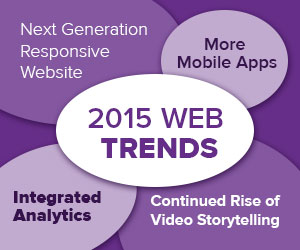
    web_trendsI have the honor of helping a number of association clients plan their web budgets for the next year or two or three. When preparing a web budget, my team and I do research, look at what other organizations are doing, talk to the innovators in the space, and brainstorm with our clients. So what’s in store for associations in 2015?

    Next Generation Responsive Website

    Associations that don’t already have a responsive website need to get one. And fast. Clients that already have a responsive website should be looking closely at their analytics and interviewing members to find out the information and services they most need when visiting the association’s website on a tablet or smartphone. This data will help you prioritize some content over others, change the order of calls to action on a mobile view, make some items disappear, or bring other content to the forefront. You don’t have to collapse your entire menu and you don’t need to just tile the elements in a straight line.

    What’s more, the next generation responsive website doesn’t just resize webages, it serves up different media files based on screen size and bandwidth. For example, on a phone over 4G, a responsive website will display lower resolution images. The same website on a retina screen iPad over broadband will serve up higher resolution images and HD video.

    More Apps

    Since phones and tablets are selling at a much faster rate then desktop computers, it only makes sense that apps be a part of your mobile strategy. Meeting and convention apps that connect attendees, help them explore content, and feature exhibitors are a no-brainer. Apps that introduce your industry to a wider audience are great. Technical apps that replace a desktop program might make sense, unless it devalues a high-priced, high value product. Finally, news apps that aggregate content across your websites and social media pages will help keep members abreast of all the news in your space.

    Integrated Analytics

    Most organizations rely on multiple platforms for their communications. The problem is that each platform has its own set of reports and analytics. Your website may be running Google Analytics. Your CMS has its own internal usage reporting. Your blast email platform reports on views and clicks. Your LMS (learning management system) has yet another set of reports. In 2015, I recommend that organization integrate the reporting across their systems. For example, most trade associations know what people are doing on their websites and their newsletter open/click rate. But what if they could also know what percentage of primary contacts are logging in to their members’ only site and opening their weekly newsletter? Integrated reporting that ties demographics and activity data will provide valuable, actionable data.

    Continued Rise of Video

    I know I sound like a broken record, but video needs to be part of every organization’s 2015 strategy. Pages with video encourage more visits, and longer visits. Google increasingly includes YouTube videos in search results. Video can be used to brand an organization, explain what an organization does, showcase success stories, tech people how to use applications, and give members and customers a voice.

    Storytelling

    Finally, in 2015, associations need to make their case to members, legislators, the media and the public via authentic storytelling. The formal, stilted language of the press releases of yore is not nearly as effective as writing that sounds like you’re having a conversation with someone you know and trust. Unless you’re The New York Times or The Wall Street Journal, your content needs to be succinct, fresh and user-friendly.

    My team and I will be on the lookout for evidence of these trends around the web and certainly amongst our clients and report on them as we learn and adapt to these trends. How about you? What will YOUR focus be in 2015?

  • Why Should You Hire an Agency to Redesign Your Website?

    Why Should You Hire an Agency to Redesign Your Website?

    matrixgroup292Every once in a while, I hear from a prospect who says his organization is considering redesigning their site and they’d like to do the design and CMS implementation on their own. They either want to use in-house resources or they intend to use an off the shelf template for design and styling.

    Sure, this can seem really cost-effective, but is it really the best solution? On the flip side, does it pay to pay an agency to handle your redesign?

    When you hire a great agency, you’re getting the best thinking from strategists, designers, front-end developers, developers, SEO managers, and content experts. There’s no way that a WordPress theme you purchase for $49 can give you all that. And most organizations’ can’t afford to have all those resources on staff because they’re pricey and they don’t need them full-time for an ongoing period of time. For the cost of one really great staff person or half a person, you get the combined talents of 5-7 talented professionals for a concentrated period of time.

    What’s more, a great agency gives you the benefit of this great team of people working together to give you great results. When Matrix Group designers are working on comps for a client, there’s always an internal review to discuss compliance with the specs, implementation pros and cons, impact on SEO, and usability.

    Finally, a great agency goes beyond the templates and the programming. They help you develop the powerful content that will ultimately bring search engines and real visitors to your site. Off the shelf templates and themes never do this for you.

    I have a good friend with whom I share a fabulous hairdresser. Eileen always needles me that I argue too much with Crystal. She says, “you want your clients to take your good advice about web design coz you’re the expert, right? You should do the same with Crystal.” Touché!