
On January 20, I watched the Presidential Inauguration celebration from my couch. Normally, I would have been jonesing over the inaugural balls I’ve never been invited to, but this year, I had a front row seat as Tom Hanks hosted a star-studded musical extravaganza. How amazing to see John Legend, Justin Timberlake, Bruce Springsteen, Yo-Yo Ma and Katie Perry (among so many amazing artists), and I loved that ordinary Americans got to introduce these stars.
I felt the same during the Democratic National Convention last August. Yeah, sure, every Democratic and Republican convention is televised, sort of. You can watch on C-SPAN, or catch highlights on network or cable television, but this coverage always seemed so cold and distant, like an afterthought. Last year, the Convention went virtual. Remote viewers were the main audience and boy were we treated well. It felt like we joined Michelle Obama in her office. And the state roll call, normally a dry and pompous affair, became a celebration of America as delegates, parents, teachers, small business owners, essential workers, activists and elected leaders cast their states’ votes to nominate Joe Biden. Three delegates from California were on a beautiful bluff, the delegate from Alabama was on the famous Edmund Pettus Bridge, tribal members from states with large Native American populations announced their states’ votes, and on, and on. It was glorious! And I got to be part of it! We all did!
Four years from now, presumably most Americans, indeed citizens of the world, will have been vaccinated and in-person events will once again become the norm. Will we go back to the exclusive conventions and balls of the past? Will I once again sit on my couch and wonder how I could have gotten myself invited to an inaugural ball? I sure hope not. The pandemic has broadened the reach of these events, and allowed ordinary citizens to be part of the proceedings, the events and the fun.
While I am dying to see my family and friends, meet with clients, and travel on vacation, I hope we don’t go back to the way things were. I hope we figure out how to continue to make our events more accessible to everyone.
It’s safe to say that, thanks to the pandemic, our lives are lived online now more than ever before. The more time we spend in the digital world, the more the lines are seeming to blur between physical and virtual, lending way to some exciting new web design trends. Here are the 5 trends that I think will be most popular in 2021:
The death of “skeumorphism”, or the digital equivalent of “real-world” surfaces and objects, gave rise to “flat” design that has dominated UI design for a few years now, famously championed by Jony Ives, former design director of Apple. The inevitable backlash to flat design is a trend back towards more “realistic” interfaces, but far short of full skeumorphism. This “neumorphic” trend features elements that rise subtly from the background, (e.g., gentle shadows), and are far more subdued than pure skeumorphic digital objects. While more prevalent in app design, these neumorphic elements are popular on the web as well.
2. More lives lived online, more integrated experiences
2020 saw us working remotely, avoiding close contact with other humans, and sheltering in our homes. The COVID crisis has had an enormous impact on our daily lives, and how we do business. Matrix Group is, of course, no exception – we’ve had to change our way of interacting with our teams, serve our clients, and craft interactive experiences. For our association and non-profit clients, one of the biggest challenges was how to hold conferences and annual events in the year of COVID and non-gatherings. To address this challenge, we at Matrix Group created a virtual event platform called BeSpeake, with the goal of having virtual meetings that are more than just a bunch of video conference windows, but a space to still have meaningful interactions with members, vendors, and sponsors. This trend of integrating live video, multimedia presentations, chat, and data is continuing to evolve as we need digital tools to replace what was done face to face, but now is increasingly done virtually.
3. Less rigid layouts
Since the earliest days of the Internet, web design has always been a grid-based experience, due to the limitations of, at first, table-based HTML layouts, then CSS. The ability to freely place elements anywhere on the canvas has been something that we web designers have always envied from print design. This limitation is gradually being removed, however, through more advanced CSS and the latest browser support. Asymmetric grids, overlapping elements, and even randomly-placed objects are in vogue, and are a welcome respite from the usual, rigid layouts of most web pages. My hope is that someday soon, we can design as fluidly as print designers, and web designers will have the freedom to create as we see fit, not limited by code or browser technology.
4. The horizontal scroll is back!
Horizontal scrolling was once popular, then became a huge no-no; but it’s making a comeback. Perhaps the resistance has been eroded by the mobile experience, where apps frequently use the horizontal swipe interaction to scroll content. There are many more sites using horizontal scrolling, such as this site for Italian gelato. We at Matrix Group have done a few recently for clients, including a recent project for FMI’s Food Prices report. For good usability, it’s key to make sure to have clear controls for the horizontal scroll, such as arrows, or to allow for the mouse scroll wheel.
5. 3D elements
3D elements are becoming increasingly used on websites, whether in the form of rendered illustrations or an actual 3D-like environment. One of my favorite recent sites is the Year of Greta, where the interaction is a virtual experience based around a 3D statue of Greta Thurnberg. As you drag your mouse, the statue rotates and video windows appear that commemorate the 2019 moments of Greta’s fight for climate change. The use of 3D can be gratuitous, but I feel in this case, it was used well, and a fitting testament to a courageous young woman fighting for our environment.
—
2020 was a tumultuous year, with disruptions on many fronts. One of the main missions of a designer is to bring visual order to chaos, to facilitate communication, and to create experiences that entertain, educate, and illuminate. All these “trends” reflect advances in technology, stylistic evolutions, and so on, but ultimately, they are a means by which we hope to bring joy to our clients and our audiences. Here’s to a more joyful year ahead!
Well, the pandemic that was supposed to last a couple of weeks has dragged on through the Spring, Summer and Fall. Nearly 10 months since stay at home orders were issued, what have we learned about virtual meetings and engagement?
Pre-Recorded Is Giving Way to Live
Early in the pandemic, meeting planners pivoted to Zoom meetings that focused on education, a lot of it pre-recorded. Exhibits halls were limited to directory listings.
9 months later, we know that attendees are sick of starting at their screens, passively watching a presentation. By late October, most of our clients had switched over to live presentations. One client said they switched because:
Pre-recorded is more work for the staff
Speakers want their presentations to be perfect when they are pre-recorded, so they do take after take, which requires a lot of editing
A lot of speakers gets their energy from the audience, so recorded presentations don’t have the same vitality
Our clients have packed their programs with a mix of live and pre-recorded sessions. And most pre-recorded sessions also have the speakers available to chat with attendees, or a live Q&A immediately following the content presentation.
Attendees can tell when a presentation is live. Live presentations have big and little flaws that let you know this session is happening right now. Somehow, attendees are drawn to these imperfect sessions.
Attendee Engagement is Key
Clients have asked us how to add attendee engagement during their virtual events. Attendees say they don’t want a conference that feels like a series of webinars. They want to see other attendees, they want to celebrate, they want to meet new people, and they want to be entertained. Some things clients did this Fall:
NAES offered Morning Coffee each day of their Biennial Conference. Attendees were slotted into video rooms with 7 random attendees for a half hour of networking.
EAIE followed content presentations with breakout sessions where attendees were placed in video rooms with up to five other people to discuss the topic.
FACT held a Lunch with Leaders session where attendees could drop in and chat with the organization’s top leaders.
Facilitate Informal Meetings
Whenever I attend an ASAE meeting, I try to see as many clients and friends as possible. These informal meetings and chance conversations are part of the magic of conferences.
Which is why BeSpeake has a user-friendly and easy to find attendee search, a message center and 1-2-1 video meeting scheduling.
In one of our meetings, nearly 30% of the attendees participated in at least one private video meeting! And a whopping 54% participated in a breakout or appointment; in other words, more than half of the attendees participated in an activity where they were on video and meeting with other attendees!
Add Some Lightness and Entertainment
When we hosted the Biennial Conference for the National Association of Episcopal Schools, two of the most captivating involved music: one session featured a pre-recorded video of a children’s choir, and one social event featured an entertainment/musician.
It was obvious from the comments and reactions that these sessions were a welcome break from the talking heads (that were amazing, by the way), and highlighted the need for a variety of session formats.
During the ASAE TEC Conference in December, one of the most memorable events was the party hosted by the Association of Women Technology Champions (AWTC). The event was conducted in Zoom and featured games and networking. While the TEC sessions were good, the AWTC event was the most interactive and fun.
It’s 2021. While we don’t really know what the meeting landscape will look like, here’s what we do know: Attendees are looking for new, different, and engaging. Your meeting cannot be a broadcast version of your in person conference. So what are YOU going to do in 2021 to take your virtual meetings to the next level?
Howard provided an overview of the meetings and conference landscape, covering the latest news related to vaccines, state COVID regulations, and meeting statistics and predictions.
What’s the road ahead for live events? If you plan to have live events in 2021, Howard says:
Be prepared for uncertainty.
You will have a lot of last-minute registrations.
You will have a lot of no-shows.
Be prepared for short notice pivots to virtual because of state-mandated shutdowns.
You need to calculate your attendees’ psychological comfort level with risk
What will the economics be for a venue that could house 1,000 people pre-COVID, but can only house 10 people post-COVID? Does this even make sense?
There is always a risk that your event could become a super-spreader event.
At the end of the meeting, if nobody is sick, can you truly say that you held a safe event? What if you had attendees who were asymptomatic and spread the virus to your other attendees?
In light of all this, Howard recommends “Reverse Hybrid Planning.” In the past, conference planners treated the in person event as the base experience, and virtual was the add-on. But today, Howard thinks we should consider the virtual event as the base experience, and the in person event as the add-on experience. Why?
Because meetings and conferences aren’t expected to go back to their pre-pandemic attendee levels for another 3-5 years, and that’s assuming the vaccines are effective AND people agree to get them
Because employers are going to look hard at the ROI of conferences and training. Most employers today are probably thinking, “if I can train 4 people for the price of one, or spend a lot less money training one, I’m going to choose that option.”
Because virtual events have opened conferences and training to a whole world of people who previously couldn’t get on a plane or be away from home for a multitude of reasons.
As for us here at Matrix Group and BeSpeake, so far, clients are planning on being virtual through April 2021. Most are hoping that in person events will start to come back starting in May. And most are thinking they will need to plan for a hybrid experience starting in 2021.
How about you? What’s your event planning strategy for 2021?
I’m attending and speaking during the techsytalk GLOBAL conference this week. Liz King Caruso, the organizer, ran a poll on the first day and asked attendees if they were on Team Live or Team Pre-Recorded. Turns out 100% of the attendees voted Team Live.And yet…
I attended a couple of conferences last week where meeting planners and vendors were extolling the virtues of pre-recorded: you can have more sophisticated graphics, you eliminate the chance of speakers’ Internet connections going down, you can edit away mistakes by speakers, speakers don’t need to be available the specific days of your conference, yada, yada.
So why did 100% of Liz’ attendees (at least during that session on Day One) vote for Team Live?
Eight months into this pandemic and I think meeting attendees’ expectations have shifted. They are looking for live and authentic gatherings, even if they aren’t perfect.
Live gives attendees a reason to attend your meeting on specific dates and times.
Live gives attendees a chance to interact with speakers beyond chat.
Live allows attendees to set aside x days and hours for your meeting and concentrate their involvement.
Live creates energy.
Don’t get me wrong. Live isn’t necessarily easier or harder. It’s just different. And if you offer live sessions, you need to plan for live. You need backup upon backup. You need staff to support live. You need a vendor that knows, understands, and embraces live.
Does your entire conference need to be live? Absolutely not. But I do think that these days, any successful conference needs live elements. Live can take on many forms: live discussions, live speakers, live video meetings, live networking.
1) Learn something
2) Participate in the conversation
3) Make a friend
During this pandemic, when all meetings and conferences are going virtual, how are we designing the experience so that attendees can still do all three?
Learning something. Check. Organizations are doing a great job here. The content quality is way up. My clients are experimenting with live and pre-recorded sessions. And they’re sourcing speakers from around the globe, speakers who perhaps were never able to participate because of the time and distance.
Participate in the conversation. I think this has been a mixed bag. Most organizations allow comments during presentations, which has been fun and engaging, BUT these conversations can be distracting. And there’s often no way to have a conversation about a session AFTER the session, about a random topic, or with random people.
Make a friend. This has been the hardest goal to meet during virtual meetings. I’m thinking about the bus rides to events during ASAE Annual; I inevitably sat next to someone amazing and I’d make a new friend. I’m also thinking about people I sat next to during sessions or during lunch; how I miss those chance encounters!
Most virtual meetings I’ve attended have been missing this “make a friend” piece and no wonder. Most sessions are in webinar mode, which means only the speaker is on video. And even if you do attend a Zoom where everyone is on video, it’s hard to have a conversation when there are more than 20 people on the call.
The “make a friend” part is something we’re trying to solve for with our virtual meeting platform, BeSpeake. We’re using 1-2-1 video meetings to encourage connection and sharing. If you want more info, reach out.
What I want to know is this: how are YOU encouraging your attendees to connect and make friends during your virtual meetings?
Many organizations are wrestling with how they can pull off a successful virtual meeting, especially with regard to their sponsors and exhibitors. How do you provide real value for them in the virtual environment? How do you convince them that it’s worth the time and investment? Heck, will they even want to consider it?
Good news! Whether virtual or in-person, sponsors and exhibitors want and need the same thing: access to your members, their target market. We don’t have to tell you that life looks different, but regardless, business is still moving forward, and your sponsors and exhibitors still need facetime with your members.
Generally speaking, your sponsors and exhibitors want one (or more) of three things from your event:
Leads
Brand awareness
Content leadership
So how do you know what they want most, and how do you provide avenues for fulfilling those needs? Ask! Have strategic conversations with your sponsors and exhibitors to learn more about what they want. Start by asking your largest sponsors and exhibitors, but talk to everyone, even if it’s just an email:
What value do your exhibitors and sponsors get and expect from your in-person conference and tradeshow?
Have their sponsorship and marketing goals or objectives changed recently, as a result of the pandemic?
Have they participated in a virtual event or meeting recently? What was their experience? Good? Bad? Indifferent?
If they can still meet their goals, are they willing to support YOUR event?
Before you enter into these conversations, make sure you brainstorm with your team and have a list of things you’re thinking of offering to your sponsors and exhibitors. During the conversation, be sure to listen, be open-minded, and take feedback. Then, design sponsor and exhibitors opportunities, and your event, with their needs in mind.
The world has changed, but your sponsors and exhibitors continue to be invaluable partners for your organization. Give them what they need, and they’ll partner with you for life, no matter the venue.
I’m attending a lot of conferences these days. I’m also helping clients plan and execute a lot of conferences. All of them online, of course.
One of the biggest questions being asked by meeting planners is: Should my educational sessions be live or pre-recorded? Live streamed at a certain time or available on demand?
Pre-recorded has some obvious benefits:
Your speakers won’t have technology issues
You can control the start and end times
You can up the production value of your sessions with extra editing, graphics, transitions, etc.
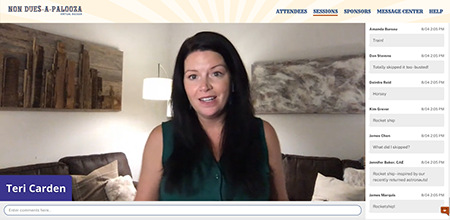
I recently had the pleasure of working with Teri Carden on Non Dues-a-Palooza, a conference dedicated to helping associations increase their non dues revenue through partnerships and great ideas. Teri had 10 case studies, and 6 pitches by sponsor companies. The case studies were going to be pre-recorded so Teri wondered how she could add a live element to the conference so that the case studies didn’t feel like just another set of zoom webinars. Should the 2-minute pitches by demo companies be live or pre-recorded? Should her welcome be pre-recorded?
After much discussion, Teri decided on a mixed format: she would be live but the case studies and 2-minute demo pitches would be pre-recorded. In addition, the demos would be live as well.
Live can be nerve-wracking. You never know what can happen: someone’s Internet drops, the speaker mutes herself accidentally, your schedule falls apart because someone ran long. BUT, live has benefits as well:
Your presenters can answer questions in real-time
Your presenters can lengthen or shorten remarks as needed
Perhaps most importantly, your attendees feel like they are experiencing something happening real-time, that they need to be online at a specific time and place in order to be part of something.
I’m speaking at the ASAE Annual Conference this week. Speaking is perhaps a weird verb because my session was pre-recorded. Instead, I will be available via chat to respond to attendee comments. There’s a part of me that wants people to listen to my session, not just try to keep up with the stream of comments. If I had my druthers, I would have pre-recorded my session but been live, on video, for the Q&A. But yes, that’s different, more complicated technology to make that happen. So I will be presenting on Wednesday AND responding to questions and comments.
Personally, if a conference is made up entirely of pre-recorded videos, I think some attendees will lose interest. The motivation to participate NOW will dissipate because sessions are pre-recorded and will inevitably be available on demand, in which case it doesn’t really matter when you watch the videos.
How about you? How is your organization navigation live vs. pre-recorded? What has worked? What have you learned?
PowerShell is Microsoft’s automation scripting language and shell. PowerShell allows the automation of just about any aspect of Windows Server and Microsoft’s enterprise software, including Azure. I’d been wanting to learn PowerShell for some time now, and this spring, I finally dedicated some time to this project. What have I learned?
PowerShell is a programming language but it’s also a shell, which means it’s a bit quirky.
Microsoft has put a lot of effort into making the automation story compelling.
If you want to automate Microsoft stuff, PowerShell is absolutely worth learning.
There were more resources for new administrators than programmers.
If you want to get started with PowerShell, here are my favorite resources:
As the world of work continues to transition from physical to virtual, the same is happening to conferences, trade shows, and meetings. There are platforms to choose, new or different program formats to consider, and on and on. But the biggest question on everyone’s mind is: how much should I charge for my virtual conference?
As with most questions like this, the answer is: it depends. It depends on your industry, the type of experience you’re planning to provide, your attendee demographics, your sponsorship model, etc. But take solace in this: our clients, partners, and friends are finding that attendees don’t expect virtual conferences to be free. People understand that a lot goes into event planning and preparation, and that there are costs associated with any type of event, no matter the format.
Here are some things to consider when deciding what to charge for your virtual event:
Consider your industry. How badly have your members, attendees, sponsors, and exhibitors been impacted by the pandemic? Are budgets being slashed? Will attendees be paying out of pocket? If your members are really hurting (and whose members are not?), consider reducing your registration fees to show compassion to members and encourage attendance. Many clients are reducing fees to maintain member engagement and demonstrate that they are being responsive.
Consider your key demographics. Younger generations are more accustomed to meeting and connecting virtually, more likely be more optimistic about what they’ll gain from a virtual conference, and maybe willing to pay for it. Younger members are also more likely to value your educational programming because they need it to advance their careers. Older attendees may be less comfortable with an online format, and more likely to be skeptical of the value of the meeting because they come for the networking. On the other hand, older members are going to be more senior, and have more access to training funds. In all cases, study your attendee demographics, call up some members, and get some feedback from the field.
Are you offering CEUs? Many organizations offer attendees the chance to earn Continuing Education Units (CEUs) when they attend sessions. One professional society we know is not lowering fees BUT because the conference will be online and recorded, attendees will have greater opportunities to earn CEs, thereby raising the value of the meeting.
What level of experience will you provide? Let’s face it. Your attendees expect a highly produced event when they attend in person. Their expectations don’t change because the event is online. They still expect a great user experience, sessions with high production value, and a mix of education and entertainment. Your attendees will be less excited about paying for what feels like watching YouTube videos, sitting through more Zoom meetings with mediocre graphics, and no opportunities for networking. If you’re going to charge top dollar, give your attendees a top dollar experience.
What’s your sponsorship model? Since there’s more opportunity for sponsors to get prominent face time in front of attendees – think YouTube style ads at the beginning of sessions, banner ads, virtual tradeshows, etc. – they may be willing to purchase richer sponsorship packages, which can subsidize attendee’s conference fees. Alternatively, you may have a harder time getting sponsor and exhibitor buy-in because virtual conferences are untested, or your virtual meeting offers few opportunities for truly showcasing their companies and products.
It’s really hard to come back from free. Some of our clients are opting to change their conferences to free events. I get it. Members are hurting and it feels wrong to charge money for benefits. BUT a conference that doesn’t generate revenue becomes a giant expense, and members may come to expect that all future events will be free. Yuck.
While there’s no magic formula, you’ll need to take all of these factors — and more — into consideration. We’re hearing that most attendees are very open to registration fees that are 50-75% of normal registration fees. Will that work for every event and every association? Of course not, but it’s a good starting point. And like I often say, when in doubt: ask! Your members know you’re charting new territory daily, so don’t be afraid to send out a poll to see what their thresholds may be. Good luck and please do share your experiences!
Looking for a custom tailored virtual meeting platform that can take your virtual conference to the next level, providing your attendees and exhibitors with a comprehensive, hand crafted experience? We’d love to show you a demo of BeSpeake, our new Virtual Meeting Platform. Let’s get it scheduled!