Matrix Group International

Tag: Project Management

  • Crowdsourced Software Development?

    Crowdsourced Software Development?

    This afternoon, the MatrixMaxx team at Matrix Group held a Town Hall meeting with clients to get feedback on about a half dozen features slated to go into the 10.1 version (scheduled for release in early February).  We could have surveyed clients via e-mail or a Web survey; we could have conducted a focus group; we could have called a select group of clients and consultants; or we could have gone with our gut and made decisions about credit card processing, meeting wait lists, individual relationships, etc.

    Instead, we decided to crowdsource the specifications.  Crowdsource?  What does this mean?  Wikipedia defines “crowdsourcing” as the “act of taking tasks traditionally performed by an employee or contractor, and outsourcing them to a group of people or community, through an “open call” to a large group of people (a crowd) and asking for contributions.”  Wikipedia also uses this definition: “the trend of leveraging the mass collaboration enabled by Web 2.0 technologies to achieve business goals.”

    In the past, Tanya (the Director of MatrixMaxx) and I would sit down, discuss requirements, maybe make a few calls, and then decide on the specifications for each release.  This time around, we decided to get immediate feedback from as big a group of clients as possible to validate our ideas and generate new ones.

    The Mechanics of the Town Hall Meeting

    • We sent an e-mail invitation to all MatrixMaxx clients, inviting them to an hour-long, online Town Hall meeting.  The e-mail provided details on the half dozen topics under consideration, with a general discussion of the options available.
    • Clients were invited to provide feedback in real-time during the meeting, before the meeting via phone and email, and after the meeting via phone and e-mail.
    • About 60% of the clients registered at least one person to the Town Hall meeting, which was conducted via conference call and Webex.
    • Tanya ran the meeting, leading the discussion and taking notes, which were shared out via Webex to all participants.

    (more…)

  • Post-Launch Tasks = Project Overhang

    Post-Launch Tasks = Project Overhang

    Man climbing rock overhangAfter each Web site launch, I ask the Project Manager in charge what’s left to do. Why?  Because inevitably, there are items that didn’t make the launch. I call this Project Overhang and it can be deadly to a firm’s profitability and productivity.

    Project Overhang is what we call tasks that are left over from a project. The project, site or application can be up, tested and launched, but there are tweaks we didn’t complete, post-launch fixes or small change orders.  Often, Project Overhang does not generate additional revenue and the items are so small that they can slip off our radar if we’re not careful.  Project Overhang is much less likely to happen on a client account because those projects are external, revenue-generating and discussed during post launch check-ins.  But Project Overhang on internal projects can linger for years!  I once had a to do item to update a new staff orientation guide that didn’t get done for two years! (more…)

  • How SCRUM Made Our Office Move Great

    How SCRUM Made Our Office Move Great

    Office moves are never fun. Our move was months in the planning, but we were still scrambling last Friday night, the day before the movers arrived.  The plan was to complete the physical move on Saturday, then have all staff come in on Sunday to set-up their own work areas, test the network and phones, and help unpack the common areas. There were a million tasks to be done? How was it all going to get done? Then we had a great idea: let’s use SCRUM, do a one-day sprint and complete as much of the move as possible. Here’s what we did, with amazing results.

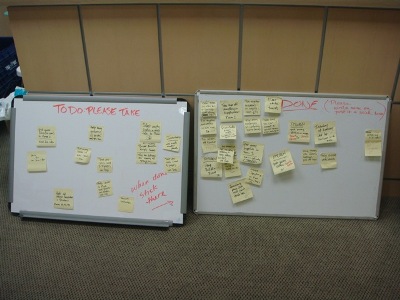
    Office Move To Do List

    Here is our Office Move To Do List at the start of the day on Saturday. (more…)

  • An Office Buildout Is Just Like a Web Site Redesign

    An Office Buildout Is Just Like a Web Site Redesign

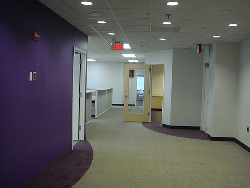
    Matrix LobbyMatrix Group is getting close to moving to its new space at 2711 Jefferson Davis Highway in Arlington (Crystal City), VA.  This is the first time that we’re doing a buildout and I’m looking forward to seeing how our physical space can support how we collaborate and do our work.  I’ve also been fascinated to realize that a construction project is like a Web site design project in many ways:

    User Experience

    • Our construction project began with our Architect visiting our existing space, interviewing staff, and learning how people work together and on their own. This is akin to the user experience part of all of our Web projects where we look at analytics, interview staff and users, and create personas to represent key target audiences.
    • The space plan and architectural drawings are akin to navigation and wireframes. In our case, our Architect conducted a test fit to make sure the space would fit our general needs, then created a plan that indicated where we would have offices and where we would have open space.
    • Then came design. When designing a Web site, we create multiple designs over multiple rounds for the home page, sub-pages, content pages, print style sheet, etc.  For the office, we picked carpet, colors, office furniture system, lighting, and chairs.

    Implementation and Budget

  • What Clients Want: To Be Understood

    What Clients Want: To Be Understood

    childinshoesOne of my Project Managers (we call them PMs at Matrix Group) was struggling with an account. The client was frustrated, the Project Manager was frustrated, so of course, now I’m frustrated. I called the client, had a long de-brief session, worked through some issues, and with a few tweaks, the project was back on track. The PM wanted to know how I did that. My secret? I put myself in the client’s shoes.

    As a business owner, I get to be manager of staff and projects AND client to our many vendors.  As the chief salesperson for the company, I interact the most with customers and users.  As a liberal arts person turned techie, I know enough to be dangerous, but I can’t write a line of CSS to save my life.  All of this means that I can more easily see a situation from a client’s perspective.   Here’s what I’ve learned over the years about clients:

    • Clients are busy, the Web site is usually just a small fraction of their job, they don’t spend all day thinking about the Web site, and there’s a whole lot of  stuff going on that they don’t know and don’t care to know. We can never assume clients know that a new version of Internet Explorer is coming out and it’s going to be more standards-compliant, that title tags should not be more than 64 characters or Google will ignore them, and that a print style sheet is different from a printer-friendly page.
    • Most clients are non-techies who need a technical solution. They seek a solution and a result.  We need to give them context for our solution, and enough detail so that they can make an informed solution, but not so much that they get overwhelmed.  We also need to communicate concepts using terms they understand.  For example, when a Web design has been approved and we have to now slice the design, I liken it to going to blueline.  Clients who have ever had anything printed are familiar with blueline; it’s close to a final proof and changes cost time and money.

    (more…)