Matrix Group International

Tag: Blogging

  • The Life Changing Magic of Tidying Your Website: Keep Only What You Love

    The Life Changing Magic of Tidying Your Website: Keep Only What You Love

    I’ve blogged in the past about Marie Kondo’s best-selling book, The Life Changing Magic of Tidying Up. Last year, my husband and I set about tidying our house, with great success. While I wouldn’t exactly call my house neat and sparse, I am definitely more in control of the clutter.

    So what’s all this got to do with your website?

    Marie Kondo’s number one rule for deciding whether to keep something is pretty simple: Does it spark joy? In other words, does that article of clothing, book, or memento spark joy and love?

    I think we can apply the same rule to the content on our websites. The next time you conduct a redesign, or engage in an inventory of your content, ask yourself this about each page and document:
    • Is this content signature content, or content that one should find at the top of a search results page?
    • Is this content that members most want to find?
    • Is this content valuable?
    • Is this content of interest to lots of people? or your most important audiences?
    If the answer is no to specific content, consider removing it from your site — forever. Removing clutter from your site has all kinds of benefits:
    • Your navigation will be easier to navigate
    • Your search will return fewer, higher quality results

    If you find that you just can’t part with content, move it to an offline archive. Monitor the amount of traffic to the old URL and track requests for the archived data. Just like the dress you haven’t worn in x months or years, once a certain amount of time has passed, you should consider that content permanently removed from your site. Remember that 20% of your website pages will drive 80% of overall traffic, so why not focus most of your attention on that 20% and make it great?

    Just as our homes suffer from clutter, so too, do our websites suffer from digital clutter. Make 2018 the year your clear your website of unnecessary content that just doesn’t spark joy.


  • Is Blogging Passe?

    During the Fall and Winter, I meet with many clients to help them formulate their web plans and budgets for the following year. During many of these meetings, I suggested to clients that they consider a leadership blog to raise awareness of their industry’s issues, make leadership more accessible and approachable, and showcase their thought leadership. Surprisingly, a couple of clients recently remarked, “Blogging, isn’t that passe?”

    My initial reaction was “no way!,” but since several clients had made the comment, I decided it was worth doing more research.

    If you google “is blogging passe,” you’ll get nearly 150,000 results, many of them with the exact title of “is blogging passe?” Some of these articles and posts go back as early as 2008. The general thinking goes like this: with the rise in popularity of Facebook and microbloggins platforms like Twitter, putting up and managing a corporate blog is passe. Put another way, since it’s much easier to create short-form content on social networks, long-form content creation (blogging) is dead.

    So is blogging passe? Here’s why I think blogging is not dead. In fact, I think niche blogging with high quality content is more important than ever.

    Casual bloggers have migrated to social networks, leaving the blogosphere to more committed bloggers intent on developing and sharing quality content. When blogging first appeared on the web scene, everyone started blogging. People blogged about their pets, they posted photos, they shared links. This type of casual blogging is now found mainly on Facebook, Instagram, Reddit, Twitter, etc.

    Blogs by experts and thought leaders continue to be very popular. We’re actually seeing that people prefer corporate, association and non-profit blogs to corporate, association and non-profit websites because of the perspective and the voice that come from blogs. Blogs simply feel and sound more human than corporate websites, which is why they often get more traffic than corporate websites. Webbiquity says corporate blogging is more important than ever.

    Producing unique, original and useful content is the only way these days to approach the myriad changes in the search algorithms being put in place by Google and Bing. In other words, the search engines like blogs because they tend to have unique and original content that searchers are looking for.

    Google is about to roll out Author Rank. With Author Rank, Google wants to make it easier for users to find the work of specific writers, and leverage its ability to use authors as an element for ranking pages and sites. Author Rank means you have a blog, you connect it to your Google+ account, you get verified, and your blog content contributes to page rank, which directly affects where your site shows up in Google search results.

    Blogs continue to be a great way to educate your members and customers. I tell clients that blogging requires a greater commitment than Twitter or Facebook, but it provides more benefits. If your organization is not yet blogging, I hope you’ll ignore the hype and consider a timely, niche blog that speaks directly to your target audiences

     

  • Creating an Integrated, Layered User Experience Across Your Social Media Pages

    Creating an Integrated, Layered User Experience Across Your Social Media Pages

    I was researching an organization last week and visited their website, blog and social media pages. The website was nicely designed, easy to navigate, and had good information.  The blog was terrific and I quickly subscribed to the RSS feed.  When I got to the organization’s social media pages, I was sorely disappointed.  Their Twitter and Facebook pages had nothing but headlines from the blog. Clearly, all they did was take the blog RSS feed and use it to populate their social media pages.

    So did I decide to “follow” the organization on Twitter and “like” them on Facebook?  Absolutely not. Since I had already subscribed to the blog RSS feed, I didn’t feel compelled to follow them on Twitter and Facebook.  Why add clutter to my social media streams with information I can already get elsewhere?

    I know it’s tempting to set-up pages on Twitter, Facebook, LinkedIn, and other social media platforms and populate them with posts from your blog or press room.  We’re all busy and most communications and marketing departments are stretched thin.  But posting the same information across platforms isn’t doing your organization any good. Why?

    • By posting headlines that meet the least common denominator across platforms (probably Twitter, with its 140 character limit), you miss out on functionality offered by the other platforms.  For example, Facebook lets you post longer updates, upload photos and videos, include links, host discussions, etc.
    • You don’t give your target audiences a reason to follow or fan you across platforms.  Just imagine this.  If you post complementary but different content across platforms, your clients, prospects and supporters might just follow you on multiple platforms, giving your company an incredible voice with those individuals.
    • If you’re posting headlines from your news room, you’re not offering people the authentic, personal voice we’ve come to expect on the social media pages.

    Here’s what we do at Matrix Group:

    • Our website showcases our products, services, clients, portfolio, news and webinars.
    • This blog, which is authored by me, Joanna, the CEO, features my thoughts and commentary on social media, marketing, communications, strategy, customer service, trends and gadgets.  This blog DOES feature website launches at the bottom of each page.
    • Our Twitter page showcases our work and clients, but the majority of the tweets are about industry news, trends, how-to articles, and case studies.  Twitter will tell you who we are and what we’re reading.  We’re pretty chatty on Twitter; we post updates multiple times a day.
    • Our Facebook page also showcases our work and clients, but we also post photos and updates about happenings in the company, including trainings, parties, fun events, etc.  Facebook will tell you a lot about who we are as a company and our culture.  For example, our staff pumpkin carving contest was featured on our Facebook page.  We’re less chatty on Facebook, just updating a few times a week.
    • Our Flickr page is home to our photo library of company events, while our Facebook page has the “best of” photos.
    • Our YouTube channel is a work in progress and will soon feature short interviews with senior staff about their areas of expertise, including branding, the user experience, software development and security.

    As you can see, our various pages are all designed to showcase our expertise, clients and work but the user experience on each platform has been carefully crafted to take advantage of that platform’s capabilities.  And while the website is clearly a marketing channel for the company, we’re not very sales-y on our social media pages, focusing instead on posting useful and interesting links.

    How about you?  How are you creating an integrated use experience across your company’s social media pages?  What’s working for you?

  • What Happens When Your Facebook Page or Blog Gets More Traffic Than Your Web Site?

    What Happens When Your Facebook Page or Blog Gets More Traffic Than Your Web Site?

    Every week, I check out the usage reports for the Matrix Group Web site and blog. I also look closely at the analytics reports from Facebook for our Facebook fan page.  In the last year, traffic on this blog has overtaken the traffic on the public Web site.  And as we increase the number of fans on our Facebook page, our interactions have grown steadily as well.

    A recent article in Ad Age explores how some of the top consumer brands have Facebook pages with a fan base and interactions that far outstrip that of their official Web sites. Starbucks has 12.9M fans; Coke has nearly 11M fans; Oreo has 8.9M fans.  Of the companies in the article, only Starbucks has steadily increasing Web traffic.

    All of this got me thinking:  What happens when an organization’s blog, Facebook, Twitter or other social media page gets more traffic than the official Web site? Is this the ultimate goal for marketers?  Is traffic on a social media site worth as much as traffic on a company Web site?  Does this increased traffic ultimately lead to more customers and sales?

    I have clients who worry about redirecting traffic to social media pages, for fear of losing control over the conversations, not owning the Web property, or that the interactions are not quite official enough.  Others hold their social media stats in the highest regard.  Most of us  wonder what it really means when somebody chooses to “like” our fan pages.

    How to make sense of all this?  Here are some thoughts:

    • If your Facebook page is getting increased traffic and interactions, while traffic on your regular Web site is on the decline, ask yourself, “What is it about my Facebook page that’s working?  What’s making people “like” us, click through to articles and comment?  What are the lessons for content and opportunities for interaction on our official Web site?”
    • Your goal should be to have your Web site, Facebook page, Twitter page, blog, e-mail campaigns, microsites, etc., all be part of an integrated strategy where each Web property is complementing the others and encouraging cross traffic.
    • Ultimately, the goal should be conversions, whether that means more sales, more subscribers, more members or more donations.  Your goals should never be about traffic on specific platforms; that’s just a tactic.
    • You need a way to track the effectiveness of followers, likes, clicks and fans across the different platforms.  Use tracking codes, cookies and marketing codes to determine which platforms are really helping your business to thrive.
    • (more…)

  • Blogging Best Practices – Part Two

    Blogging Best Practices – Part Two

    This week, I’m doing part two of a blog post I started last week on Blogging Best Practices. This post is inspired by a webinar that I conducted with my friend, blogger and activist Shaun Dakin, Director of Business Development at Infield Communications.  Here are additional take-aways from the webinar.

    • How Long Should Your Posts Be? We suggest that each post be no more than 4-6 paragraphs.  If your posts are too long, your followers may decide to read them at a later time and not come back.  But you want enough length to be able to cover a topic with enough substance.
    • Create Visual Interest. Although followers follow blogs for their content, we believe that your posts will have more impact if they have photos, videos, event basic html formatting.  If nothing else, use formatting to make your content skimmable.
    • Align Posts With Your Keyword/SEO Strategy. While I’m a firm believer that you can’t force keywords into headlines, do try to make your titles and opening paragraphs keyword rich.
    • Create Compelling Introductions. Think about it.  You make a decision about whether or not to open an e-mail or click on an article in your RSS reader based on the title and opening paragraph.  So make your blog post introductions compelling to encourage clicks.

    (more…)

  • Blogging Best Practices – Part One

    Blogging Best Practices – Part One

    A couple of months ago, I had the pleasure of conducting a webinar on Blogging Best Practices with my friend, blogger and activist Shaun Dakin, Director of Business Development at Infield Communications.  Shaun and I are passionate bloggers and we each had a lot to say about what we think it takes to be a good blogger and have a successful and well-read blog!  Here are some of the take-aways from the webinar:

    • What Are Your Goals? The most important thing is to align your blog’s goals with your organization’s goals. Are you trying to engage your target audiences?  Influence?  Foster specific actions?  Your goals should be measurable so that, at the end of the day, you know if your blog is a success.
    • Who Should Blog? Shaun and I believe that anyone can blog, but for most organizations, you need people who have a 20,000 foot view of the industry or issues, enjoys writing (or is paired with someone who enjoys writing and is a good writer to boot), and is committed to pumping out content on a regular basis.
    • What Should You Blog About? This is the $64,000 question!  Ultimately, you need a mission statement for your blog that guides your content strategy.  We grouped blog posts into the categories.  In practice, most blogs employ a variety of blog post types to keep readers engaged.
      • Hot items/News – These posts tend to cover what’s new in the industry, breaking news, etc.
      • Strategy/Commentary – These posts try to provide a perspective on specific issues and usually aim to persuade readers to take a certain point of view.
      • Trends – These posts report on market trends, trending topics, research and statistics.
      • How-To Guides – These posts are often a combination of text and video and aim to provide users with a practical guide to doing something specific.

    (more…)

  • Accession Point Blog

    Accession Point Blog

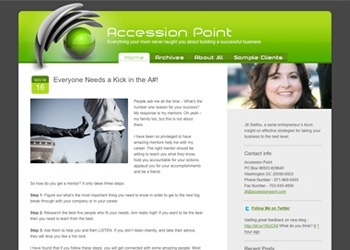
    Matrix Group worked with Accession Point to design and launch a blog for CEO Jill Stelfox. As a recognized consultant, Stelfox wanted a platform to share her blunt insight on how to help companies and CEO’s take their businesses to the next level.

    Matrix Group work includes the following:

    • Designed a blog that reflected Accession Point’s identity, as well as captured Stelfox’s personality
    • Incorporated a content management system (CMS) to allow Stelfox to update her content on a frequent basis
    • Assisted on content development, ensuring posts were effective and worked well on the Web
    • Added a “share” function, allowing visitors to share Stelfox’s blog posts through social networking/bookmarking sites

    Visit the Accession Point Blog

  • Fire Your Broker Web site Redesign

    Fire Your Broker Web site Redesign

    Matrix Group collaborated with author and certified financial planner Kelly Campbell to launch a redesigned Web site for Fire Your Broker. The redesign features Kelly’s book Fire Your Broker, a practical guide to help individuals take over their financial futures and find the right broker.

    Our work included:

    • A new blog where Campbell addresses financial issues, and offers insightful tips on how to prepare for retirement and sustain financial security beyond one’s working years.
    • The incorporation of other social networking tools like Facebook and Twitter to help establish a fan and follower base.
    • The implementation of Expression Engine as the CMS.
    • A fresh look and feel that serves  that highlights Campbell’s expertise and perspectives on the nation’s brokerage industry.

    Visit Fire Your Broker

  • Integrating Traditional Marketing with Social Media

    Integrating Traditional Marketing with Social Media

    Grow Smart Business logoI had the pleasure of being part of a panel at today’s Grow Smart Biz conference, sponsored by Network Solutions.  Our topic was “Integrating Traditional Marketing with Social Media.”  Despite being the last panel of the day (we started around 4:20pm), I estimated that over 80% of the conference attendees attended the panel.  And by the number of questions raised, this is a hot topic for sure.

    You can read a nice recap of the panel on the Solutions are Power blog, but here were my take-aways: (more…)

  • Who’s Afraid of User-Generated Content?

    Who’s Afraid of User-Generated Content?

    Users on ComputersFrom homemade movies on YouTube, to movie and book reviews, comments on blogs, and entries in Wikipedia, user-generated content (UGC) has changed the Web forever. I can’t imagine the Amazon shopping experience without comments and ratings from other moms, the posts from the 500 or so people I follow on Twitter could keep me occupied and interested all day, and I thank God every day for the thousands of homemade Thomas the Tank Engine movies on YouTube that keep my five-year old enthralled on a rainy day.  Mashable reported that more than 82 million people in the US created content online in 2008.

    So how come most organizations shy away from incorporating UGC on their sites? (more…)