Matrix Group International

Category: Blog

  • How Many Times Do I Need to Pay For This Song?

    How Many Times Do I Need to Pay For This Song?

    Rock BandI love Rock Band for the PS3. A friend lent his set a couple of weeks ago to me and my husband and we’ve been enjoying learning how to “play” drums and guitar, as well as do vocals. Rock Band comes with a collection of songs but you can buy scores of other songs (in different genres) on the Sony store.

    So last night, I paid $1.99 for the Police’s Synchronicity.  I love this song.  I loved the album when it came out.  I even saw the Police in concert for this tour.  So I was happy to shell out $2 to be able to sing one of my favorite Police songs.

    Then it hit me:  I’ve paid for Synchronicity four times: (more…)

  • Measuring the ROI on Social Media Initiatives

    Measuring the ROI on Social Media Initiatives

    Analyzing The DataI met with a group of CEOs this morning and social media came up in conversation. More than several members of the group wondered if a social media strategy is worth the effort. In other words, how do we measure the return on investment (ROI) of our social media initiatives?

    This is a topic that comes up a lot at Matrix Group. Unfortunately, there isn’t a magic formula for calculating ROI on social media activities. Mashable says that you can measure the ROI in two ways:

    • Qualitative – Are you part of the conversation in your industry? Are you able to demonstrate that you or your organization is a thought leader? Is social media able to help you build better relationships  with your target audiences?
    • Quantitative – Look to your usage reports, RSS subscriptions, e-mail opt-ins, e-commerce sales and registrations to see if social media is increasing traffic and transactions. (more…)
  • An Office Buildout Is Just Like a Web Site Redesign

    An Office Buildout Is Just Like a Web Site Redesign

    Matrix LobbyMatrix Group is getting close to moving to its new space at 2711 Jefferson Davis Highway in Arlington (Crystal City), VA.  This is the first time that we’re doing a buildout and I’m looking forward to seeing how our physical space can support how we collaborate and do our work.  I’ve also been fascinated to realize that a construction project is like a Web site design project in many ways:

    User Experience

    • Our construction project began with our Architect visiting our existing space, interviewing staff, and learning how people work together and on their own. This is akin to the user experience part of all of our Web projects where we look at analytics, interview staff and users, and create personas to represent key target audiences.
    • The space plan and architectural drawings are akin to navigation and wireframes. In our case, our Architect conducted a test fit to make sure the space would fit our general needs, then created a plan that indicated where we would have offices and where we would have open space.
    • Then came design. When designing a Web site, we create multiple designs over multiple rounds for the home page, sub-pages, content pages, print style sheet, etc.  For the office, we picked carpet, colors, office furniture system, lighting, and chairs.

    Implementation and Budget

  • What’s Your Elevator Speech?

    What’s Your Elevator Speech?

    elevatorI moderated a strategy meeting yesterday and a redesign kick-off meeting this afternoon. During both meetings, I started the discussion with a simple question: what’s your elevator speech? It sounds so trite and overused to ask about one’s elevator speech, so we did something different.

    We asked each person how they would explain their job or company to:

    • Their spouse
    • A high school student
    • A neighbor
    • A member of the press
    • A Fortune 100 CEO

    As expected, we got a wide variety of answers.  Surprisingly, the best responses were from people trying to explain their business to a high school student. How can this be?  I think it’s because when talking to a student, we avoid jargon, we use analogies, and we try to explain the most meaningful aspects of our work. (more…)

  • Celebrating 10 Years With a Microsite

    Celebrating 10 Years With a Microsite

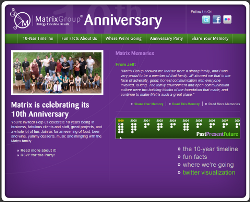
    Matrix Group 10t hAnniversaryWe did it! We launched a microsite for the Matrix Group 10th anniversary! It took us several months and a whole lot of research, but we did it. Why create a site for the occasion?

    10 years feels like a real milestone to us, especially to me. Like I say in my “Where We’re Going” letter, when I started the company, I wasn’t thinking about balance sheets or Web standards. I just wanted to help companies with their Web sites. And when my Advisory Board Chair asked me about my five-year plan (during year one), I just laughed; I was so focused on surviving the first year, five years felt like a lifetime.  So it felt right to create a microsite that lets all of us at the company see where we’ve been and think about the future. (more…)

  • Your Web Site Is Done, Now Who Owns The Design Files?

    Your Web Site Is Done, Now Who Owns The Design Files?

    locked CDA client whose Web site we recently implemented asked us to make changes to their Web site.  What is normally a routine request turned into a major affair.  The problem?  The design firm that had created their original designs had gone out of business.  The contract specified that the design firm owned the design and the all source files.  So when the company went out of business, gone went the files. Ugh.

    I attended a wedding recently where the couple had hired a much sought after photographer.  I asked him if he gave clients their digital files and he said yes.  He said that he believed in charging clients a fair price and then letting them own all the original images.  Yes, he makes more money if clients order photos or a photo book, but if they don’t, he’s been fairly compensated and he’s happy. (more…)

  • Beer and Cream Cheese SCRUM

    Beer and Cream Cheese SCRUM

    Beer + cream cheese = cheesecakeLast Thursday, the MatrixMaxx team celebrated a successful SCRUM sprint with a beer and cream cheese party.  So what do beer and cream cheese have to do with software development, specifically SCRUM? Read on and find out.

    MatrixMaxx is Matrix Group’s Web-based association management software product.  For about a year, the team had been exploring agile development methodologies.  Maki, our CTO and Chief Architect for MatrixMaxx, was really hot to implement SCRUM.

    There is a lot to SCRUM, but here’s what SCRUM means to a non-techie, manager type like me:

    • SCRUM is all about roles and process.
    • There are 3 main roles in SCRUM: the ScrumMaster (who serves as the project manager); the Product Owner (who represents the stakeholders like me and the clients); the Team (the folks who do the development work).
    • Development cycles are broken up into sprints, which last anywhere from a week to 30 days; each sprint has a defined list of shippable work.  Complex projects are broken up over multiple sprints, but each sprint must include deliverables that the customer can recognize and use.
    • There is a daily SCRUM meeting (lasting no more than 15 minutes), during which each team member answers the following questions:  what have you done since yesterday?, what are you planning to do today?, and what is preventing you from making progress? (so the ScrumMaster can facilitiate a resolution).
    • Tasks, or user stories, are posted on a board and each team member takes tasks off the board each day.

    Sounds great, right?  But for an agency like Matrix Group, SCRUM posed some problems:
    (more…)

  • Will Social Networks Trump Traditional Networks In The Future?

    Will Social Networks Trump Traditional Networks In The Future?

    NetworksOne of the people I’m following on Twitter (who shall remain nameless) recently commented: “Prefer getting updates from my friends via Twitter. Much more efficient and I don’t need to see them.”  Hmmm….

    I don’t know about you, but even though I love Twitter, Facebook, LinkedIn, yada, yada, I still really like getting together with my college buddies, grad school buddies, fellow DC Web Women, fellow volunteers for Doorways, etc.. Yes, it’s “efficient” to get updates from friends in far away lands via their social network pages, and I have strengthened ties with folks via Twitter and FB, but will my social networks ever trump my traditional networks?

    I don’t think so.

    A recent article in The Economist maintains that “(o)ld-style networks… are usually stronger than online ones, , and the trust between their members facilitates transactions of all sorts.”  Transactions like doing business together, hiring staff, and lending money.

    For me, however, it’s not a black and white issue.  Here’s what I think is happening:

    • Family networks will probably trump all networks because “blood is thicker than water” although we all know that families are also our craziest and most dysfunctional networks.
    • School, fraternity and work networks will remain the strongest because these are ties that get developed over time and involve shared efforts. So for me, my Stanford and Matrix Group networks will continue to be my strongest networks.
    • Offline networks that involved shared interests will remain strong because members have a common interest. These networks, however, will be expanded to include online members.  In fact, I expect these networks to be strengthened by the ability to connect with others worldwide, in different languages. (more…)
  • Is Cloud Computing In Your Future?

    Is Cloud Computing In Your Future?

    Cloud ComputingCloud computing is hot, hot, hot.  Early this year,  PC World predicted that cloud computing would shape up as a big trend in 2009.  We all know Amazon as a giant Internet retailer, but its newest business is cloud computing; you can now buy processing power and storage from Amazon!  Last year, Google launched Google App Engine, a service that lets developers write applications and host them on Google infrastructure.  SalesForce has a similar cloud that lets developers build and host systems on top of the SalesForce engine.

    But what exactly is cloud computing and why does it matter?

    Wikipedia defines cloud computing as “a style of computing in which dynamically scalable and often virtualized resources are provided as a service over the Internet.”  Whatis says that cloud computing is different from traditional hosting in three ways:

    • It is sold on demand, typically by the hour (this is why cloud computing is often called utility computing)
    • A user can have as much or as little of a service as they want at any given time
    • The service is fully managed by the provider (the consumer needs nothing but a PC and Internet access).

    Just imagine this: your organization has 1,000 boxes of documents to scan and OCR and you need to get the work done in one week.  By hosting your application on the cloud, you could have as much processing power as you need. Hundreds of servers could be deployed to your project at once.  When the work is done, your hosting obligations go to zero.
    (more…)

  • My Favorite Twitter Visualization Sites

    My Favorite Twitter Visualization Sites

    Twitter logoI love Twitter.  Yes,  it’s information overload and there’s a lot of noise, but I love the commentary and the interesting links.  I also appreciate the updates from friends and family.  More recently, I am loving the Twitter visualization sites that are popping up everywhere.

    So, what the heck is a Twitter visualization?  If you’re on Twitter, you know that there are millions of individual posts, replies, and discussions every day.  Figuring that people out there would want to do things with this flowing data, Twitter publishes an API (application programming interface) that lets developers have real-time access to tweets and some user information.  The result is hundreds (thousands?) of sites that let you search, map and analyze tweets, relationships between users, and topics.  Here are some of my favorite Twitter visualization sites.

    • Twistori is my favorite.    Click on the words love, hate, think, believe, feel, wish and see a real-time stream of posts that contain these words in the tweet.
    • WeFeelFine is a visualization of not just tweets, but blog posts and images as well.  Explore Murmurs and see a flood of tweets with the words “I feel” in them.
    • Twittervision shows tweets from around the world, overlaid on a world map so you know where the tweet are coming from.  Twittervision is even available in 3D.
    • Having an event?  PepsicoZeitgeist shows real-time tweets about Internet Week in New York City.  I especially love the top words from IWNY tweets.
    • TweetStats lets you enter your Twitter username and see a bunch of statistics about your tweets, including when you tweet, average daily tweets, who you tend to retweet, etc..  Did you know all this about yourself?
    • Twitter Friends Network Browser lets you see your Twitter network and click and drag to do fun things.
    • Hashtags shows you the top hash tags on Twitter right now.
    • MyTweetMap lets you see tweets from the people you are following, overlaid on a map.
    • Dipity let you explore tweets in a timeline format but the site has since gone dark. Here’s a blog post that explores what happened to Dipity.

    What’s fascinating to me is how Web designers and developers have found countless ways to transform the universe of Twitter data in new and different ways.  Each site introduces me to new people to follow and gives me insight on new topics.

    How about you?  What are your favorite Twitter visualization sites?