Matrix Group International

Month: February 2011

  • Does Your Organization Have a Groupon Strategy?

    Does Your Organization Have a Groupon Strategy?

    It seems everyone is hawking a good deal lately. A couple of people at Matrix Group recently got a 50% off deal from Groupon for a spa treatment. Earlier this week, AppSumo had a great deal on heat mapping software form CrazyEgg. Amazon has Daily Gold Box Deals. There are so many of these discount sites that there’s now a term for them: group coupon sites.

    A recent article in the Vancouver Sun reports that “frugality (is) the top consumer trend in 2011.” After this long recession and with many people still feeling uncertain about the economy, it only makes sense that we’re all trying to make our dollar go further by looking out for sales and coupons.

    I think that most people are looking for savings and value everywhere: when they’re shopping for clothes, booking travel, buying software, or registering for meetings. How does frugality affect your organization and what are you going to do about it? Here are some ideas:

    • Offer more for the same price. If you’re loathe to discount, I don’t blame you. But since most people are looking for a deal or extra value, what extra thing can you offer? Last year, when we announced the Matrix Group webinar series, we offered four webinars for the price of three to people who registered for the entire series. It worked really well for us because we got a lot of registrations to all four events and clients got a deal.
    • Create lightning deals. Most organizations offer an early bird registration fee. But what if you offered a steeper discount during just one day? Market the heck out of the deal, create some buzz and capture registrations early in the game. I call this the groupon strategy (I’m going to get sued for saying this, hope not).
    • Offer discounts for PR. When I got my haircut at Salon DeZen the other day, the stylist offered me 10% off my bill if I checked into Yelp. Owner Maria Burns knows that a check-in or a great review are worth way more than the few dollars off she’s giving away.
    • Create social deals. This idea isn’t new. In fact, it’s a classic campaign: refer a new member, registrant or purchaser and get a discount off your next bill. Encourage your clients and members to register for a meeting as a group and give them a break.

    I have a feeling that frugality is going to get even more chic and popular. How will YOUR organization take advantage of this trend? What’s your discount/value strategy? What’s worked for you?
  • DecisionPath Consulting Website Redesign

    DecisionPath Consulting Website Redesign

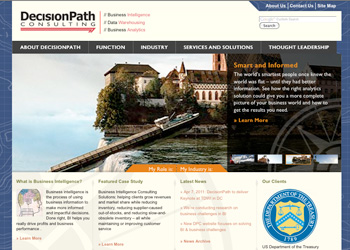
    DecisonPath, a business intelligence consultancy, called on Matrix Group for the redesign of its website, which needed to better communicate the company’s capabilities and experience. More importantly, DecisionPath’s staff wanted the website to serve as the company’s primary marketing vehicle and lead generation tool. SEO and usability were critical components of the website’s design and content.

    Matrix Group:

    • Developed a user-friendly navigation with a clear understanding of user motivations and behaviors.  Matrix Group considered all types of users for this website, from individuals looking for consulting services based on their functionality within their company to more industry focused.
    • Created a clean, updated design that positions DecisionPath as the “agency that can help its clients build its customers’ business by making their businesses’ smarter.  The new website now provides visitors with information on how business intelligence, analytics, and performance management, can be used to help solve companies’ challenges. The website also offers case studies, demonstrating the company’s expertise in utilizing business intelligence into helping clients’ find solutions to their business problems.
    • Implemented a content management system (WordPress) making it easier for DecisionPath’s marketing staff to maintain the website and ensure the information remains up to date (Previously, the entire site was entirely static HTML and required more technical knowledge to update).

    Visit the DecisionPath Consulting Website.

  • Grocery Manufacturers Association Website Redesign

    Grocery Manufacturers Association Website Redesign

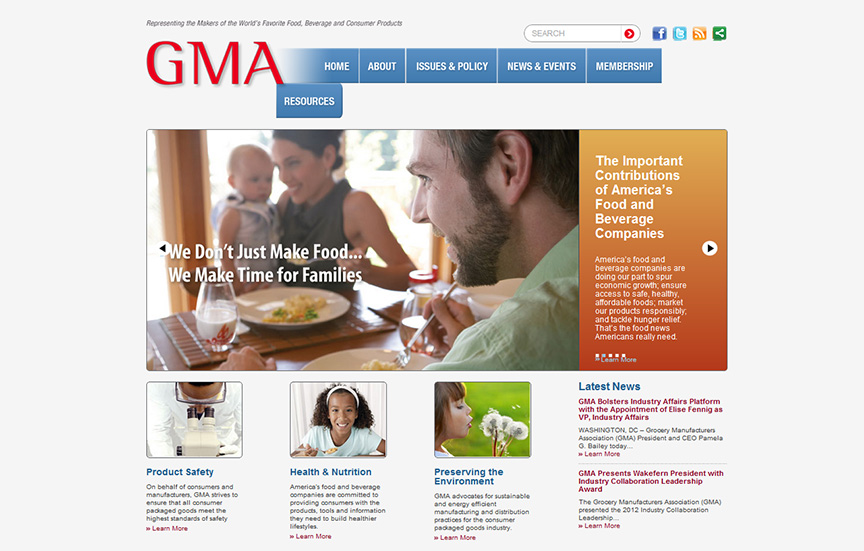
    Matrix Group partner, Grocery Manufacturers Association (GMA) is the leading voice for food, beverage and consumer product companies and serves many audiences in communicating the interests, research and publications developed by staff and also helps its members produce safe products through a strong and ongoing commitment to scientific research, testing and evaluation. GMA partnered with Matrix Group and Rational 360 on a website redesign and implementation. Rational 360 created the information architecture and design, while Matrix Group implemented a new content management system and integrated the website with GMA’s membership database.

    Matrix Group and Rational 360 work features:

    •  News and information organized by topic, including Product Safety, Health & Nutrition and Preserving the Environment.
    •  A unified member experience for members who previously had to use multiple passwords to access content on two websites (GMA merged with another organization several years ago), and multiple, separate e-commerce applications. Today, visitors use one username and password to access ALL resources and members seamlessly gain access to protected content and discounts.
    •  Complete integration with GMA’s back office. Member profiles are changed instantly, purchased are processed in real-time, and all registrations are automatically saved to GMA’s association management software, MatrixMaxx.

    Visit the Grocery Manufacturers Association Website.

  • International Association of Chiefs of Police Website Launch

    International Association of Chiefs of Police Website Launch

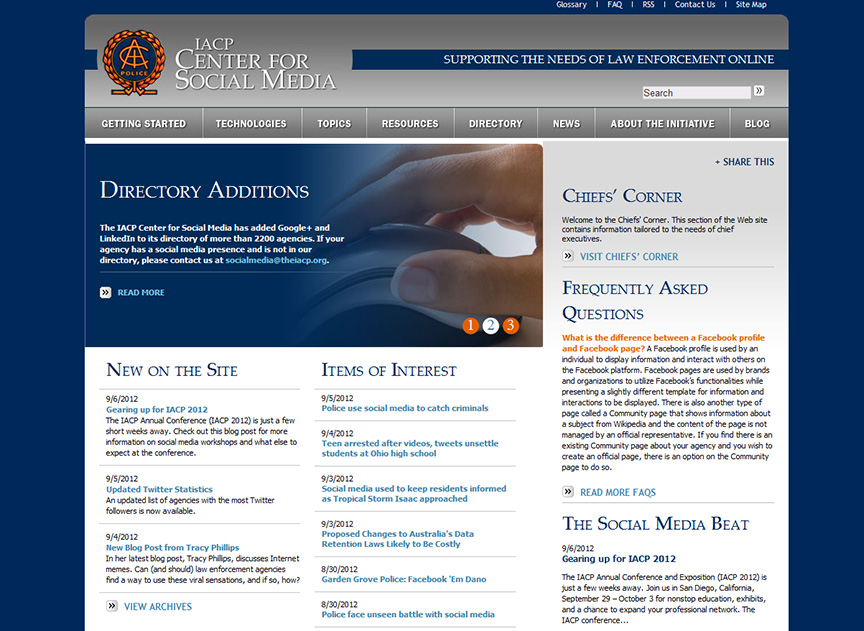
    Matrix Group  has been a long time partner of the world’s oldest and largest nonprofit membership organization of police leaders, the International Association of Chiefs of Police (IACP) who decided to launch an online clearinghouse of information and free resources to help members develop or enhance their agencies’ use of social media and integrate the tools into their daily operations. To create this online resource center, IACP turned to Matrix Group. Matrix Group collaborated with IACP staff on a new website, using the agency’s user-focused methodology to develop and implement the strategy around the website.

    Matrix Group:

    • Developed a user-friendly navigation with a clear understanding of the users’ motivations and behaviors.  Matrix Group considered all types of users for this website, from beginners to more experienced users. The topic-based navigation directs visitors clearly to specific areas of the website based on their needs.
    • Created and integrated an online directory of law enforcement agencies that use social media, including the URLs of agencies’ social media pages and blogs.  This directory not only showcases the work that the various agencies are doing, but it also helps members develop their own social networking strategies, policies, etc. Members can now browse or search the directory, and view other agencies Facebook pages, Twitter profiles, blogs, etc.
    • Created a catalog of resources, templates, case studies related to law enforcement use of social media. The new website is a “one stop shop” where chiefs and officers can find examples of social networking policies and strategies, download guides and fact sheets on how to create profiles on social networking sites, and read case studies about how other agencies are including social networking in their work.

    View the International Association of Chiefs of Police – Social Media Website.

  • Examples of Really Great Donation Pages

    Examples of Really Great Donation Pages

    mouse connected to a tin canEvery December, my husband Maki and I sit down and make decisions about our charitable giving. Once we’ve decided on the organizations and amounts, we go online and get everything done. What I’ve noticed is that most organizations have less than optimal donate pages or sections of their website. Here’s what I want from a Donate page:

    • Why I should give
    • What my money supports
    • An easy way to make a donation, preferably without having to create a login
    • If using a third party payment gateway or network, make it really clear to me what I’m going to see on my credit card statement
    • A statement that you won’t rent or sell my information to other charities

    Instead, what I usually find is a simple e-commerce form that simply asks me for my credit card information! What a waste of an opportunity to make the case for giving!

    So I scoured the Web and looked for effective donation pages. Here are some I love:

    Johns Hopkins Giving – This is a microsite devoted entirely to giving. I like the navigation: Why Give, Where to Give, How to Give, Calendar. I also like the branding area, which has great stories about Hopkins students and professors and doesn’t rotate too quickly.

    Humane Society – I like how the donation process starts on the home page through a simple form, then continues to a larger form. I think it’s effective to call donors heroes who stand up for animal rights.

    Meals on Wheels America – Without support from programs like Meals on Wheels, millions of seniors are forced to prematurely trade their homes for nursing facilities.

    Wounded Warrior Project – When you give to the WWP, you’re supporting an organization whose broad appeal reaches across demographic, geographic, and political boundaries. For us, it’s not about the war; it’s about the warrior.

    How about you? What are your favorite donation pages? Got any examples of donation page disasters?

  • Sheet Metal Workers – National Pension Fund Website Redesign

    Sheet Metal Workers – National Pension Fund Website Redesign

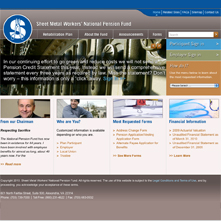
    Matrix Group recently worked with the Sheet Metal Workers – National Pension Fund (SMWNPF) on their website,  which  provides pension fund participants with information about the Fund, plan of benefits, financial information, forms, contact information, and frequently asked questions about the Fund.  Matrix Group worked closely with SMWNPF staff to design a “user-centered website” that now speaks clearly to SMWNPF’s target audiences of employers, retirees, participants, trustees, SMWNPF staff and business managers of local union affiliates.

     Matrix Group:

    • Developed a robust navigation that helps visitors navigate to specific sections based on their needs.  Visitors can navigate by audience, topic or most frequently requested information.
    • Created a design that is friendly, professional but not slick, accurately echoing the image of the Fund.  The design includes prominent calls to action, e.g., Participant Sign in and Employer Sign in.
    • Implemented a content management system that allows SMWNPF staff to update the entire site without knowing html skills.
    • Supported the launch of the website by developing a postcard and video that showcase the new site.

    View the Sheet Metal Workers – National Pension Fund Website.

  • What’s the Best Way to Reach Your Best Friend These Days?

    What’s the Best Way to Reach Your Best Friend These Days?

    I got a voice mail from a vendor the other day. He left me three numbers and the best times to reach him at each number.

    One of my Project Managers said she was having a tough time reaching a client. I suggested she try the client’s cell phone since that client is almost never at her desk but she’s almost always available via cell phone.

    I have a friend who almost never answers his phone, but if I send a direct Tweet, I get an instant response.

    Egads. With all of these communication channels, what’s the best way to reach someone these days?

    On any given day, I check multiple devices for voice mail, e-mail or text messages: work e-mail, personal e-mail, home phone, work phone, cell phone, Twitter and Facebook. Some of these channels overlap.  For example, direct messages on Twitter, Facebook messages and work voice mail all end up in my e-mail.

    But with so many devices to check for messages, I invariably favor certain methods (work e-mail, work voice mail and cell phone), to the detriment of others. Case in point: I completely missed a friend’s voice mail on my home phone because she called while I was upstairs with the baby one Sunday. Since I was home all day, it never occurred to me that I might have missed a call, so I didn’t check voice mail for several days. Eeek.

    Many of my friends and staff have consolidated communications on their cell phones. They have no land line at home and do everything on their smartphone. But my husband Maki and I won’t give up our land line because in an emergency, my trusty land line phone (an AT&T Trimline 210 from 1989) that does not need a power source will still work (unless the central office is out).

    I thought Google Voice would save me. Google Voice gives you a phone number that’s tied to YOU, not the device. Currently, I have a Google Voice number that rings on my cell phone and home phone; by the end of the week, it will also ring my direct extension at work. I can program Google Voice to ring on specific phones during certain hours of the day. And I can make free calls anywhere in the US and around the world to other Google Voice subscribers. Pretty cool. Currently, only Maki, my mom and the nanny have this number because they’re the people who MUST reach me when they NEED to reach me. But here’s the rub: Google Voice gives me another mailbox to check! Ick. I hope I managed to disable that feature.

    All of this thinking about how to reach me and how to reach other has got me thinking. Are we making ourselves crazy by always being reachable and having the expectation that everyone should be reachable at all times? If you’re an NCIS fan, you know that Gibbs’ Rule #3 is “Never be unreachable” so I guess I need to continue diligently checking e-mail, voice mail, text messages and social media messages. <sigh>

    How about you? What’s the best way to reach YOU? And how do you let friends know the best to reach you?