

Matrix Group International

Tag: Trends

  • Web Design Can and Should Be CMS-Agnostic (and why we love WordPress more and more)

    Web Design Can and Should Be CMS-Agnostic (and why we love WordPress more and more)

    webdev_smHere at Matrix Group, we use a variety of platforms and frameworks to build client applications. On the content management system (CMS) side, we really like Sitefinity and WordPress for building websites, although we have worked with other platforms, including DNN, Expression Engine, and Kentico. WordPress has come a long way in recent years, and we’re doing more and more with it. We love its flexibility, extensibility, and clean code, to name just a few things.

    During a client meeting the other day, I was pitching doing a magazine website in WordPress. The client was surprised and said, “WordPress, the blogging CMS? Isn’t that too simple for our needs?” I explained that no, WordPress has come a long way, it powers so much of the web these days, and it is perfectly capable of the complex functionality she needs. She countered with, “So show me a site that you did in WordPress that doesn’t look like a WordPress site.”

    So I did. I showed her Endocrine News, the magazine of the Endocrine Society, the website for e-discovery firm eTera Consulting, and a convention site for the National Electrical Contractors Association.

    But then I got curious. Does my front-end team design differently based on the CMS platform? I asked my Creative Director and Senior Designer, “Do you take CMS into consideration when creating designs?”

    The response: “Heck no, half the time, we don’t even know the platform that will be used.”

    So then I asked my Lead Front-End Developer, “Does the CMS platform affect what we can and can’t do?”

    The response: “Nope. Some things are easier in WordPress, other things in Sitefinity. Just depends.”

    I know I’m involved in many Information Architecture projects, and I no longer wonder if a platform can do something I’m envisioning in a wireframe.

    I hadn’t really thought about it but it appears we are now CMS-agnostic when it comes to designing the front-end of our websites. Does that mean every CMS can do everything? Probably, at least in the arena we play in. But we definitely express favorites, and choice of platform can affect HOW a specific requirement is implemented, as well as price and timeline.

    Makes me think of a wise client who said to me some time ago, “Joanna, I don’t care what system you use to build my site, as long as it does what I want, it’s easy to use, and you can maintain it easily.”

  • What’s In Store for Associations and the Web in 2015?

    What’s In Store for Associations and the Web in 2015?

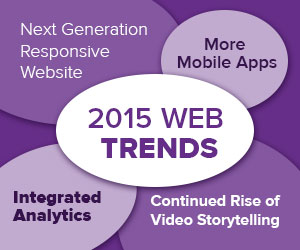
    web_trendsI have the honor of helping a number of association clients plan their web budgets for the next year or two or three. When preparing a web budget, my team and I do research, look at what other organizations are doing, talk to the innovators in the space, and brainstorm with our clients. So what’s in store for associations in 2015?

    Next Generation Responsive Website

    Associations that don’t already have a responsive website need to get one. And fast. Clients that already have a responsive website should be looking closely at their analytics and interviewing members to find out the information and services they most need when visiting the association’s website on a tablet or smartphone. This data will help you prioritize some content over others, change the order of calls to action on a mobile view, make some items disappear, or bring other content to the forefront. You don’t have to collapse your entire menu and you don’t need to just tile the elements in a straight line.

    What’s more, the next generation responsive website doesn’t just resize webages, it serves up different media files based on screen size and bandwidth. For example, on a phone over 4G, a responsive website will display lower resolution images. The same website on a retina screen iPad over broadband will serve up higher resolution images and HD video.

    More Apps

    Since phones and tablets are selling at a much faster rate then desktop computers, it only makes sense that apps be a part of your mobile strategy. Meeting and convention apps that connect attendees, help them explore content, and feature exhibitors are a no-brainer. Apps that introduce your industry to a wider audience are great. Technical apps that replace a desktop program might make sense, unless it devalues a high-priced, high value product. Finally, news apps that aggregate content across your websites and social media pages will help keep members abreast of all the news in your space.

    Integrated Analytics

    Most organizations rely on multiple platforms for their communications. The problem is that each platform has its own set of reports and analytics. Your website may be running Google Analytics. Your CMS has its own internal usage reporting. Your blast email platform reports on views and clicks. Your LMS (learning management system) has yet another set of reports. In 2015, I recommend that organization integrate the reporting across their systems. For example, most trade associations know what people are doing on their websites and their newsletter open/click rate. But what if they could also know what percentage of primary contacts are logging in to their members’ only site and opening their weekly newsletter? Integrated reporting that ties demographics and activity data will provide valuable, actionable data.

    Continued Rise of Video

    I know I sound like a broken record, but video needs to be part of every organization’s 2015 strategy. Pages with video encourage more visits, and longer visits. Google increasingly includes YouTube videos in search results. Video can be used to brand an organization, explain what an organization does, showcase success stories, tech people how to use applications, and give members and customers a voice.

    Storytelling

    Finally, in 2015, associations need to make their case to members, legislators, the media and the public via authentic storytelling. The formal, stilted language of the press releases of yore is not nearly as effective as writing that sounds like you’re having a conversation with someone you know and trust. Unless you’re The New York Times or The Wall Street Journal, your content needs to be succinct, fresh and user-friendly.

    My team and I will be on the lookout for evidence of these trends around the web and certainly amongst our clients and report on them as we learn and adapt to these trends. How about you? What will YOUR focus be in 2015?

  • I Did It! I Cancelled My Cable Subscription!

    I Did It! I Cancelled My Cable Subscription!

    nocablesmallI did it! A couple of weeks ago, I cancelled my subscription to cable TV through Comcast. Why? Gosh, so many reasons but primarily because it was costing me $120 per month and my family just doesn’t watch that much TV. Don’t get me wrong. We watch a lot of shows, just not cable TV. So far, here’s how we’re surviving and thriving without cable:

    • HD Antenna. We had an HD antenna that lets us watch network television in HD. Finally putting it to use. Works pretty well. $50.
    • Netflix. My 3-year old is fond of saying, “I love Netflix.” We watch all kinds of shows and movies on Netflix. Like the rest of DC, I’m hooked on House of Cards. $8.99 per month.
    • Amazon Instant Video. Since I’m an Amazon Prime member, I get access to tons of free shows and movies, many of them not available on Netflix, like The Wire, my new favorite and Stargate SG-1, my old favorite. Free, if you don’t count my Prime membership.
    • Hulu. I just signed up for this. I love that I have access to most of the latest TV shows, including the late night talk shows. My husband loves watching movie trailers. $7.99 per month
    • Network television apps. I’m pretty impressed with the ABC, CBS and NBC apps. I get access to all of the shows, although I’m not nuts about the ads and the fact that shows expire too soon for me, since I don’t watch regularly. The Taste disappeared on me last year when the season ended; why not keep up old episodes for a few months? Free. On the CBS app, I’m now locked out of some content because I can’t log in to my Comcast account. Bah.
    • Specialty channel apps. I’m in love with the PBS app. I binge watched A Chef’s Life earlier this year.
    • Chromecast. This $35 device from Google lets us stream shows from a table or phone to the big TV in our living room. It’s also handy when we’re traveling and want to watch a movie with the kids.
    • iTunes, Sony and Amazon stores. Maki, my husband, has banned me from buying movies on physical media. So no more buying DVDs. Instead, we rent movies through one of the online stores. If it’s a movie I know we’ll watch multiple times, like The Lego Movie, I’ll buy it through iTunes and download it to whichever iOS device my child happens to be on at the time.

    What gets tricky is figuring out where and how to watch a specific show. For example, my 3-year old wanted to watch Blue’s Clues. This show used to be on Netflix but one day, it was gone. I googled “Blue’s Clue on Netflix” and found lots of threads about Netflix no longer having the show.   So I started checking different apps but what a pain! I found that TV.com has a nifty database of shows and where they’re available. Search for the show you want, then click Watch Online. Hover over an episode and TV.com will let you which platform has it, e.g., Netflix, Amazon Instant Video, Hulu, etc. Love this.

    What I don’t have is a way to watch CNN and live sports that aren’t on network television. So I settle for the CNN app, which doesn’t have live streaming unless you’re a cable subscriber. Bah. So I turn to the NPR app, which has text and audio. And I now listen to the Radio Washington app, which lets me listen to WAMU (the local NPR station) live. Thankfully, my family’s isn’t big on watching live sports. We’ll just have to keep our friends who have cable TV and giant TVs. 🙂

    It’s been a couple of weeks and I haven’t missed cable. This might change and I can always re-subscribe. In the meantime, I’ll enjoy my apps.


  • Thinking About the Future in the Age of Surprise

    Thinking About the Future in the Age of Surprise

    Figure holding multiple directionsI had the pleasure of speaking at the International Foundation of Employee Benefit Plans (IFEBP) last week during their Benefit Communication and Technology Institute in San Jose, CA. My topics? Getting Started with Video and Website Best Practices. But that’s not the topic of this blog post.

    The closing session made a real impression on me. Terry Grim, a partner at the Foresight Alliance, talked about the art and science of predicting the future and boy was she terrific.

    Terry started off by saying that many things that seem to catch us by surprise were actually predicted, including 9/11, the rise of drones, extreme weather. And yet, despite our technological advances, it’s still very hard to predict THE future. Why? Terry says:

    • Forecasting errors are most caused by forecasters’ assumptions, which turned out not to be accurate.
    • We tend to think of the future as one thing but there is a range of possible futures.
    • The expected future is actually unlikely to happen because while we can usually forecast probable and preferred futures, we tend to be less good at forecasting plausible alternatives.
    • Even when we do predict a chance or shift, we are often lousy at predicting or anticipating the ramifications of said change or shift.

    Ultimately, good forecasts must allow us to make better, more informed decisions. So how do we do this? Terry says:

    • We need to think about the range of possible and plausible futures. We should ask ourselves, “If current trends continue or don’t continue, what will happen?”
    • When looking at plausible futures, we must look wider and factor in social, economic, environmental, regulatory, social, political and technological forces that will/could/might shape the future. Most of us have a lens through which we’re comfortable looking at the future. Good forecasting means looking at the world through different lenses, hence the importance of having a diversity of backgrounds and experiences on your team.
    • We must look at 2nd and 3rd order ramifications of changes. We must take a longer view of the impact of plausible futures.
    • We must look deeper and ask ourselves, “What do we not know? What do we think we know that might be incorrect?”

    Terry called this time The Age of Surprise because there are so many forces of changes pressing on us at once: technological, medical, political, economic. She called on all of us to question our assumptions, look wider, deeper and longer to understand the future, and use more comprehensive data to make decisions.

    As someone who has been “surprised” many times this year by turns in the market and marketplace in which Matrix Group operates, I’m thinking hard about possible and plausible futures, and hoping to bring better data and forecasts to our strategic planning.


  • Top Tech Resolutions for 2014

    Top Tech Resolutions for 2014

    blank list of New Year's resolutionsIt’s the new year, which means we’re all talking about our New Year’s resolutions. While most of us are thinking about diets and exercise routines, I’m thinking about tech resolutions. Here’s my list of top tech resolutions that I think you and your organization should consider in 2014.

    Make your site responsive. If your site isn’t already responsive, resolve to redesign your website or create responsive templates. Know that more and more of your readers are coming from mobile device and more will come if you make your site mobile-friendly.

    Go visual. All the research shows that web pages with images and video get more views and generate more time on site. Facebook favors posts with images. YouTube is the #2 search engine. The world is favoring visualizations.

    Add a new platform to your communications strategy. With the proliferation of new communications and social media platforms, it’s a good time assess your strategy and see if you should add a new platform. Yes, you must have the business case and the resources to be successful.

    Be on Google+. Google’s social strategy is struggling. So it’s favoring Google+ posts in its search results. If you’re not already on Google+, it’s time. You’ll reach a largely male, techie audience that is usually worth attracting.

    Look at your Google Analytics reports. I’m amazed at how many organizations do NOT make a habit of looking at their analytics. Yes, traffic reports don’t tell the whole story, but they don’t lie. Your usage reports will tell you what people are doing and viewing on your site, and, more importantly, you should be measuring campaign conversions so you can figure out which platforms to invest the most time in.

    Develop an editorial calendar. This is the only way to ensure you have good, quality content posted on a regular basis to your website, e-newsletters, and social media pages. Good content will boost your search engine ranking. A calendar will eliminate some of the struggles associated with generating good content.

    Back up to the cloud. Because it’s easy, convenient and inexpensive. Because it means you have access to your “stuff” from anywhere. And because it’s a terrific disaster-recovery tool.

    Secure your mobile devices. The stats on the number of phones and tablets that get lost and stolen each year are staggering. Be sure to use a PIN on your device and install “Where’s my iPhone/Android?” so that can remotely erase your data. And if you’re backed up to the cloud, you can easily restore all of your information and services to your new device.

    Use a password manager. Still using sticky notes or Excel to manage password? Still using the same password across sites? Security breaches are becoming more frequent and affecting more people. Limit your exposure by using KeePass or LastPass to manage your strong passwords. And NEVER use the same password on multiple sites. Otherwise, you’re just asking the hacker who breached x retailer site to access your Amazon, Apple or Schwab account.

    Audit your privacy filters on social networks. I make a habit of auditing my privacy settings on Facebook, Google+ and other platforms on a regular basis. You probably don’t want the world accessing photos of your baby or your boss checking out your rants.

    There you have it. My Top 10 tech resolutions for 2014. What are YOUR resolutions?

  • What Does It Mean to Have an Interactive Website?

    What Does It Mean to Have an Interactive Website?

    Man touch virtual screen iconsNot so long ago, clients and prospects would call me and say, “Joanna, I want my website to be more interactive.” They wanted to move beyond a website that just had a lot of text to one where visitors could fill out online forms, make purchases online, register for meetings, etc. Today, I would say that an interactive website is one where:

    Visitors can perform transactions via an online form. It’s 2013, we shouldn’t be asking our customers to download, print, fill out and mail/fax PDF forms.

    Visitors can submit stories, photos, videos, comments, blogs. yada, yada. The most popular websites in the world are ones where users provide all the content. Shouldn’t YOU be harnessing the knowledge and experiences of your members?

    Visitors can interact with the information and services that you offer. Let’s face it, interactive features like calculators, clickable maps and interactive timelines encourage exploration and suck us in because we get to control the experience and we’re rewarded with a little more data as we click, zoom, pan and swipe.

    The content and experience is personalized based on demographics and history. I remember when Amazon first started offering recommendations; it was creepy. Today, I welcome the recommendations because they’re usually spot and they encourage us to explore authors, music and games that we would otherwise never be exposed to.

    There is context-sensitive, user-friendly help. This help could take the form of a live chat feature, pop-up help screens and a helpful glossary.

    Earlier this week, Matrix Group Creative Director Alex Pineda and I did a webinar on the “5 things you can do to make your website more interactive” and we touched on the tips and trends above. After conducting hundreds of user interviews, watching people test websites and hearing what users have to say about their wants and needs, it’s clear that the top websites are personalized and encourage exploration through a rich, immersive experience. Creating this type of experience is quite a challenge but it’s what our visitors want and expect.

  • Social Media Gives Each Of Us Our Own Reality Show

    Social Media Gives Each Of Us Our Own Reality Show

    Remember The Truman Show, released in 1998? Truman Burbank thought he was an ordinary guy, but in reality, his whole life was one big reality show. It was a great story but a ridiculous premise.

    In 2003, MySpace was launched. All of a sudden, teenagers had a way to create personal web pages to share their profiles, photos, videos, artistic creations.

    In 2004, Facebook gave college students a way to broadcast their status so that their friends knew how to find them and know what they were up to. Over time, Facebook would open up, allow anyone to create an account, and allow us all to share status updates, photos, videos, interests, and our location.

    After a few years, critics, predicted that privacy would be the downfall of Facebook. Why would people want to share so much of their lives?

    Today, nearly 900 million people share the most intimate details of their lives on Facebook. Millions of people check-in from their current location every hour on Foursquare and other location-based networks. Over 100 million people tweet the details of their lives from Twitter: what they’re thinking, doing, eating, reading. The reality genre is the single, hottest genre on television.

    Just like Truman Burbank, social media has given each of us our very own reality show.

    Think about it. If you subscribe to a friend’s account on FriendFeed, you can see EVERYTHING she’s doing on the Web: what she’s tweeting, what she’s posting to Facebook, her blog posts, her photos on Flickr, her videos on YouTube. It’s sort of like stalking, only we encourage it and we admire those with the largest followers.

    We even title our social media reality shows. On most social networks, I’m jmpineda. I’m not a very big star. I only have 1,591 followers on Twitter, 302 connections on LinkedIn and 233 friends on Faceook. Meanwhile, a good friend has over 1,200 LinkedIn connections, over 10,000 Twitter followers, and nearly 800 Facebook friends. She’s got an amazing Klout score.

    The next time you pooh pooh the reality TV genre, ask yourself: Are you part of the craze with everything you’re posting and sharing on social media? What’s the name of YOUR social media show?

  • Will Facebook Survive? And Does It Really Matter?

    Will Facebook Survive? And Does It Really Matter?

    Last week, I had the pleasure of being a speaker at the Benefits Communications Conference of the International Foundation of Employee Benefit Funds. During the closing session, one of the attendees asked me which social networks I thought were going to survive into the future. The dialogue went something like this:

    Me (Joanna): I can’t predict the future, but I think Facebook and YouTube will stick around for a while.  Not sure about the smaller networks, especially those without solid revenue models.
    Participant: But I’ve heard that the younger audiences are leaving Facebook now that their parents are signing up.
    Me: Yes, I’ve read that as well, but Facebook has really tipped in terms of popularity, all the research shows that the older audiences don’t leave a social network once their friends have joined and they’ve made a commitment to the site, and Facebook as a platform for all kinds of third-party applications is really compelling.

    But then I got to thinking.  Does it really matter if Facebook survives?  Does it really matter which of the social networks survives?

    If you’re hesitating about investing in a social media strategy because you’re wondering which of the platforms will survive, I think you’re worried about the wrong issue.  Here’s why:

    • Social media isn’t just a fad. Social networks have fundamentally changed how we communicate, connect and market.  Social networks have “tipped;” there is now a critical mass of people on social networks.  You can’t ignore the numbers.
    • In the end, it doesn’t matter which social network survives because there are now so many mainstream and niche social networks, it’s almost pointless to worry about which ones will make it.  Remember when we thought no other search engine could threaten Yahoo!’s primacy?
    • Your social media strategy probably needs to include having a presence on multiple networks, depending on where your target audiences are AND to ensure good coverage and reach for your marketing messages.

    Here’s what I think IS important:
    (more…)

  • Who Watches TV During Regular Broadcast Hours?

    As I write this, I’m watching an episode of NCIS that I purchased from iTunes and streamed to my Apple TV. Last weekend, I was swapping stories with friends about our favorite TV shows and when someone mentioned a show I didn’t recognize, I asked when it was on. The answer? “I don’t know, I TiVo everything.”

    That’s when I realized that I nearly never watch TV shows during regular broadcast hours.  Instead, I rely on recordings and purchases to watch shows I’m interested in, when I want them.  And since the networks now stream shows on their Web sites and Hulu, who needs to be a slave to the TV schedule anymore?

    In a report titled “Television, Internet and Mobile Usage in the US,” Nielsen calls this phenomenon “timeshifted TV” because viewers are watching shows on their own schedule.

    Who’s been hurt by this phenomenon?

    • The networks that rely on advertising since so many of us fast forward through commercials or purchase commercial-free shows.
    • Providers of schedules, like TV Guide and the newspapers, since we use our devices to view or purchase what we need on demand.

    Who’s benefiting?

    • Companies that allow us consumers to watch shows on demand, like Netflix, iTunes, Comcast, Verizon, etc.
    • Companies that can develop non-traditional advertising and PR campaigns and don’t just depend on viewers watching shows and sitting through commercials.

    How about you?  What are your viewing habits?  What other disruptive technologies and trends are helping us say bye-bye to traditional forms of leisure?

  • A Look Back at 2009: My Favorite Statistics and Trends Web Sites

    A Look Back at 2009: My Favorite Statistics and Trends Web Sites

    It’s the new year and it’s customary to look at the previous year and make predictions about the upcoming year or decade.  Every day in my e-mail inbox, I get a flood of Top Ten lists.  So where do I go when I need statistics about which Web browser is winning the browser war, how many users Twitter really has, or the gadgets and technologies that will likely shine in 2010?  Here are my favorite sites: