
Matrix Group International

Month: February 2022

  • What’s It Like to Travel These Days?

    What’s It Like to Travel These Days?

    I never really stopped traveling during the pandemic. Yes, I traveled a whole lot less, but I have seen my mom several times, I went on vacation, and I have attended out of town conferences. Just since the start of the New Year, I’ve been to San Diego, San Francisco and New York.

    Whenever I come back from travel, friends and co-workers ask me, “what’s it like to travel these days?” This post is for all of you who have been wondering what it’s like to get on a plane or train, stay in a hotel, or attend a conference or show. Here’s what I have observed and learned, in no particular order.

    • Mask mandates are very strict at airports, on planes, and on trains. Even if your local jurisdiction is no longer requiring masks, you’ve got to mask up when traveling by air or rail.
    • At New York restaurants and shows, be prepared to show your vaccine card and ID to get in.
    • Many NoVA and DC restaurants ask for proof of vaccination if you are eating indoors.

    So what’s it like to travel these days? On the whole, it feels great. Since last July, I’ve been to Santa Fe, Boston, Nashville, San Diego, San Francisco, and New York City. I’m a pretty careful traveler. I wash my hands a lot, I mask up, and I carry wipes, hand sanitizer, and extra masks. When I can, I eat outdoors. Even though I’ve never tested positive, my household has had COVID, so the existential fear of COVID that loomed before me is now mostly gone. 

    This post is not about whether or not I think life is, or should be, back to normal. For the record, I don’t think either is true. It’s about travel, which for me, has been pretty joyous and safe. If and when you do decide to travel, be safe, be well.
  • Onboarding New Staff During a Pandemic and the Power of Company Fundamentals

    Onboarding New Staff During a Pandemic and the Power of Company Fundamentals

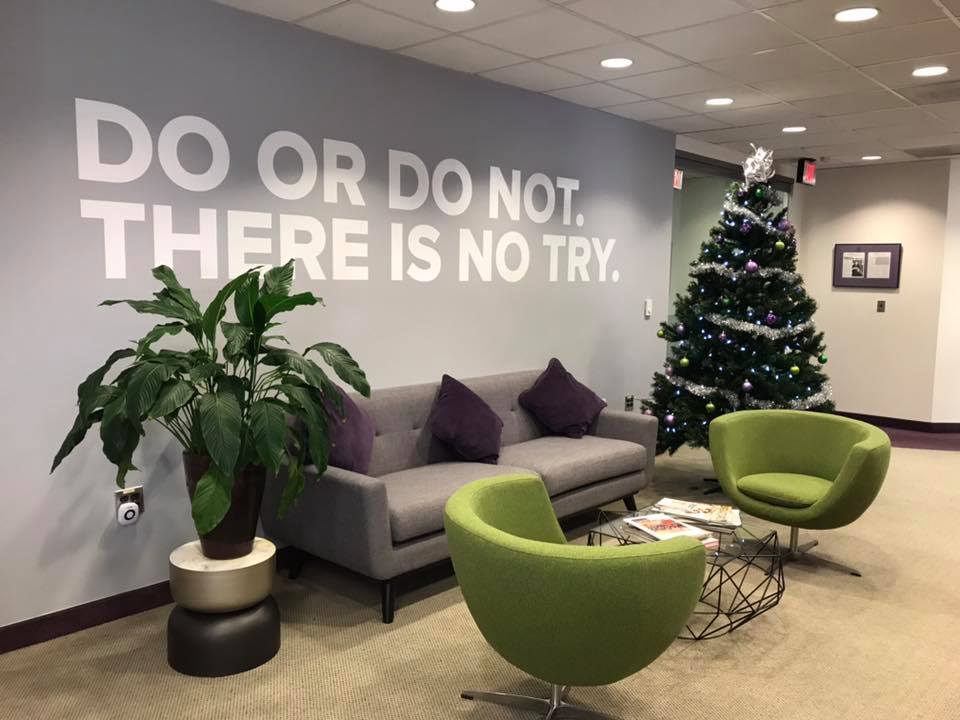
    A picture of an office waiting area, with the words 'Do or do not" written above, and 'There is no try' written below.During the pandemic, Matrix Group has hired new staff. Most of them are out of state because, you know, why not? We are all remote anyway, so why does it matter if Mark is in New Jersey? Not to mention the fact that finding great talent is so tough right now, who cares if Mark is in New Jersey?

    I did fret a little, however, about onboarding these new staff. Before the pandemic, ¼ of the Matrix Group was already remote, but they were all staff who had previously worked in the office and then moved away for a variety of reasons. These were team members who were inculcated in the Matrix Group ways, they had deep networks, they had strong ties to their managers and teams.

    Turns out that something we’ve been doing for a looooong time has served us well as we’ve hired and onboarded staff who may never set foot in the Arlington, VA office. 

    Matrix Group has company fundamentals. These fundamentals are 23 rules to live by that we developed eons ago. Here are some of my favorites:

    • Do or do not. There is no try.
    • Communicate to be understood.
    • Don’t let your client make a mistake.
    • Don’t let your boss make a mistake.
    • We are curious.
    • When in doubt, act with urgency. Everything has a timeline.

    Here’s the trick: each week, we pick a fundamental and every meeting opens with a discussion about that fundamental. During staff meetings, I take the fundamental and ask if someone would like to comment on it. During project managers meeting, I take the fundamental and ask how we’ve lived it, or not lived it, this week. The idea is to provide guidance on how to live and interpret the fundamentals so they’re not just empty slogans. I want everyone to know what it means when I say “let’s get curious about this” or Rajani says “ASAP is not a timeline.”

    Back to onboarding. Turns out these fundamentals do more than serve as something to talk about. They give staff guidance on how to behave, they let us tell stories about how we’ve lived or violated the fundamentals, and they give my team common language about what’s acceptable and what’s accepted at work.

    Once I realized this, I spent a whole lot less time fretting about whether or not my remote staff would “get” the Matrix Group company culture. I smile when I hear someone fairly new at the company start to use the company fundamentals in their communications. I love it when I hear or read, “I know we’re not supposed to let clients make a mistake,” or “I know we’re not supposed to deliver bad news via email.”

    How about you? How are you defining your company fundamentals for new or remote staff? What’s working?