Matrix Group International

Month: June 2019

  • It’s Not Easy Being Green: Our Quest to Have a Sustainable Office Move

    It’s Not Easy Being Green: Our Quest to Have a Sustainable Office Move

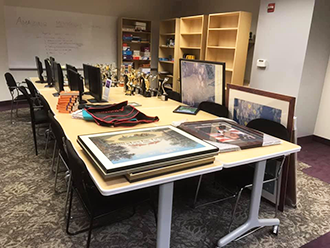
    office items for free on tableYou may have already heard the news. Matrix Group is moving. Just down the street. After 10 years, to keep the creative juices flowing, we’re giving ourselves a change of scenery and a change in office format.

    We’re moving to a smaller space but we’re not really losing space. Here’s why: we’re moving to a suite that has access to a fantastic kitchen, library, lounge and two state of the art conference rooms. We never would have been able to afford these amenities on our own, so we’re pretty excited.

    All of this means that we need less furniture and we need it configured differently from what we have now. We have this beautiful system furniture that we bought 10 years ago. It’s paid for, fully depreciated, made in America, in great shape, and really good looking. I should be able to reuse it, right? Wrong.

    Everyone we spoke with said we should buy new furniture. Why? Because it will be too much money to take down, inventory and reassemble the old stuff. Because the new space is different. Because our system is no longer being made, so if we need parts, we’ll be out of luck. Because. Because. Because.

    Can we sell the furniture? Not really. Even though there are used furniture companies around, our consultant strongly discouraged us from trying to sell our furniture because it’s no longer being made. “It has to just go to landfill,” we were told. “You will be happier with new furniture and it will cost about the same amount.” Really?

    The staff and I decided to take a stand, try to save some money and prevent our furniture from going into landfill. Here’s what we’re doing:

    • We tried out a zillion plans but we finally came up with a plan that uses all existing parts in new and different ways. We love the new plan. You’ll have to come see.
    • We’re working with a local school to donate our excess furniture because public schools are always in need of supplies. I love the idea that some teachers will be able to reuse our beautiful desks and bookcases.
    • We’re also giving away our excess office supplies because once we went through our cabinets, we had dozens of empty binders, boxes of new folders, and reams of legal size paper we’ll never use.
    • We’re giving away desks, frames and kitchenware to staff and eventually to Goodwill. Our large conference room has been a bazaar for the past few weeks; if it’s on the table, anyone can take it.
    • We had dozens of awards (statues and frames) that we just can’t bring with us. We just won’t have the room and some are quite old. Believe it or not, there are places that will take used awards, strip out the labels and reuse them. Imagine this: some drama student is going to get an award previously used for a web design award. Makes me chuckle.
    • We’re giving away a bunch of stuff through a Buy Nothing group on Facebook. What’s a Buy Nothing group? It’s a group on Facebook where all the members agree to ask for what they need and give away their excess. No money is ever exchanged. I love, love, love the Del Ray/Alexandria Buy Nothing group. I’m giving away chairs, office decorations, the works.

    It would be much easier to pay our furniture consultants to haul away the old stuff and install new furniture. We also could have just tossed all of our old things. But heck, our landfills are full and China won’t take our recycling. If we don’t even try to reuse, reduce, recycle, they’re just empty words.

    In the end, we will save money; we estimate that we’ll be saving half of the cost of buying new by contracting with our consultant to move and reinstall. We will, however, have expended significant staff time to sell and donate our things, but we think it’s been time well spent. Not to mention all the happy people who are getting beautiful, inexpensive or free things from Matrix Group. Rajani (my VP) says it’s good karma to give away all this stuff for nothing or next to nothing.

    We’ll post pictures and videos after the move. In the meantime, if you need a desk, call me. Fast.

  • How We’re Using Agile and SCRUM to Manage our Office Move

    How We’re Using Agile and SCRUM to Manage our Office Move

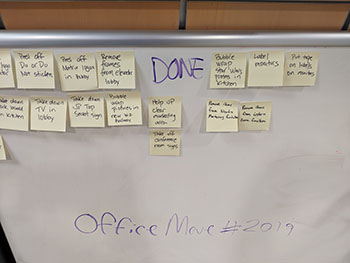
    SCRUM board for Matrix Group MoveMatrix Group is moving! We’ve been in this office for ten years and it’s time. Our needs have changed, and my creative team (yes, even developers are creative types, in my opinion) needs a change of scenery.

    As with all moves, there are about a million tasks that need to be done. So how are we managing all of these tasks, while still doing work for our clients?

    Ten years ago, we set up a SCRUM board for the weekend of the move. This time around, we’re using weekly sprints and a SCRUM board for the entire process. Here’s how we’re managing the work:

    • We have a Move Team that meets twice a week to see how we’re doing against the mammoth task list and timeline that we established a couple of months ago.
    • The timeline, tasks and decisions are stored in a Google doc. The tasks are grouped by week, so in essence, we’re doing one week sprints.
    • Maria is in charge of managing the Google doc, marking things done, adding details, and documenting decisions. I guess you could say she’s the SCRUM Master. Even though she’s remote, she knows everything happening as part of this move.
    • I’m the Project Owner because I’m the one who ultimately decided that we needed to move. And I make the high level decisions about what we’re moving, what the new office will look like, timing and budget.
    • To get the zillion tasks done, we set up a SCRUM Board in our lobby. Starting Monday, the Move Team has been writing down tasks that need to be done and sticking them on a TO DO board.
    • Staff have been grabbing tasks and doing them. Some tasks take 15 minutes, some longer. Once a task is done, the post-it is moved to the DONE board.
    • Move Team members add tasks to the TO DO board as they come up. The list of TO DO items will likely grow as we get closer to the move.

    The SCRUM Board works because:

    • Everyone can help, according to their availability and schedule.
    • We have a visual on the amount of work to be done.
    • The move becomes a shared responsibility, not just a task for the admin team or the Move Team.

    It’s only been a couple of days but already, the results have been amazing.

    During the actual move weekend, we’ll have music and food so that the task of setting up the new office isn’t a drag, but rather a party and a celebration!

  • Amazing Member Journeys Start with Member Interviews

    Amazing Member Journeys Start with Member Interviews

    Working with some new clients, I’ve been hearing this a lot: My website navigation sucks. Members can’t find information. They call us a lot in frustration.

    So how do we solve this problem? It almost always starts with member interviews.

    Why? Because if it’s members who are struggling with some aspect of your digital presence (website, AMS, LMS, community, mobile app, you name it), it’s important to get their perspective on what’s not working, what they expect, and what they need.

    Some clients balk at the idea of interviewing members, worrying that it will take too long, be a bother to their members, cost too much money. Most clients, however, welcome these interviews as a way to get honest feedback about their digital initiatives. Here’s what we’ve learned when it comes to conducting member interviews:

    Recruit a cross-section of members

    One client gave us all new members to interview so the perspectives we got were skewed. Ideally, we want new vs. long tenured members, current vs. former members, young professional vs. mature, new to the profession vs. longtime in the industry, satisfied vs. pissed off, senior vs. entry level.

    Do the interviews in person or over the phone, one on one.

    Having multiple people during the interview changes the dynamic, especially if the client is listening in and the member knows the client is listening.

    Connect members with their feedback

    Allow members to remain anonymous but do ask if it’s okay to connect their name with their feedback so the organization can follow up.

    Keep the interviews short

    It’s important to keep the interviews brief, no more than 20 minutes so that members know you are being respectful of their time.

    Develop questions ahead of time

    and make sure they are designed to give you insight into the members’ pain points. If findability of information is the issue, ask about labeling, ask how they find information, ask if and how they use the search, ask about a recent hunt that didn’t prove fruitful.

    Allow for  free wheeling conversation

    Do allow time for the conversation to stray a bit so that you can get unsolicited feedback about member needs, joys and frustrations. Sometimes you get lucky and you get real gems of insight because you allowed the conversation to wander. A simple, “is there anything else you wish the website did?” or “Is there anything else you wish x organization knew?” can elicit some great insights.

    Thank you goes a long way

    While I don’t think a thank you gift is necessary, a thank you or some type of follow up is a must. Even if it’s just a thank you email and then later on, an update on the project.

    I hope you’ll include member interviews in your next digital project! You’ll be glad you did!