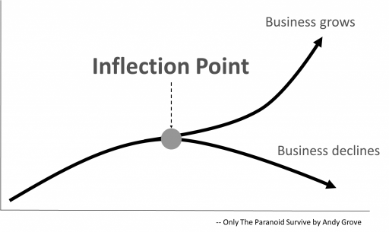
 As I write this, I’m currently watching the live event of Apple’s latest iPhone 8 event. They just announced an update to the Apple TV set top box, with support for 4K, because, according to Tim Cook, “TV is at an “inflection point” with the mainstream adoption of 4K.”
This made me ponder the implication of this term “inflection point”. By definition, in math terms, it’s “a point of a curve at which a change in the direction of curvature occurs.” In Tim Cook’s reference, it’s when a technology reaches a certain critical mass in terms of how many people use it, hence Apple’s new product.
In larger, cultural terms, an inflection point represents a fundamental change in how people live, do business, communicate. On the NY Times website, there is a video of all the things the iPhone “destroyed”, in terms of how it disrupted whole industries, and changed how we interact with each other:
The list of disruptions engendered by the rise of mobile technology is enormous, including the taxi industry, alarm clocks, cameras, etc. Every organization is faced with the potential of disruption, with the inflection point. The key is to anticipate this disruption, and embrace it, to evolve, rather than die. History is littered with industries and companies that could not embrace change and fell by the wayside.
Since I’ve been with Matrix Group (1999), there have been a huge number of inflection points, both culturally and technologically. Every time there is a major fundamental change, we’ve had to adapt our design process, business practices, and offerings to clients. From desktop to mobile, cloud computing, content management systems, these new technologies have all had huge impacts on our business, and how we help our clients.
Some of the new potential inflection points include the internet of things, virtual reality, screen less experiences etc. As a company that designs interactive experiences for our clients, it’s imperative that we stay on top of these changes, embrace these changes, and think about how we can apply these inflection points to help our clients evolve and thrive, and not die.
 Holding a training session can be tough. You have to give your audience all of the information they need in a limited time frame, without overwhelming them or, let’s be honest, putting them to sleep. It can be quite the task and balancing act.