

Matrix Group International

Month: April 2016

  • Make Sure You Have Good Inputs Going Into Your Google Analytics

    Make Sure You Have Good Inputs Going Into Your Google Analytics

    Close up of hands on table, one holding tablet with data visualizations on itI was in a meeting with a client last week and he complained that their Google Analytics (GA) reports just aren’t that useful. I asked why, and he said, “GA tells me the top pages visited on my site and that Google is referring a lot of traffic, and that’s about it.”

    Hmm… I decided to get curious.

    So here’s the deal with GA. If all you do is put the code snippet in your header, you’ll get generic data from GA. But if you give GA better input about where people are coming from and why, you’ll instantly get better GA reports. Here’s how to do that:

    • Never, ever send out a URL without UTM codes.

    UTM stands for Urchin Tracking Module. Urchin is the company that created what is now Google Analytics; Google purchased the company many years ago. A UTM tag is a tracking marker appended to a URL, and is recognized by Google Analytics as a dimension. For example, if you send out a link to a new item on your website in an email newsletter, you could use a UTM code for source = 04-17-2016-newsletter. If anyone clicks on that link, GA will report that traffic as having come from your email newsletter. Voila! All of a sudden, you have better tracking and you know whether or not your email newsletter is generating views on your website. Yes, your blast email provider probably gives you open and click data, but it’s most likely not connected to your overall website analytics reporting. Use this handy URL builder from Google to build data-rich URLs

    • Create redirects for your print URLs.

    So what about your convention brochures? You can’t exactly expect readers to type in a URL that has 100 characters. In this instance, you should create a vanity URL for each print piece (e.g., /2016convention for the brochure and convention 2016 for the postcard) and use your CMS to create a redirect for the actual page, with UTM codes that will attribute traffic to the actual print piece.

    • Use Google Analytics Annotations.

    GA lets you add little notes to your GA reports, attached to specific dates. For example, my marketing team enters annotations every time we send out an email newsletter, post a new event on Facebook, etc. This way, if we see a spike in traffic, we can look to see if that traffic might have been generated by something we did. Of course, we then verify using the Source dimensions in GA.

    • Set up Google Tag Manager.

    Google Tag Manager is an upgrade to Google Analytics and it helps you keeps track of the tags on your website and when they are triggered. For example, Tag Manager will let you track whether and how many people are clicking on the slider in your branding area, the number of downloads of your PDF annual report, etc. The best thing about Tag Manager is that once it’s setup, you don’t need to mess with the CSS on your site again; you then use a Google interface to setup tracking.

    You don’t need to be a developer or a CSS wizard to do the things I mention above. I will be blogging in the future about more advanced things you can do with Google Analytics, enhancements that require some programming. But in in the meantime, if you improve your inputs to Google Analytics, your analytics will be better.

    BTW, Matrix Group has an Analytics practice. If you need some training, help with a specific campaign, or help getting started, give us a call.

  • Does Your Website Need a Redesign or Refresh?

    Does Your Website Need a Redesign or Refresh?

    Woman setting before Mac screens, man reaching in front of her to point at something on screenA couple of weeks ago, I attended a meeting with a client who was interested in redesigning their website. “Why?” I asked. The site looks pretty good, the site is mobile-friendly, and the analytics are pretty good. So what’s driving the desire for a redesign?

    The answer: They wanted to make a few changes to the home page, the content throughout the site, and a bunch of the photos. Even though a redesign would have brought Matrix Group a large project, I recommended a website refresh, not a redesign.

    When should a website be redesigned? It’s always going to to depend on the circumstances, but I recommend a full redesign when:

    • The organization is going through a rebranding because of a name change, shift in focus, drastic changes in programs and services or rethinking of its mission and market position.
    • The organization feels that the website no longer represents the organization.
    • The navigation doesn’t have any bearing on what the organization stands for.
    • The design doesn’t reflect who the organization is today.
    • The organization wants to update a large percentage of the content.

    When should a website refresh be done? Again, it’s going to depend, but I recommend a refresh when:

    • The organization is largely the same: same mission, same values, same general program offerings.
    • The website largely works, but it could use some tweaks to the navigation, the images need updating, and the content needs to be refreshed.
    • There are key pieces of the site that don’t work, but they’re not necessarily related to the overall site. For example, many prospects come to us saying that their site search is broken or they need a new member directory or store.

    Sometimes, a client wants to redesign because they hate their CMS and want to move to something different. With a CMS migration, it makes sense not to just to migrate the exact site. Since we’ll be touching every page, it makes sense to ask if it’s also time to rethink navigation, design, integrations and search.

    Matrix Group recently refreshed portions of our website. The analytics on the home page weren’t where we wanted them to be, so we challenged ourselves to update just the home page. It worked. I was also not happy with our Careers landing page. Since we are always looking for the best people, it made sense to redesign just that landing page. During all this, we didn’t do a redesign. We were largely happy with the overall design, navigation, color palette and tone of the content.

    I happen to think it’s important to tweak and refresh your website regularly, at least annually. In fact, some clients do such a good job of evolving their sites that redesigns may be a thing of the past for them.

    What are YOU doing this year? A redesign or a refresh?

  • Why I Traded in My Black Belt for a White Belt

    Why I Traded in My Black Belt for a White Belt

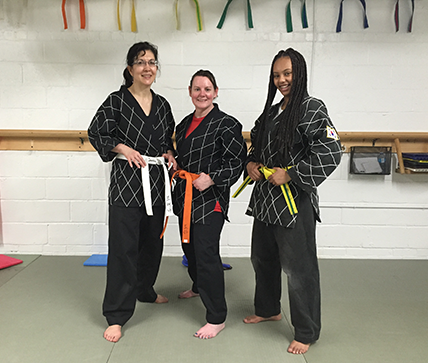
    HapKiDoA couple of weeks ago, I took the plunge and signed up for HapKiDo. HapKiDo is sometimes called the “anti-martial art” because it emphasizes deflection and leverage. HapKiDo techniques use joint locks, strikes and dynamic kicking.

    I’m a black belt in TaeKwonDo. Why embark on another martial art, especially when my TKD journey has just begun and I’m far from expert on the many TKD techniques?  Or, as my husband asks, “Why embark on a whole new journey of pain?”

    The short answer is that I’m curious. The HapKiDo workouts are really intense, the HKD students are really good friends and they have this stance that says “don’t mess with me.” Yeah, I want some of that.

    This isn’t the interesting part of this story.

    What’s more interesting is the story behind my decision to finally sign up. You see, I had been flirting with the idea about six months ago. I took a couple of trial classes, and they were hard, but they were terrific. But I just couldn’t bring myself to sign up. My excuses were myriad and valid to anyone who inquired: “I’m busy enough, the classes are too late, the HKD guys are always injured, yada, yada.”

    But in my quiet moments, when I was honest with myself, those excuses sounded lame. The real reasons were deeper and had more to do with my sense of who I am than with anything else. You see, starting a new martial art means becoming a white belt all over again. It means not knowing anything, making lots of mistakes, looking silly, feeling embarrassed, feeling slow, standing at the end of the line. Was I ready for that? It was going to be uncomfortable and a lot of hard work – who needs that?

    Turns out my martial arts journey parallels my professional journey in many ways. You see, Matrix Group is getting disrupted. A little background: We build fantastic, effective, user-friendly websites, e-commerce sites, customer/member portals, intranets, etc. We’ve been doing this a long time, we’re great at it, you could even say we’re black belts at it, maybe even 2nd- or 3rd-degree black belts. Trouble is, there are about a zillion agencies in the DC area, indeed the country, that look like us. So over the past couple of years, we’ve been undergoing a process of reinvention. Not only have we been asking, “what’s next?” we’ve been working on ways to bake “what’s next?” in to our day-to-day lives. This process has been hard, uncomfortable, even heartbreaking at times. It has meant closing down product lines, saying good-bye to people, and testing out new products and services that will resonate with the company, my staff and our clients.

    In essence, a couple of years ago, we had to become white belts, learn some new skills and get beat up in the process. In the past few years, as we’ve been developing our mobile offerings, we’ve had fits and starts. We’ve changed frameworks, made mistakes, and done things the “wrong” way. But now we’re cruising with mobile. Every website is responsive by default, responsive isn’t taking as much time as it used to and testing is easier. Our mobile app business is booming.

    Being a white belt is hard and frustrating, but it’s also exhilarating. At work and at the dojang (martial arts studio in Korean), I’m learning fast, I’m feeling good, and I’m feeling strong. And it turns out my TKD experience is coming in handy. I have good endurance, I know a lot of the kicks, and I can take a hit. So I’m not exactly  starting from ground zero. And so it goes at work. Our expertise in design, user experience, browsers, database development, and membership databases only benefit us when we build new association membership experiences for a phone. This experience will be a good foundation when we start building virtual reality apps in the next year or so.

    So, what’s my martial arts week like these days? It’s TKD 2-3 times a week (where I’m a black belt and building on what I know) and HKD 2 times a week (where I’m a white belt and everything is new.) It’s a mix that works for me.

    How about you? What will be your white belt experience this year?