Matrix Group International

Month: March 2015

  • Catholic Health Association Centennial Site

    Catholic Health Association Centennial Site

    CHA Centennial SiteRepresenting more than 600 hospitals and 1,400 long-term care and other health facilities in all 50 states, the Catholic Health Association of the United States (CHA) represents the largest group of nonprofit health care providers in the nation.

    This year, the association is celebrating its 100th anniversary. In honor of this milestone, CHA launched a centennial campaign.

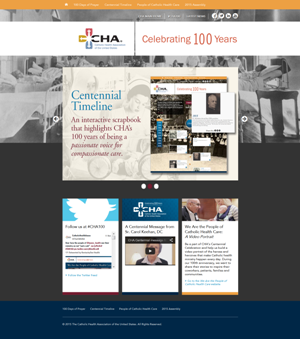
    As part of the campaign, CHA wanted to create a special anniversary microsite that showcases its rich history; highlights individuals of the industry and invites members, partners and other visitors to join the celebration.

    Matrix Group partnered with CHA to create a special microsite. The website features:

    • An interactive timeline: The site’s main showpiece is the timeline, which uses photography from the association’s archive, bringing CHA’s rich history to life.  The timeline dates back to the early 1900s, giving visitors a sense of how the association has evolved over the century. As visitors scroll through the timeline, the background images change to illustrate Catholic health care in each decade.
    • A video portrait series: The videos profile individuals who work in Catholic health care, truly capturing the voice and compassion of the ministry. Members are encouraged to submit video profiles through the website and promote the campaign on social media.
    • 100 days of prayer campaign:  The annual campaign continues through the World Day of the Sick on Feb. 11, 2015. Visitors can submit prayer intentions and sign up to receive weekly prayers. On World Day of the Sick at 1:00 p.m. the participants will participate in one minute of prayer for the sick and those who care for them.

    Visit the CHA Centennial Site now.

  • Why Every Organization Should Care About Search Engine Optimization (SEO)

    Why Every Organization Should Care About Search Engine Optimization (SEO)

    Internet search conceptEvery once in a while, a client or prospect will tell me their organization doesn’t care about search engine optimization (SEO). Why? I get these reasons:
    • The organization targets a very specific, very niche set of audiences.
    • The organization has a defined universe and they are largely known to the association and vice versa.
    • The organization doesn’t have e-commerce on the website so they don’t need to reach out a wide audience to make sales.
    Even if all of this is true, I say that EVERY organization should care about SEO because:
    • A huge number of people use Google (or another search engine of choice) to access a known website. We know this because when Google used to make search terms available, it was shocking to see that so many people type specific URLs into Google. Evidently, there are people who just always start with search without even realizing it.
    • Your target audiences may know your organization very well, but they may not know your URL off the top of their heads. So what they do? They Google for it. Again, looking at search terms tells us a whole lot of traffic comes from Google, from people who know the specific organization they seek.
    • Many, many people rely on Google to search a website because the internal site search sucks. During many user interviews, members tell us they use Google to find what they are looking for on a specific site because the site search wasn’t effective.
    • If your organization is a trade association, you may “know” all of your member companies, but new member company staff may not who are you and what your organization does.
    • No matter how good your marketing and how often you mail or email, the vast majority of your customers do not know everything your organization has to offer. For example, Suzie Smith attends your annual conference ever year but she doesn’t know that you also publish a certain publication on a specific topic, so what does she do? She Googles for it!
    If your website isn’t search-engine friendly because you think SEO doesn’t matter, I hope you’ll think again. Even people who know your organization still rely on Google to find your site and search your site. If Google can’t find your site and can’t index the content properly, you may be losing out on traffic from the very people you think are going directly to your site.
  • Pick Up the Phone! Why Your Marketing Plan Needs a Personal Touch

    Pick Up the Phone! Why Your Marketing Plan Needs a Personal Touch

    Phone in handI am a big fan of phone calls. I spend most of day in meetings and on the phone. Why? Because I can’t land new deals or big deals via email, just doesn’t happen. When we launch websites, I try to call the client contact and the CEO within a few weeks to say thank you. On the weekends, I call my friends, I don’t just post Facebook updates. Recently, I’ve noticed a bias against phone calls. During a roundtable discussion with a group of association executives about meetings and tradeshows, I asked how many make phone calls to past attendees or must-have attendees. Only 1 association had an active phone initiative. Why not make phone calls? I got these reasons: it’s too hard to do, it’s too expensive, it’s too time-consuming.

    I’m grateful to Michael Lanham of Learning Forward for sharing a recent study featured in The NonProfit Times. Here’s an excerpt:

    “During the 2014 International Fundraising Congress (IFC), Geoffrey W. Peters, chairman of CDR Fundraising Group, shared the findings of his organization with a test it undertook. Of 6,225 total donors, 1/3 got no acknowledgement, just ongoing mail; 1/3 got a thank you note; 1/3 got a phone call. Here are the astonishing results from the test:

    • Thank-you calls increase subsequent giving. The subsequent gift rate for donors who received a call was 47 percent higher than those who received no thank-you response and 22 percent higher than those who received a thank-you note.
    • The thank-you call increased the average size of the subsequent gifts. The average gift from donors who called was 8.3 percent higher than those who received no acknowledgment and 3.5 percent higher than those who received the note.
    • The donors who received the phone call generated an additional $8,661 in gross revenue at a 2.4:1 return on investment (ROI).”
    With results like this, isn’t it worth exploring how we can integrate phone calls into our membership recruiting, new member onboarding, fundraising, meeting campaigns, and exhibitor recruiting? Here are some ideas:
    • Make phone calls to new members to say thank you for joining, to explain the membership path, and give them concrete ways to become involved right away.
    • Make phone calls to past attendees of meetings to say thanks for attending in the past and here’s why you should come this year.
    • Make phone calls to people who donate their time and money to your foundation or cause.
    • Make phone calls to random members throughout the year to ask them how your organization can do better.
    When I was a fundraiser many years ago for the San Francisco Education Fund, my boss used to say, “Joanna, people don’t give money to causes. They give money to people.” Most of my trade association and professional society clients tell me that people join and stay because of the people, the networking opportunities, and the access to people in the industry. So I say let’s put the people back in our marketing and make some phone calls!