
Matrix Group International

Month: June 2013

  • No Mobile Strategy? Your Website Could Face a Google Demotion!

    No Mobile Strategy? Your Website Could Face a Google Demotion!

    Image of a downward pointing arrowPsst, want to know a secret? The world isn’t going mobile, it’s already mobile. Check out just a few statistics. In India, mobile traffic has surpassed desktop traffic. Google reports that 25% of paid search clicks are coming from mobile devices. The Pew Research Center reported this month that 34% of Americans aged 18 and older own a tablet computer.

    So it came as no surprise to many of us when Google announced “Changes in rankings of smartphone search results.” In describing the most common configuration mistakes that companies make, Google let the world know that if your website isn’t mobile-friendly, you’ll get a demotion in search rankings. When you consider that mobile searches are an increasing percentage of total Google searches, and Google stays at the top of the search food chain by presenting good results, it makes sense that Google would demote sites that have faulty redirects, show blank mobile pages, aren’t optimized for a mobile device, etc.

    In this article, Google describes the 3 ways to build smartphone-optimized websites: responsive design, serving different CSS based on the use agent (desktop, smartphone, etc.) and separate, mobile sites. It’s important to note that Google’s recommended configuration is responsive design. Why?

    • Using a single URL for all content makes it easy for Google’s search algorithm to assign proper indexing properties for the content
    • No redirects are needed
    • Google crawlers need only visit a website once to index the content

    Here at Matrix Group, nearly all of our designs and redesigns are responsive. We think it just make sense to change the user experience based on the visitor’s device. And because users never have to remember multiple URLs, visits across all types of devices are encouraged. In fact, across the board, we’ve seen mobile traffic to our client sites soar after the sites were redesigned and made responsive.

    So, what’s your mobile strategy in 2013? And what are your plans for making your website responsive?


     

  • UX Magazine

    UX Magazine

    If you’re in the design, front-end development or usability business, you will love this site and magazine!

  • Icon Finder

    Icon Finder

    Love this search engine for icons. They’re cute, inexpensive and super fun!

  • What Does It Mean to Have an Interactive Website?

    What Does It Mean to Have an Interactive Website?

    Man touch virtual screen iconsNot so long ago, clients and prospects would call me and say, “Joanna, I want my website to be more interactive.” They wanted to move beyond a website that just had a lot of text to one where visitors could fill out online forms, make purchases online, register for meetings, etc. Today, I would say that an interactive website is one where:

    Visitors can perform transactions via an online form. It’s 2013, we shouldn’t be asking our customers to download, print, fill out and mail/fax PDF forms.

    Visitors can submit stories, photos, videos, comments, blogs. yada, yada. The most popular websites in the world are ones where users provide all the content. Shouldn’t YOU be harnessing the knowledge and experiences of your members?

    Visitors can interact with the information and services that you offer. Let’s face it, interactive features like calculators, clickable maps and interactive timelines encourage exploration and suck us in because we get to control the experience and we’re rewarded with a little more data as we click, zoom, pan and swipe.

    The content and experience is personalized based on demographics and history. I remember when Amazon first started offering recommendations; it was creepy. Today, I welcome the recommendations because they’re usually spot and they encourage us to explore authors, music and games that we would otherwise never be exposed to.

    There is context-sensitive, user-friendly help. This help could take the form of a live chat feature, pop-up help screens and a helpful glossary.

    Earlier this week, Matrix Group Creative Director Alex Pineda and I did a webinar on the “5 things you can do to make your website more interactive” and we touched on the tips and trends above. After conducting hundreds of user interviews, watching people test websites and hearing what users have to say about their wants and needs, it’s clear that the top websites are personalized and encourage exploration through a rich, immersive experience. Creating this type of experience is quite a challenge but it’s what our visitors want and expect.

  • Accurate Insulin Decisions Website

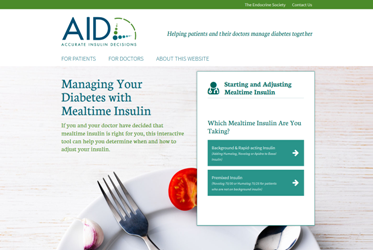
    Accurate Insulin Decisions Website

    Accurate Insulin Decisions, a joint initiative of The Endocrine Society, American Diabetes Association, American Association of Diabetes Educators, American College of Physicians, American Osteopathic Association, American Pharmacists Association and Diabetes Nation, is a program dedicated to helping patients learn to set realistic goals and decide if mealtime insulin can help them achieve those goals, based on their lifestyle and priorities.

    Diabetes affects millions of Americans. According to the Center for Disease Control (CDC), 25.8 million adults and children in the United States have diabetes—that’s 8.3% of the population.

    To better support individuals living with this disease, The Society and its partners needed to create a website to promote their joint initiative. They also wanted to provide doctors and patients with online resources on mealtime insulin.

    Matrix Group designed the website as an easy to use resource for patients and doctors. The new website:

    • Features an interactive tool called “Starting and Adjusting Mealtime Insulin.” 
    • Is built in WordPress, a popular content management system
    • Is designed and built to be mobile-friendly

    Visit the Accurate Insulin Decisions website.