Matrix Group International

Month: January 2013

  • Matrix Group Fundamental #4: Don’t Let Your Boss Make a Mistake

    I’ve blogged in the past about JP’s rules. After hearing a great presentation on company values by Dave Friedman to my CEO peer advisory group (i’m a member of Vistage) I decided to rename them Matrix Group fundamentals. The more I thought about it, the more I realized that JP’s rules are really a code of conduct, a set of rules that evolved over time and that provide guidance on “how to be” at Matrix Group.

    Dave says that while most companies have corporate values, most companies don’t do a good job of providing enough guidance about what those values really mean, how to interpret them and how to live them on a daily basis. So at his company, he started each week with an email to his staff about one of the fundamentals. He talked about what the fundamental meant to him and provided examples of how to live it. He then asked all staff to open each meeting with a quick discussion about the fundamental of the week.

    I’ve been following Dave’s advice for a few weeks now and I’m loving the results. A recent discussion about “It does or it doesn’t but never should” kicked off a lively debate at staff meeting and “Don’t let your client make a mistake” got the project managers talking. Here’s my most recent email about this week’s fundamental: Don’t let your boss make a mistake.

    Week of January 21, 2013
    Fundamental of the Week: Don’t let your boss make a mistake.

    One of the worst and saddest things for me is when I hear: well, I knew it was the wrong way to go, but I didn’t mention anything.” If I ever hear that, I know that the staff member, client or partner has checked out or is not committed to the success of the project. Or perhaps this person doesn’t feel they have the ability or power to say something because the person making the decision or talking at a meeting is a manager, VP, Director, or CEO.

    We are a company of experts. Each of us brings a unique blend of education, experience, background and skills to this company. Most of the time, most of us aren’t afraid to speak our minds; this is why we bring people together in meetings and have inter-disciplinary teams and projects.

    But what do you do when your manager just made the wrong call during a call with a client that *could* have long-lasting and negative consequences for us and the client?

    What do you when JP say something just totally wrong about what Sitefinity or the Google search can do?

    What do you when your manager says “this should take 2 hours” but you think it will be 4 or 6 or 8?

    In all of these cases, I believe that you all have an obligation to do something, say something. You clearly need to do it in a respectful way that doesn’t make your manager look bad or feel stupid, especially in front of a client. Here are some suggestions:

    After the call, ask for a few minutes and say to your manager, “hey, I have concerns about x. I think if we did that, this will happen. But if we do x, the client still gets what they want and the code will be x, y, z.” If you feel very strongly about a technical or artistic decision, you should feel free to bring this to Jason, Eric, Alex or even myself. Nobody will get thrown under the bus.

    If I ever say something totally wrong in a meeting, pull me aside after the meeting and say, “actually JP, Sitefinity does xx.” If it’s during the meeting and it’s important that the client have the info right there, you can always say, “excuse me, JP, but I’m pretty sure that the in a recent version of Sitefinity or CF or Google or whatever, that issue was addressed.” If you do it respectfully, you will actually make Matrix Group look good because a subject matter expert said something, contradicted the CEO and did it in a professional, respectful way. I will thank my lucky stars I brought an expert along!

    If you and your manager have completely different perspectives re: scope, then step back and say, “I think this will take much longer, here’s why. Can we chat for a moment to make sure we’re talking about the same scope of work?” Chances are, there’s been a miscommunication about the scope or the PM needs a little education. Either way, it never, ever hurts to clarify the work and the expectations.

    It turns out to be another time commitment to write what I hope are thoughtful emails on the fundamentals each week. But, as my coach Pete Schwartz always reminds me, one of my main jobs is to coach my staff and provide guidance for how to think and behave so that we are all in alignment and serving our customers well.

    How about you? What are your company’s fundamentals? How are you communicating your fundamentals to staff, especially new staff?
  • Time To Audit Your Privacy Settings – Everywhere

    Time To Audit Your Privacy Settings – Everywhere

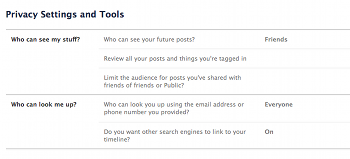
    I got a new iPhone last year and configured it to upload photos to Facebook. Imagine my surprise when photos of me and my kids ended up public on Facebook, even though I have my settings set to all photos as viewable by Friends Only by default. So I dutifully reviewed all of my Facebook privacy settings, updated the viewing options for all of my photo albums and went on my merry way.

    I wouldn’t call myself paranoid about privacy and security on the web, but I do watch what I post online and I take advantage of privacy options, whenever available. Make it your New Year’s resolution in 2013 to audit your privacy settings on all social networks and think about what information you’re putting out on the web, private or not. Here’s my privacy punchlist to help you out:

    Be careful when uploading photos to Facebook via your smartphone. For some reason, Facebook sometimes doesn’t honor my default option to make photos Friends Only and I have to manually change the viewer settings on some photos.

    Beware of what other people can do to your posts and photos. Last month, Mark Zuckberg’s older sister posted a photo on Facebook that friends and friends of friends could see. A friend of a friend saw the photo, assumed it was public and tweeted it. What ensued was a very public conversation between Randi Zuckerberg and the tweeter Callie Schweitzer on Twitter. The media had a field day. Check out this story on Forbes.com. Folks, if you let them, friends and friends of friends can share your posts, share your photos, tag you in photos, yada,  yada.

    Remember that Facebook apps can access your personal information. Everyone seems to love birthdays and birthday greetings on Facebook. Well guess what? Even apps can access your birthday when you give them permission to access your Facebook account. And since knowing your birthday is a key piece in identify fraud, think about not sharing your account, or not putting your exact birthday (does that violate the Facebook terms of service?).

    Know that your company email account is not private.  Your personal gmail account is one thing, but all the courts have upheld the notion that corporations own employee accounts on corporate mail servers, which means they can audit and read your company emails at any time. Most companies even have policies saying they can and will do this when needed.

    But hey, even private email accounts aren’t always private. We might be shocked by the General Petraus affair, but equally of interest is how the FBI found the emails between General Petraus and Paula Broadwell in private gmail accounts. What started out as a cyberstalking investigation ended up bringing down a CIA Director! So assume that all of your emails could be made public and that they will exist on some computer or back-up for the next generation or two.

    Everything we do is  being tracked. When I stop to think about it, I cringe at the data that government and retailers are amassing about me. I use my American Express credit card for nearly all of my purchases, I use my rewards cards at places like Giant, Harris Teeter and Barnes & Noble, my E-Z Pass tracks where I’ve traveled on the toll road, Google tracks all of my searching history, Amazon knows what I like enough to buy, and Facebook knows where I’ve been, who my friends are and what I ate last Sunday. If you want to stop some of this tracking, don’t use a credit card, don’t use rewards cards, use a Do Not Track app on your computer (like Abine), logout of Google before doing searches, and turn off cookies or delete them regularly. For me, these steps aren’t exactly practical, but I offer them as suggestions for those who do want to limit tracking.

    Ultimately, I always try to remember that anything I do online on the web and in email could be made public at any time.

    How about you? How much do you care about privacy and security? Are you doing anything about your privacy settings or changing your behavior?

    Many thanks to my friend Shaun Dakin for his help with his post. Shaun is a huge online privacy expert and advocate. Find him on Twitter @shaundakin and Facebook at Dakin Associates.

  • National Geographic’s Photo of the Day

    National Geographic’s Photo of the Day

    Get a different, gorgeous photo every day, from around the world.

  • Meshu

    Meshu

    Love to travel? Map where you’ve been in the world then wear the drawing as a piece of art!

  • “The Black Church and HIV: A Social Justice Imperative” Video for NAACP

    “The Black Church and HIV: A Social Justice Imperative” Video for NAACP

    Gibraltar Associates, a leading public relations agency, partnered with Matrix Group to create a video for the National Association for the Advancement of Colored People (NAACP) as part of the NAACP’s initiative to combat HIV in the African-American community.

    To kick off their campaign, the NAACP wanted to create a dynamic, powerful video that addresses faith leaders in African communities across the nation. The NAACP is working with the Black Church to encourage faith leaders to rally their parishioners to take a stand against the HIV/AIDS crisis.

    Gibraltar Associates partnered with Matrix Group to create an inspirational video. Here’s what we did:

    • Created a video that addresses this national epidemic, and also evokes a sense of urgency and encourages African Americans nationwide to combat HIV in their communities.
    • Constructed a video that layered the animations, inspirational music and powerful voiceover talent
    • Created and incorporated a series of animated infographics adapted from the still images and statistics provided by Gibraltar Associates.
    • Integrated the online video into the national initiative’s multi-faceted campaign.

    Watch the Video

  • Casualty Actuarial Society Website Redesign

    Casualty Actuarial Society Website Redesign

    Casualty Actuarial Society (CAS) is a national organization that advances the body of knowledge of actuarial science, which analyzes property, casualty and similar risks.  The Society aims to increase awareness of actuarial science, as well as establish and promote high standards of conduct, competence, and qualification for membership.  The Society conducts and funds research in the field and actively provides continuing education for its members.

    CAS wanted to make their website the go-to site for their members and anyone interested in the field.  This required the website to be easy to navigate; make information like educational materials, exam and volunteer registration more accessible; and make the site viewable on mobile devices.

    Here’s what we did:

    • Created a beautiful design that showcases the prominence of the profession and association.
    • Made it easier to find information about events and exams.
    • Upgraded the custom ColdFusion content management system.
    • Upgraded the website’s integration with the CAS’ association management system, netFORUM from Avectra.
    • Created a mobile stylesheet to make it easier for members to access the website from their smartphones.

    Visit the Casualty Actuarial Society Website

  • Precision Machined Products Association Website Redesign

    Precision Machined Products Association Website Redesign

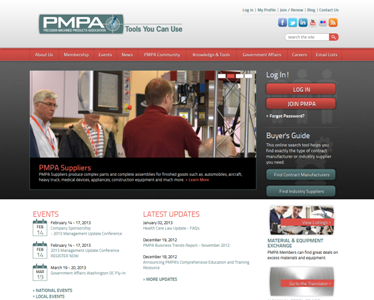
    Precision Machined Products Association (PMPA) is an international trade association representing the interests of the precision machined products industry. Utilizing the latest technology, including CNC turning and milling centers, rotary transfer machines, CNC and automatic screw machines, these companies produce complex parts and complete assemblies for finished goods such as: automobiles, aircraft, heavy truck, medical devices, appliances, construction equipment and much more.

    The PMPA website was last redesigned five years ago. PMPA sought to redesign the site to increase awareness of the organization’s work, increase visits to PMPA’s member directories, and foster more networking and information-sharing between members.

    To help PMPA meet their goals, Matrix Group:

    • Revamped the navigation to make it easier to find PMPA services (e.g., directories, meetings, news).
    • Created a new Knowledge and Tools section that groups PMPA information, services and resources by the topics of greatest importance to PMPA members
    • Created a modern design that represents the PMPA brand
    • Implemented the new PMPA site in the Sitefinity content management system.
    • Increased the integration with the website and MatrixMaxx, Matrix Group’s web-based association management software (AMS).

    Visit the PMPA Website

  • International Facility Management Association Website Redesign

    International Facility Management Association Website Redesign

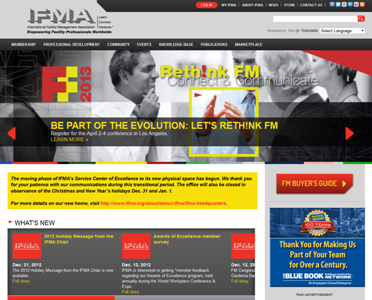
    The International Facility Management Association (IFMA) is the world’s largest international association for facility management professionals, representing more than 20,000 worldwide. IFMA’s mission is to “advance the facility management profession by providing exceptional services, products, resources and opportunities” for its members by conducting research, offering continuing education and certification opportunities and working to advance the facilities management profession.

    IFMA sought to transform their fragmented online presence into a seamless website in order to meet the organization’s strategic goals and provide members a vastly improved user experience.

    To reach their goals, IFMA teamed up with Matrix Group. We:

    • Developed a new taxonomy designed to connect all the audiences with IFMA’s vast collection resources, products and services.
    • Created a navigation strategy focused on simplifying the browsing experience for members and visitors.
    • Designed pages that demonstrate IFMA’s position as the largest association for facility managers worldwide.
    • Unified the login process and single sign-on with iMIS, allowing members accustomed to using several different IFMA-affiliated sites to sign in using a single accounts.
    • Deployed responsive design templates to support a variety of devices in anticipation of members’ use of mobile phones and tablets to access the site.

    Visit the IFMA Website