
1,300 artists and performers take over an 11-story building in Crystal city and turn it into the DC area’s biggest creative event.
Month: May 2012
-
Time to Audit Your Facebook Settings Again
Like many people I know, I view my Facebook personal page (versus the Matrix Group brand page) as the place where I connect with friends, share personal updates, post photos of my family, yada, yada. While Twitter and this blog are part of my public, professional persona, Facebook is more a part of my personal life.
Which is why I review my Faceobok account and privacy settings on a regular basis. If you haven’t done so recently, I suggest you do it now. Facebook settings change all the time and you might be surprised to discover, for example, that a bunch of albums containing your childrens’ photos are now public (which is exactly what happened to me). Here are settings that I recommend you review right now:
How to Check Your Settings
After logging into Facebook, click on the down arrow in the top right corner of the page, next to Home. Most of what you want to do will be under Account Settings and Privacy Settings.
Account Settings >> Security
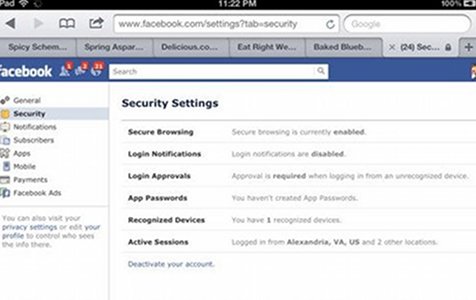
Select Account Settings, then go to Privacy in the left hand navigation. I recommend editing your settings to Enable Secure Browsing when possible. This means that when you go to www.facebook.com, you’ll be redirected to https://www.facebook.com, which means traffic between your computer and the Facebook servers will be encrypted. I think this is sensible and important given how many of us post a lot of personal information to Facebook, including birthdays, names of family members, hometown, etc.
I recommend making Login Approvals Required when logging onto Facebook from an unrecognized device. This means that you’ll have to approve a login from a new and unrecognized device via your phone. Again, I think this is sensible. If someone ever tries to access your Facebook account from a different computer or phone that you don’t recognize, you’ll know that your account may have been compromised and you can act immediately and change your password.
Privacy Settings
If you’re not familiar with this page, I suggest going through all of the options on this page. Here are the settings you should pay most attention to:
Default Privacy Setting. While you can select an audience for posts and photos, some apps don’t let you select. Choosing Public, Friends or Custom will provide a default privacy setting for these types of posts and apps.

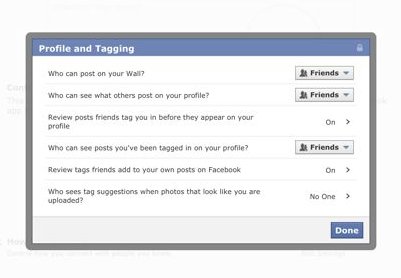
Profile and Tagging. This is a biggie for me. I only let Friends post to my wall and only Friends can see what others post on my wall. I also have the setting turned on that allows me to review tags of me before they get posted.
Ads, Apps and Websites. This is another important one. Facebook says that “people who can see your info can bring it with them when they use apps.” Which is why I limit the information that can be accessed to just my Bio, Website, Links and Education. I don’t provide access to my birthday, hometown, etc.
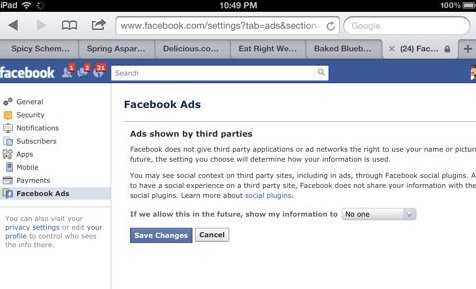
Instant Personalization. If you have this enabled, on Facebok partner websites, you’ll get a personalized experience based on the information in your profile + your friends’ information. I have this turned off.
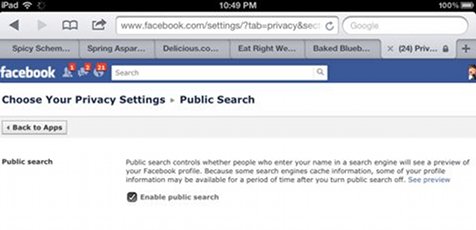
Public Search. Although I’m fairly picky about who I will accept friend requests from, I do enable public search because I do want friends, former classmates and former co-workers from years past to be able to find me. That is, after all, one of the charms of Facebook.
Your Public Actions and Likes
Know those Facebook and Google+ Like buttons that seem to be everywhere? For the most part, only people in your friend network can see your likes when they visit the page or your Facebook profile. But here’s the deal: if you like something on a third party, public site, I don’t believe you can have an expectation of privacy, so I recommend liking and commenting on third party sites with the understanding that all of this information can and will be public.
I hope you’ll take the time to audit your security and privacy settings NOW. The Electronic Frontier Foundation did a timeline of Facebook’s eroding privacy policies over time. While Facebook has recently made changes as a result of government intervention, I still say be careful, audit your settings often, and for god’s sake, don’t post anything you wouldn’t want your mother to read on the web.
-

Bike Score
Bike Score measures whether a location is good for biking on a scale from 0 – 100. Washington DC is #6 on the Most Bikeable Cities list!
-

Does Facebook Have Staying Power?
 Everywhere I turn, I’m hearing about Facebook’s IPO on Friday. The media, economists, pundits and the public are speculating about stock price, total valuation, and on and on. And of course, people are questioning whether or not Facebook will have staying power in the long run.
Mark Evans from Forbes Magazine warns readers to “Stay away from the Facebook IPO” because of social media fatigue, Facebook is no longer hot and sexy, and Facebook has not figured out how to make money from mobile, which represents nearly half of Facebook’s users.
A poll by AP-CNBC this month reports that half of Americans think Facebook’s appeal will fade. But if you look closely at the numbers, nearly 60% of those polled under 35 say Facebook is a good bet. And you know how we talk about the 800 pound gorilla? Facebook now reports that it has 900 million subscribers around the globe! Who can argue with numbers like that?
Me, I’m influenced on this issue by an article written by Michael Mauboussin back in 2005 on ecosystems. Mr. Mauboussin is the Chief Investment Strategist at Legg Mason Capital Management. In the article, Mr. Mauboussin says that “the crucial battle is not between individual firms but between networks of firms.” Ultimately, “keystone companies—businesses at the center of a healthy economic ecosystem—are the most likely to deliver sustainable value creation.” In the article, Mr. Mauboussin was talking about eBay, which has created an entire ecosystem to support its business, including hundreds of thousands of sellers, drop off stores, auction service shops, and payment processors like PayPal.
Is Facebook a keystone company? On the face of it, I think the answer is yes. There are hundreds of thousands of companies that have created business pages to promote their products and services, hundreds of companies have been formed entirely for the purpose of creating social, gaming and business apps for Facebook, Facebook has thousands of advertisers, thousands of companies are now selling their products through a Facebook store, and there have got to be hundreds of thousands of consulting companies helping clients take advantage of Facebook.
Like eBay, I think Facebook will lose a lot of its hip and sexy aura, and Facebook will likely develop plenty of rivals. Will Facebook stick around for decades, even generations? No idea. But if people continue to spend a lot of their social time on Facebook and companies and advertisers continue to advertise and promote on the platform, I don’t see how Facebook can be a bad bet. Does this mean I’m going to buy a bunch of stock on Friday? Nope, I’m going to see where the stock settles and then I’ll give it more thought.
How about you? Do you think Facebook has staying power? Are you going to buy Facebook stock? Do you think Facebook is a keystone company?
P.S. If you want a copy of Mr. Mauboussin’s article, go to the LMCM Vault, then do a search by Author = Mauboussin and date range = 2005. Sorry, I could not figure out how to get a direct link to the PDF. I think the article is absolutely worth reading. I also highly recommend subscribing to Mauboussin on Strategy, a monthly publication. (Nope, I am not affiliated with LMCM, I don’t own their stock, and I’m not related to anyone there.)
-

Smashing Magazine
If you’re a designer, front-end developer or developer, this is a must read. Every day, you’ll get tips, tools and inspiration.
-
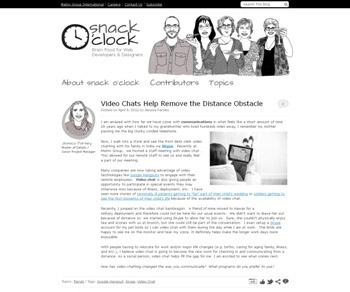
Matrix Group SnackOClock.net Staff Blog
As a result of a town hall meeting in early 2012, Matrix Group decided to launch a new staff blog – SnackOClock.net – featuring brain food for Web developers and designers. We launched the blog to showcase our expertise, highlight cool projects, discuss innovative techniques we’re implementing on client sites, and demonstrate thought leadership among our peers.
Designed and developed by Matrix Group staff, the blog has proven to demonstrate our staff’s outstanding ability in more ways than one.
Matrix Group Services:
- Blog strategy and branding
- Blog site design
- Content plan
-

Gibbs & Cox Website Redesign
Gibbs & Cox is an independent engineering and design firm specializing in naval architecture and marine engineering. The firm also provides project management support and consulting engineering services.
Gibbs & Cox wanted to redesign their website to showcase their proven track record of excellence and reinforce their position as the leading maritime solutions firm in the nation. Gibbs & Cox also wanted the website to attract top talent by promoting their exciting new work, and featuring career opportunites and current employees.
To help Gibbs & Cox reach their goals, Matrix Group:
- Created a design that combines a maritime theme with imagery and elements of naval marine engineering and architecture.
- Used our user focused approach to create a topical navigation. This allows users to navigate the site based on their specific needs.
- Implemented a site-wide content management system. Matrix Group implemented WordPress, a popular system used by many companies today. Today, Gibbs and Cox staff can easily keep all sections of the site up to date.
-

Boston Globe
Great example of a responsive site. Check it out on your computer, iPad and smartphone. Very cool!
-
When The Going Gets Tough, We Set Up a War Room
I have a nice corner office at Matrix Group, but I haven’t seen it in a while. Why? Well, it’s been a busy couple of months at the company and I’m spending most of my days in the War Room.
We don’t really have a War Room like the White House. At Matrix Group, any room where a bunch of staff are working together on a project can be called a war room. Some people call it the Peace Room, while others call it a huddle. Whatever we call it, in the last year, we’ve discovered the joys and benefits of working collaboratively, in the same space. Here’s how it happened.
About a year ago, we had a small team that had six months to get a lot of work done. Their manager asked if he could sequester the team in one of the small conference rooms so they could collaborate, discuss issues immediately, look at each other’s code, and have the front-end developer immediately address prototyping and styling needs. The answer was, of course, yes. The result? The team got the project done and they did a great job. They reported being super-productive because they had easy access to each other, they were largely uninterrupted by the rest of the company, and they had snacks.
Six months ago, another team was crashing on three deadlines. I suggested that they set up their own war room and I was told it was too hard to lug computers and monitors into the small conference room. My response: why don’t we outfit the room with a bunch of monitors and keyboards? Then teams can come in with their laptops or desktops, have benefit of multiple monitors (which is how everyone works around here), and have an immediate war room. So we did and it worked. Staff are loving having the ability to work together collaboratively, as needed.
Even my new biz team requests huddles several times a week. During these huddles, four of us sit in a big room, discuss a topic, get work done, discuss some more and get more work done. We’re not talking the entire time and we’re not really meeting; we’re just working in the same room and occasionally looking up and getting instant access to each other.
I recently did a Matrix Minute YouTube interview with a team that set up a war room for a week to finish up a project.
If you think your team might benefit from a war room, here are my tips for doing it successfully:
- Make sure the right people are in the war room. For example, we find it helpful to always have a front-end developer in the room because they can handle so many tasks and can address the CSS issues that sometimes block developers.
- Establish a deadline and a set of goals so the team has a clear idea of what they need to get done, broken down by day and week.
- Free up people’s schedules so they can spend time in the war room uninterrupted; it’s too distracting if people have to get up and leave all the time to sit in meetings or take calls.
- Keep the team well nourished with snacks. Don’t forget healthy alternatives!
- Make sure the collaborative space is big enough and well-lit so that the team doesn’t feel like they’re in grim, cramped quarters.
- Set up the room with good technology (monitors, good chairs, etc.) so that staff doesn’t feel like they’re giving up the benefits of their own space.
- If you’re the manager, you should probably be in the war room as well. At the very least, spend part of your day in the war room or check in regularly.
How about you? How does your organization handle crazy deadlines? Have you ever set up a war room? With what results?