Matrix Group International

Month: August 2011

  • Can One Little Sticker Change the World?

    Can One Little Sticker Change the World?

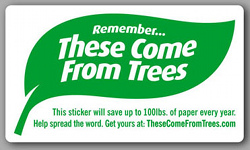
    These Come From Trees StickerEarlier this year, I was in the bathroom at my son’s elementary school when I saw the sticker you see at left on the mirror above the sink. I was intrigued by the promise that one sticker would “save up to 100 lbs. of paper every year.”

    So I visited the website (TheseComeFromTrees.com) and ordered a bunch of stickers for Matrix Group. Jessica, who is on the “green team,” put stickers everywhere we use paper: in the bathrooms, the kitchen, all the printers.

    Curious to see if the little stickers would make a difference, I started paying attention to the amount of paper waste in the women’s bathroom. Here’s what I found: in the women’s bathroom, the trash bin for paper hand towels used to fill up before lunchtime. Today, the bin does not fill up at all during the day. This is consistent every day. The women of Matrix Group are absolutely using fewer hand towels in the bathroom. Could the little sticker really be making a difference?

    We haven’t reduced the number of female staff, so that couldn’t be the cause. And I can’t imagine that we’re using the bathroom any less. So I started talking to my co-workers and they all agreed that because of the sticker, they are using 1 paper hand towel instead of 2. We had effectively halved our paper consumption!

    This got me thinking. How had a little sticker changed behavior?

    I attended a presentation last week by Don Schmincke of the Schmincke Research Alliance. He effectively articulated why management consulting doesn’t work: You can’t change behavior by changing the process. You need to change people’s beliefs in order to change their behavior. People need to believe and understand why doing something is important and necessary.

    So how did the little sticker make me change my beliefs? In this case, I don’t think the sticker changed my beliefs, but it did help me connect the dots between trees and my paper consumption. The little sticker also made it easy for me to do good: just think about where paper towels come from and use fewer!

    This reminds me of signs that remind us that stormwater drains go into a nearby river or bay. Even though I already don’t litter, I’m extra careful when I see that a gutter or drain will dump into a body of water.

    Or how about the gauge in my Honda Hybrid that tells me how many miles per gallon I’m averaging on a tank of gas? There is a number that I shoot for with every tank. When the gauge tells me I’m below that number, I look for ways to change my driving to up that number: I coast more, I don’t speed, I use distance to slow down, I turn off the AC, yada, yada.

    The question is: in our daily lives, what other signs and reminders could help us be more productive, healthier, greener, nicer? What labels and signs have helped you make a difference in your life?

    P.S. I hope you’ll consider ordering stickers for your home and office. Heck, I’m thinking of buying a bunch and plastering them in bathrooms of bars and restaurants all over town! Won’t you join me?

  • AppSumo

    AppSumo

    For tech geeks only, you’ll get daily deals on books, training, development tools, videos and more. The deals are great and the copy is hilarious.

  • Your Organization’s Voice Should Be Different Across Platforms

    If you’ve attended any of my webinars or follow this blog, you know that I advocate strongly against posting the same updates and information across different communications channels. I think it’s a waste when organizations simply post their press release headlines to their Facebook or Twitter pages. But Joanna, you say, “what if I want to educate my members and the public about one, burning issue or I want to promote a new event or publication? What if I WANT to talk about one thing across, print, online and social media for a while?”

    My answer is this: post about that one topic but change the perspective, voice and interactions depending on the platform.

    Say your organization is pushing for a piece of legislation on Capitol Hill. You could issue a policy statement and repeat that statement across all platforms. A more effective strategy would be to:

    • Post the policy statement on the website. This policy statement will likely have a formal tone and reflect the position of the entire organization.
    • Write a press release on the policy statement and send it to your media list. This, too, will have a more formal tone.
    • Post links to the policy statement on Twitter, but with differing headlines, highlighting different aspects of your policy. You could also post third party stories, facts and figures that support your position; in this instance, you would be curating relevant content to bolster your position.
    • Feature interviews with members and customers talking about why they support (or oppose) the proposed legislation on YouTube and your blog. These interviews will feature member perspective in their own voices.
    • Have the CEO write a blog post about why the issue is important to the industry and members. The tone of the blog post should be conversational and personal.

    If you are promoting a new publication or report, you could:

    • Feature the publication in your online store and what’s new section of your website. These descriptions should be compelling but more formal.
    • Post an audio excerpt on your YouTube channel and iTunes. The excerpt could be done by the author.
    • Post key findings and highlights to Twitter. The most effective tweets are thought-provoking and compelling.
    • Feature the publication on Facebook and sponsor a discussion with the author for a 7-day period. A discussion will allow a dialogue about the issue and foster a different kind of member interaction.

    Finally, if you are marketing a convention or event, you could:

    • Mail a 4-color brochure with full meeting information.
    • Mail and e-mail postcards (e-cards) that showcase the different benefits of attending the event. The tone of these pieces should be urgent and compelling.
    • Tweet conference news (number of exhibitors, confirmation of keynote speakers, etc.) and third party news that highlight the importance of the issues to be covered at the event
    • You could test different calls to action in e-mails and posts. Some calls to action could focus on benefits, some could inspire fear, while others could discuss opportunities.
    • Feature YouTube interviews or presentation highlights from the featured speakers.
    • Offer a hosted discussion with the speakers for a 7-day period on Facebook.

    Our jobs as marketers are so much harder because we are marketing to multiple generations, there is no one platform that allows us to reach all audiences, and people are motivated by different things. Having a layered messaging strategy that utilizes the capabilities of each platform and features different perspectives and voices will help you reach and connect with your audiences better.

    How about you? How are you marketing your products and services? And how does your message or approach change with each platform? What’s working?